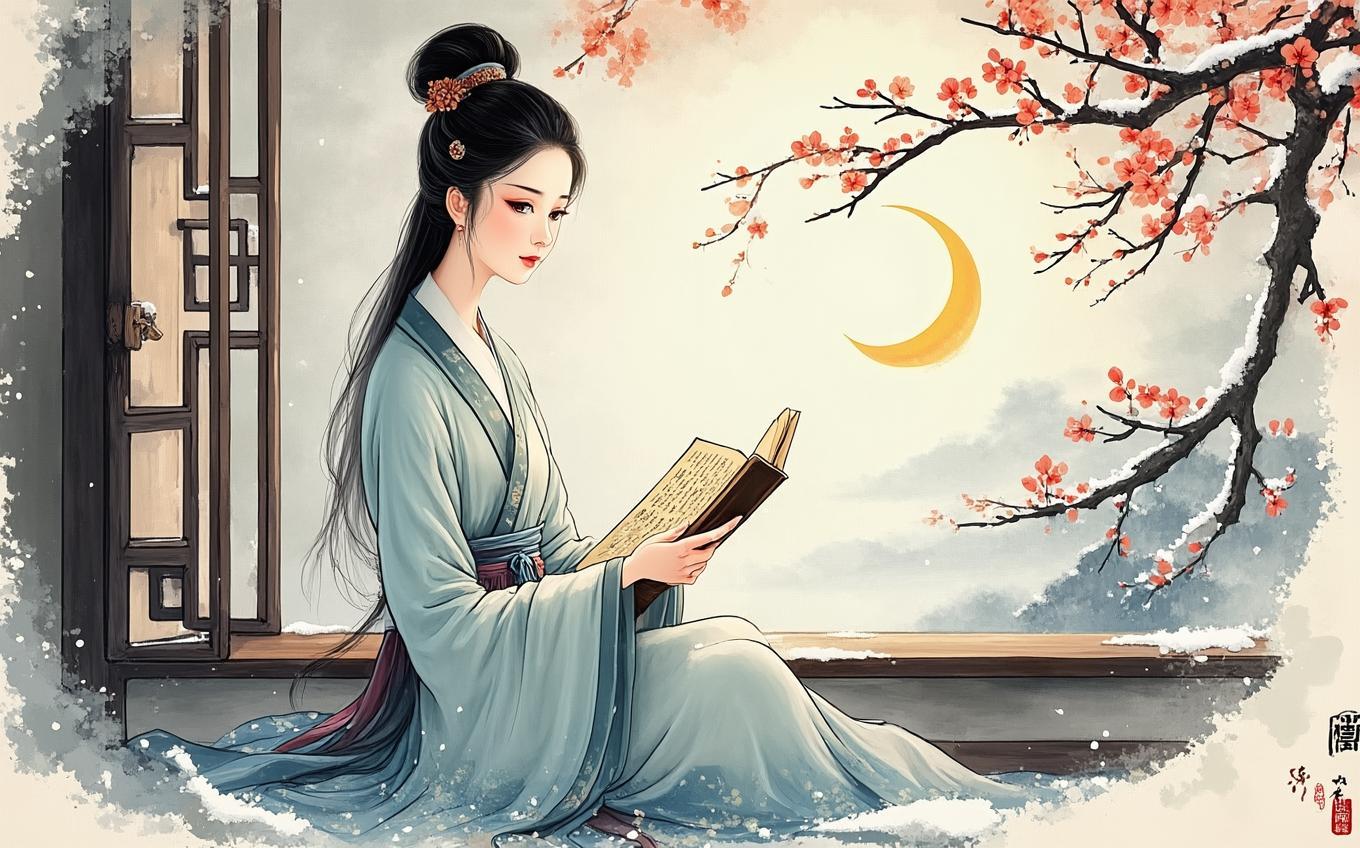
Analysis of "闺怨" - Classical Chinese Poetry
Introduction
"闺怨" (guī yuàn), or "boudoir plaint," is a classic theme in Chinese poetry that expresses the sorrow and longing of women, often left alone while their husbands or lovers are away at war, on official duties, or seeking fortune. One of the most famous examples is 《闺怨》 (Guī Yuàn) by Wang Changling (王昌龄, 698–756), a renowned Tang Dynasty poet known for his emotionally charged and concise verses.
This poem captures the quiet despair of a young married woman who realizes too late that her longing for status and wealth has cost her happiness. It reflects the societal constraints on women in imperial China while showcasing Wang’s mastery of subtle emotion and vivid imagery.
The Poem: Full Text and Translation
闺中少妇不知愁
Guī zhōng shàofù bù zhī chóu
The young wife in her boudoir does not know sorrow,春日凝妆上翠楼
Chūn rì níng zhuāng shàng cuì lóu
On a spring day, she adorns herself and ascends the emerald tower.忽见陌头杨柳色
Hū jiàn mò tóu yáng liǔ sè
Suddenly, she sees the willows by the roadside,悔教夫婿觅封侯
Huǐ jiāo fūxù mì fēnghóu
And regrets urging her husband to seek a noble title.
Line-by-Line Analysis
-
"The young wife in her boudoir does not know sorrow"
- The poem opens with irony. The woman is initially carefree, unaware of the loneliness that will soon overwhelm her. The "boudoir" symbolizes both privilege and confinement—a space of comfort but also isolation. -
"On a spring day, she adorns herself and ascends the emerald tower"
- Spring is a time of renewal, but here it contrasts with her emotional emptiness. "Adorning herself" suggests she still performs the rituals of beauty, yet there is no one to appreciate them. The "emerald tower" represents her elevated but lonely position. -
"Suddenly, she sees the willows by the roadside"
- The willow (杨柳, yáng liǔ) is a powerful symbol in Chinese poetry, representing parting and longing (its name sounds like "to stay" 留 liú). The sight jolts her into awareness—nature’s beauty reminds her of what she has lost. -
"And regrets urging her husband to seek a noble title"
- The climax reveals her regret. She once encouraged her husband to pursue glory (觅封侯), a common ambition in feudal China. Now, she realizes that love and companionship matter more than social status.
Themes and Symbolism
- Loneliness and Regret: The poem’s core theme is the pain of separation and the futility of worldly ambitions when love is absent.
- Nature as a Mirror: The willow tree reflects her inner turmoil—its lush greenness contrasts with her emotional barrenness.
- Gender and Society: The poem critiques societal pressures that prioritize male achievement over marital happiness, leaving women to bear the emotional cost.
Cultural Context
During the Tang Dynasty (618–907), Confucian values emphasized duty and social mobility, often requiring men to travel for civil service exams or military service. Women, confined to domestic roles, were left to wait indefinitely. Wang Changling, though a male poet, demonstrates remarkable empathy for women’s plight, a recurring theme in Tang poetry.
The poem also reflects Daoist ideals—happiness is found in simplicity and presence, not in chasing external validation.
Conclusion
Wang Changling’s Guī Yuàn is a masterpiece of economy and depth, capturing a universal human experience—realizing too late what truly matters. Its blend of personal emotion and social critique makes it timeless.
For modern readers, the poem resonates as a reminder of the costs of ambition and the enduring need for connection. In just four lines, Wang Changling transforms a quiet moment into a profound meditation on love, loss, and the choices that define us.
Would you trade love for glory? The young wife’s regret lingers in the air, as fresh today as it was over a thousand years ago.




Comments (0)
No comments yet. Be the first to comment!