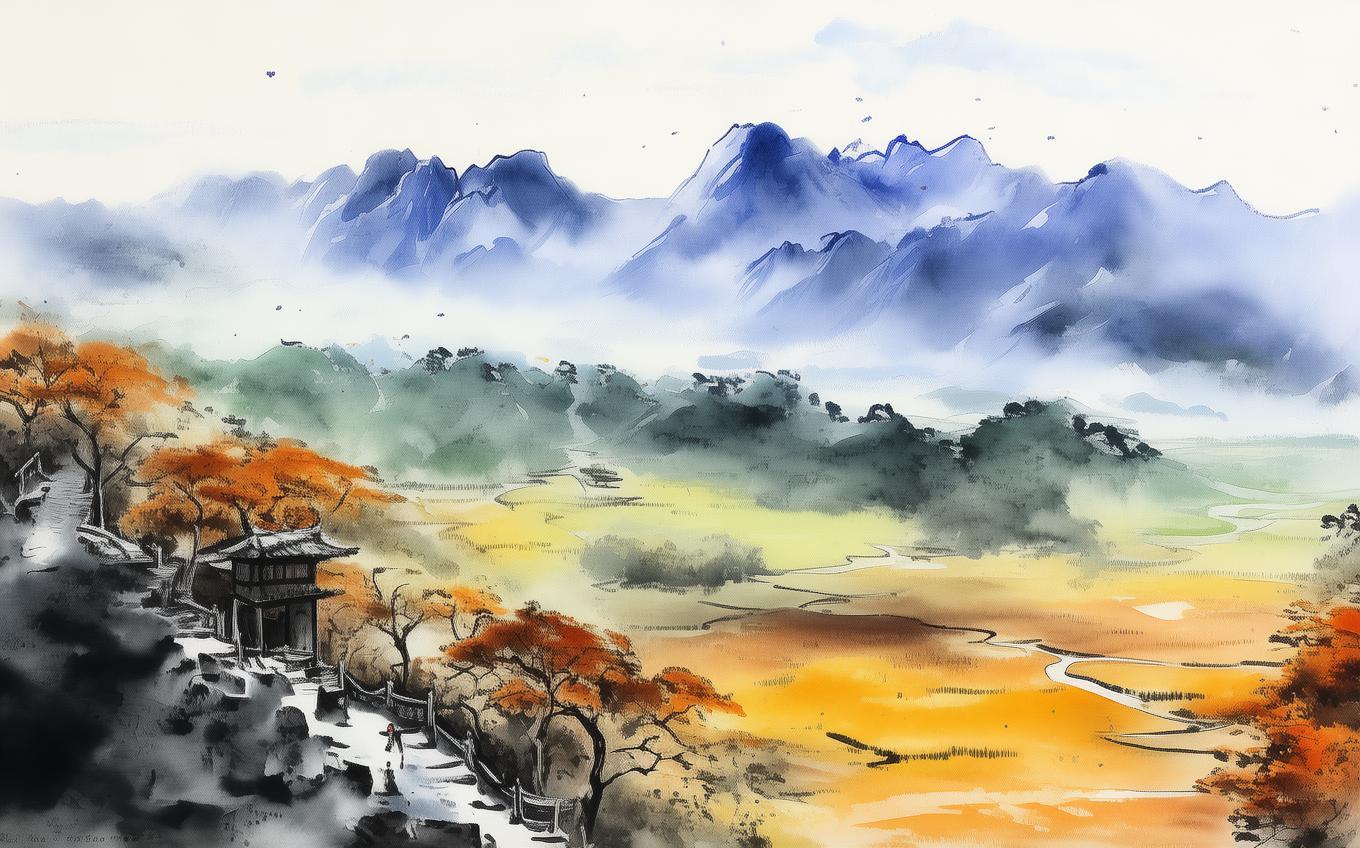
Analysis of "秋日登吴公台上寺远眺" - Classical Chinese Poetry
Introduction
The poem "秋日登吴公台上寺远眺" ("Autumn Day: Climbing the Temple on Wu Gong Terrace and Gazing Afar") was written by Liu Changqing (刘长卿, 709–785), a prominent poet of the Tang Dynasty. Known for his melancholic and reflective style, Liu often depicted themes of solitude, nature, and the passage of time. This poem, composed during his travels, captures the serene yet somber beauty of autumn while reflecting on history and human transience. It is celebrated for its vivid imagery and philosophical depth, embodying the classical Chinese poetic tradition of blending natural scenery with emotional resonance.
The Poem: Full Text and Translation
古台摇落后
Gǔ tái yáo luò hòu
The ancient terrace, now in decay,秋入望乡心
Qiū rù wàng xiāng xīn
Autumn stirs my longing for home.野寺来人少
Yě sì lái rén shǎo
Few visitors come to this wild temple,云峰隔水深
Yún fēng gé shuǐ shēn
Cloud-wrapped peaks stand beyond deep waters.夕阳依旧垒
Xī yáng yī jiù lěi
The setting sun lingers on old battlements,寒磬满空林
Hán qìng mǎn kōng lín
A cold temple bell echoes through empty woods.惆怅南朝事
Chóu chàng nán cháo shì
Sorrowful thoughts of the Southern Dynasties,长江独至今
Cháng jiāng dú zhì jīn
Only the Yangtze flows on to this day.
Line-by-Line Analysis
-
"The ancient terrace, now in decay" – The poem opens with an image of desolation, emphasizing the passage of time and the impermanence of human achievements.
-
"Autumn stirs my longing for home" – Autumn, a season often associated with melancholy in Chinese poetry, deepens the poet’s sense of nostalgia and solitude.
-
"Few visitors come to this wild temple" – The temple’s isolation mirrors the poet’s own loneliness, reinforcing a theme of abandonment.
-
"Cloud-wrapped peaks stand beyond deep waters" – The misty mountains and deep waters create a sense of distance and mystery, symbolizing life’s uncertainties.
-
"The setting sun lingers on old battlements" – The sunset on ancient ruins evokes historical reflection, suggesting the decline of past glories.
-
"A cold temple bell echoes through empty woods" – The sound of the bell amplifies the desolate atmosphere, emphasizing emptiness and transience.
-
"Sorrowful thoughts of the Southern Dynasties" – The poet reflects on the fallen Southern Dynasties (420–589), a period of political fragmentation, drawing a parallel to human impermanence.
-
"Only the Yangtze flows on to this day" – The eternal Yangtze River contrasts with the fleeting nature of human history, underscoring nature’s enduring presence.
Themes and Symbolism
- Transience vs. Eternity: The poem contrasts decaying human structures (the terrace, temple) with nature’s permanence (the Yangtze River).
- Solitude and Nostalgia: Autumn and the deserted temple evoke a deep sense of isolation and longing.
- Historical Reflection: References to the Southern Dynasties highlight the cyclical rise and fall of civilizations.
Key symbols include:
- Autumn – Represents decline and introspection.
- The Yangtze River – Symbolizes continuity amidst change.
- The Temple Bell – A reminder of spiritual and temporal emptiness.
Cultural Context
Liu Changqing wrote during the Tang Dynasty (618–907), a golden age of Chinese poetry. This period valued the interplay between nature and emotion ("shanshui" 山水 poetry). The poem reflects Daoist and Buddhist influences, particularly the idea of impermanence ("wúcháng" 无常). The Southern Dynasties reference also alludes to China’s history of division, resonating with Tang readers who prized unity.
Conclusion
"Autumn Day: Climbing the Temple on Wu Gong Terrace and Gazing Afar" is a masterpiece of Tang poetry, blending serene natural imagery with profound existential reflection. Its themes of solitude, history, and nature’s timelessness remain universally resonant. For modern readers, the poem offers a meditative pause—an invitation to contemplate life’s fleeting beauty against the backdrop of eternity. Like the Yangtze, great poetry flows endlessly, connecting past and present.

Comments (0)
No comments yet. Be the first to comment!