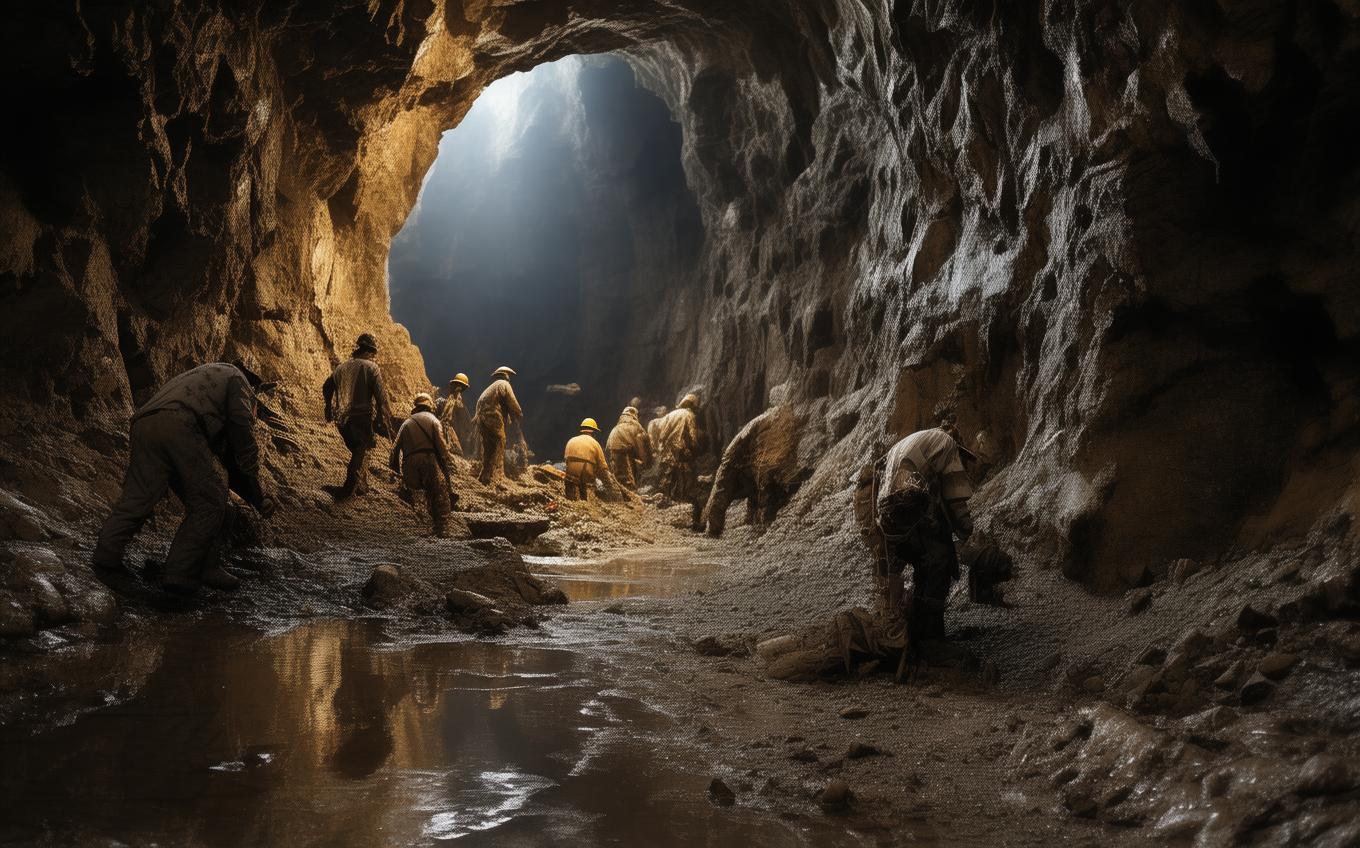
1. Basic Information
- Word: 采矿
- Pinyin: cǎi kuàng
- Literal Meaning: "extract mine" or "pick minerals" (采 = to pick, gather, extract; 矿 = mine, mineral deposits)
- Primary Meaning: mining (the process or industry of extracting ores, coal, or other valuable minerals from the earth)
2. In-depth Explanation
Context and Usage
The word “采矿” is the standard Chinese term for “mining” in both everyday and technical contexts. It refers to all kinds of mining activities, from underground coal extraction to open-pit metal-ore mining, and even includes quarrying. You will encounter it frequently in the news, in industrial reports, and in environmental discussions.
In a sentence, “采矿” can function like a verb phrase (to mine / to do mining) or as a noun (the mining industry or a mining task). Because it is built as a verb-object structure (采 + 矿), it often behaves like a separable phrase in certain grammatical patterns—for example, you might say “采了十年的矿” (mined for ten years), inserting a duration between the two characters. However, in modern usage, it is very commonly treated as a fixed compound word equivalent to “mining.”
Important nuance: While English uses “mining” both as a gerund and as a noun, Chinese uses “采矿” primarily for the activity or the process. If you want to say “a mine” (the place itself), you would usually say “矿山” (kuàng shān) or “矿井” (kuàng jǐng). “采矿” focuses on the act of extraction.
Character Breakdown
-
采 (cǎi): This character originally depicted a hand plucking something from a plant. Its core meanings are “to pick,” “to gather,” “to collect,” or “to extract.” Think of picking tea leaves (采茶, cǎi chá), collecting herbs (采药, cǎi yào), or adopting a method (采纳, cǎi nà). In “采矿,” it contributes the idea of extracting or taking out something naturally embedded.
-
矿 (kuàng): This character has the “stone” radical (石, shí) on the left, hinting at its mineral connection, and a phonetic component on the right. It means “ore,” “mineral,” “mine” (as in a deposit), or “mining.” You’ll find it in words like “煤矿” (méi kuàng, coal mine), “铁矿” (tiě kuàng, iron ore/iron mine), and “矿物” (kuàng wù, mineral).
Together, 采矿 literally paints the picture of “extracting mineral deposits.” The logic is straightforward: you go into the earth’s crust where minerals lie (矿) and you take them out (采).
3. Example Sentences
-
Chinese: 这个地区以采矿著称,特别是铜矿和金矿。
Pinyin: Zhè ge dì qū yǐ cǎi kuàng zhù chēng, tè bié shì tóng kuàng hé jīn kuàng.
English: This region is famous for mining, especially copper and gold. -
Chinese: 为了保护环境,政府加强了对采矿活动的管理。
Pinyin: Wèi le bǎo hù huán jìng, zhèng fǔ jiā qiáng le duì cǎi kuàng huó dòng de guǎn lǐ.
English: To protect the environment, the government has tightened regulations on mining activities. -
Chinese: 他大学学的是采矿工程,毕业后一直在山西的煤矿工作。
Pinyin: Tā dà xué xué de shì cǎi kuàng gōng chéng, bì yè hòu yī zhí zài Shān xī de méi kuàng gōng zuò.
English: He studied mining engineering at university and has been working in a coal mine in Shanxi ever since he graduated.
Cultural Notes
China has a long and historically significant relationship with mining. Ancient Chinese civilizations mastered bronze-making and iron-smelting, relying on systematic mining of copper and iron ores. In modern times, the Chinese word “采矿” often brings to mind images of the massive coal industry in provinces like Shanxi, Shaanxi, and Inner Mongolia. Coal mining is so central to China’s energy landscape that many people immediately associate “采矿” with coal unless the context specifies otherwise.
An interesting cultural note: the character “矿” is sometimes used colloquially as an insult meaning “stupid” or “slow” (as in 二矿, though this is very informal and regional), but this has nothing to do with the word “采矿” itself. When learners encounter “矿” in the context of mining, it is neutral and technical. Another cultural tidbit is the concept of “采矿权” (cǎi kuàng quán, mining rights), a legal and economic term heavily discussed in business circles. China’s swift industrialization has made mining a frequent topic in documentaries and news, often featuring the word “采矿” alongside debates about sustainability and worker safety.
Conclusion
To remember “采矿” (cǎi kuàng), picture someone picking (采) valuable minerals (矿) out of the ground. It is a clear, practical word for the act, industry, or process of mining. Use it whenever you need to talk about extracting natural resources from the earth, and keep its separable verb-object nature in mind for more advanced grammar. With its straightforward character logic and wide application, “采矿” is a word you will find both useful and easy to retain.
Sources and Further Reading
Dictionary links are provided for independent reference. Example sentences and learning notes on this page are educational explanations rather than dictionary quotations.



Comments (0)
No comments yet. Be the first to comment!