Introduction
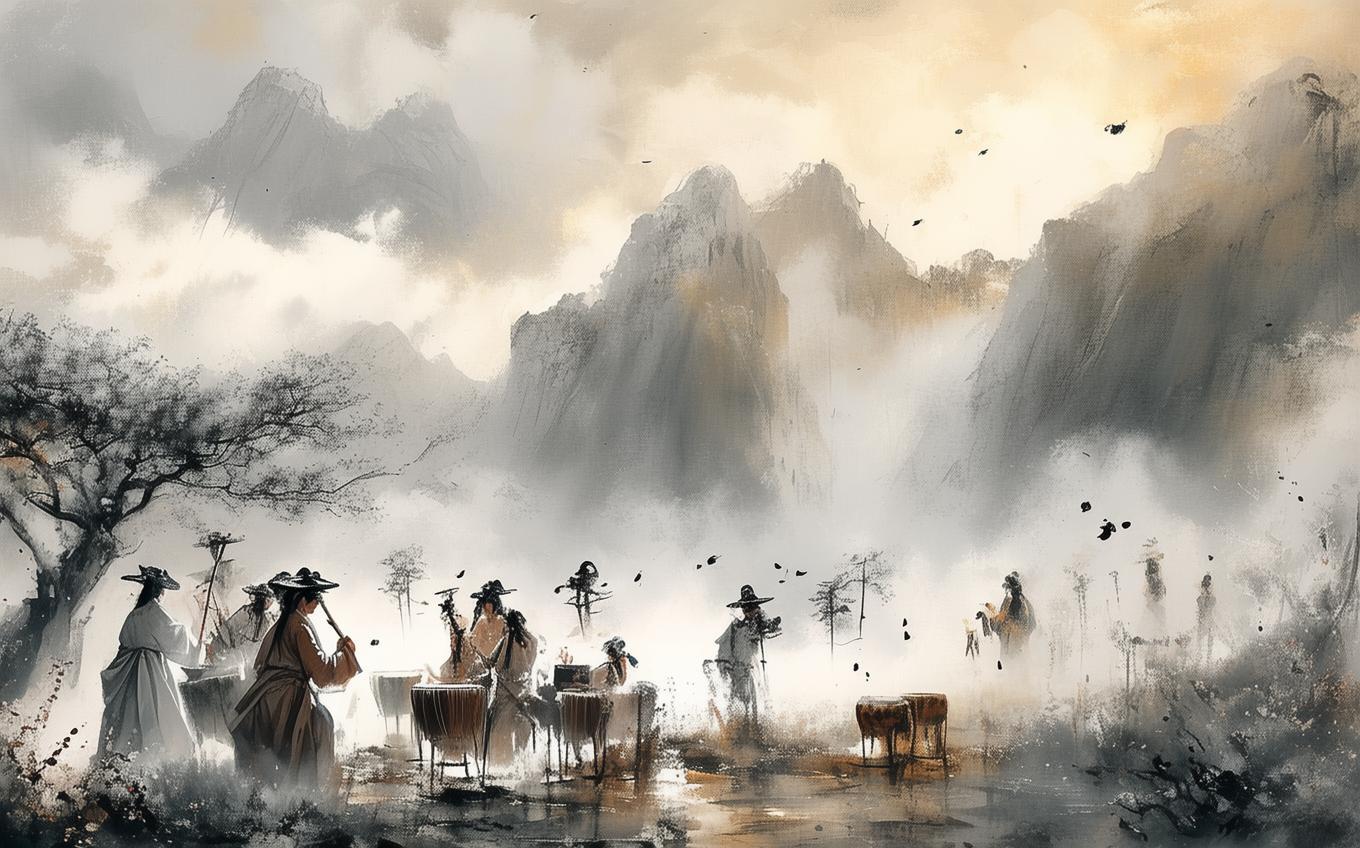
"鼓吹曲辞鼓吹铙歌靖本邦" is not a lyric by a single famous poet in the way many Tang poems are; rather, it belongs to the tradition of Yuèfǔ poetry, songs associated with court music and ceremonial performance. The title can be understood roughly as a “drum-and-wind song text” from the nǎogē tradition, with 靖本邦 meaning “pacifying the root of the state” or “bringing the homeland to order.” These works were closely tied to dynastic ritual, political legitimacy, and public celebration of military achievement.
In Chinese literary history, such poems are significant because they show a side of classical poetry very different from private lyricism. Instead of focusing on personal longing or landscape, they present the voice of the state: praise of order, conquest, governance, and the restoration of peace. For English-speaking readers, this poem offers a valuable window into how early and medieval Chinese courts used poetry not only as art, but also as political ceremony.
The Poem: Full Text and Translation
云门骇听,雷鼓鸣空。
Yúnmén hài tīng, léi gǔ míng kōng.
At the Cloud Gate, listeners are startled; thunderous drums resound through the sky.
神武佐命,天锡无穷。
Shénwǔ zuǒ mìng, tiān cì wú qióng.
Divine martial power assists the mandate; Heaven bestows blessings without end.
烈烈桓桓,暨诛不恭。
Lièliè huánhuán, jì zhū bù gōng.
Fierce and majestic in power, they move to punish the disloyal and irreverent.
蜂虿祸乱,逆节同凶。
Fēngchài huòluàn, nì jié tóng xiōng.
Like wasps and scorpions bringing chaos, the rebels in their treachery share one doom.
天子仗钺,靖本邦。
Tiānzǐ zhàng yuè, jìng běn bāng.
The Son of Heaven takes up the battle-axe and brings the realm at its root to peace.
命将授旗,四海为封。
Mìng jiàng shòu qí, sìhǎi wéi fēng.
He appoints commanders and bestows banners; all within the four seas becomes his domain.
金石既振,戎车既攻。
Jīnshí jì zhèn, róng chē jì gōng.
Bronze bells and stone chimes are sounded; war chariots press forward in assault.
威加草木,化洽昆虫。
Wēi jiā cǎomù, huà qià kūnchóng.
Majesty extends even to grass and trees; civilizing influence reaches even the smallest creatures.
Line-by-Line Analysis
The opening line, “云门骇听,雷鼓鸣空”, creates an overwhelming ceremonial soundscape. “Cloud Gate” suggests a lofty ritual or sacred space, while “thunder drums” evoke not only military force but cosmic resonance. The effect is immediate: this is not a quiet poem of reflection, but a public performance meant to awe its listeners. Sound itself becomes a symbol of power.
The second line, “神武佐命,天锡无穷”, moves from sound to legitimacy. In traditional Chinese political thought, successful rule depends on the Mandate of Heaven. The phrase 神武 (“divine martiality”) suggests that military victory is not merely human strength; it is aligned with heavenly will. To an early Chinese audience, this claim would be deeply political: force is justified because it restores cosmic and moral order.
In “烈烈桓桓,暨诛不恭”, the language turns sharply punitive. The paired adjectives 烈烈 and 桓桓 intensify the grandeur and severity of the ruling power. The target is 不恭, those who are disrespectful, disloyal, or rebellious. In the poem’s worldview, rebellion is not simply political disagreement; it is a moral offense against the proper hierarchy of the realm.
The next line, “蜂虿祸乱,逆节同凶”, uses vivid animal imagery. 蜂虿—wasps and scorpions—represent danger, venom, and social disorder. Such imagery dehumanizes rebels and frames them as toxic threats to the body politic. This metaphor is common in courtly and dynastic literature: enemies of order are portrayed as poisonous creatures whose destruction is both necessary and righteous.
The central line, “天子仗钺,靖本邦”, contains the poem’s core political image. The Son of Heaven personally wielding the battle-axe is not just a military picture; it is a ritual one. The axe symbolizes sovereign authority to punish and to correct disorder. 靖本邦 suggests restoring peace at the foundation of the state—not merely suppressing surface rebellion, but securing the realm at its roots.
In “命将授旗,四海为封”, the emperor delegates power. The act of giving banners to generals is a formal sign of military command. The phrase 四海 (“the four seas”) is a classical way of referring to the whole world as imagined within the Chinese imperial order. Thus the line suggests both practical command and universal kingship: authority radiates outward from the throne to all under Heaven.
The seventh line, “金石既振,戎车既攻”, returns to music and motion. 金石 refers to ritual instruments such as bells and stone chimes, linking warfare with ceremony. This combination is important: the campaign is represented not as chaos, but as disciplined, morally sanctioned action. The war chariots advance in a rhythm already announced by music. Violence is aestheticized and ritualized.
Finally, “威加草木,化洽昆虫” broadens the scope dramatically. The ruler’s 威 (majesty, power) and 化 (transformative civil influence) extend beyond humans to nature itself. Grass, trees, and even insects are touched by order. This is not literal description but political cosmology: perfect rule harmonizes the entire universe. The ideal sovereign does not only defeat enemies; he transforms the world.
Themes and Symbolism
One major theme of the poem is the union of military force and moral order. In many modern contexts, power and virtue are treated as opposites, but in this poem they are inseparable. The ruler wages war in order to restore peace, and martial action becomes an instrument of ethical and cosmic balance.
A second theme is political legitimacy. The repeated suggestions of Heaven’s support, ritual sound, formal command, and universal rule all reinforce the idea that rightful authority is not accidental. It is sanctioned by history, morality, and the cosmos. The poem seeks to persuade its audience that the ruler’s campaign is just.
The poem also relies on several important symbols. Thunder drums symbolize overwhelming authority and public proclamation. The battle-axe symbolizes sovereign right to punish rebellion. Wasps and scorpions symbolize treacherous disorder. Grass, trees, and insects symbolize the natural world brought into harmony by good governance. Together, these images build a vision of rulership that is at once terrifying, righteous, and civilizing.
Cultural Context
This poem reflects the political culture of imperial China, where poetry could serve ritual and governmental purposes. Gǔchuī and nǎogē pieces were associated with processions, military display, and dynastic celebration. They were meant to be heard as much as read, and their strong rhythms and elevated diction suited public ceremony.
The poem also reflects a central Chinese political concept: that a ruler’s responsibility is to create order under Heaven. In Confucian thought, good government begins with moral legitimacy; in practice, however, dynasties also had to suppress rebellion and defend their rule. This poem merges those ideas. Punishment of rebels is presented not as cruelty, but as a necessary step toward peace.
For modern readers, the poem reveals how deeply intertwined art, ritual, and politics were in classical China. It also shows that Chinese poetry was never limited to personal feeling or natural beauty. Some of it functioned as state language—formal, grand, and ideologically charged—while still using the compressed imagery and resonance we associate with great poetry.
Conclusion
"鼓吹曲辞鼓吹铙歌靖本邦" is powerful not because it is intimate, but because it is monumental. Its drums, banners, weapons, and cosmic imagery create a world in which political order is sacred and the ruler’s victory restores harmony to the realm.
Its enduring appeal lies in this fusion of poetry and power. Even today, the poem helps readers understand a major strand of Chinese literary tradition: verse not only as personal expression, but as a medium for imagining the state, Heaven, and the moral structure of the world. For English-speaking audiences, it is a striking reminder that classical Chinese poetry contains not just quiet moonlit reflections, but also the grand voice of empire.
Comments (0)
No comments yet. Be the first to comment!