Introduction
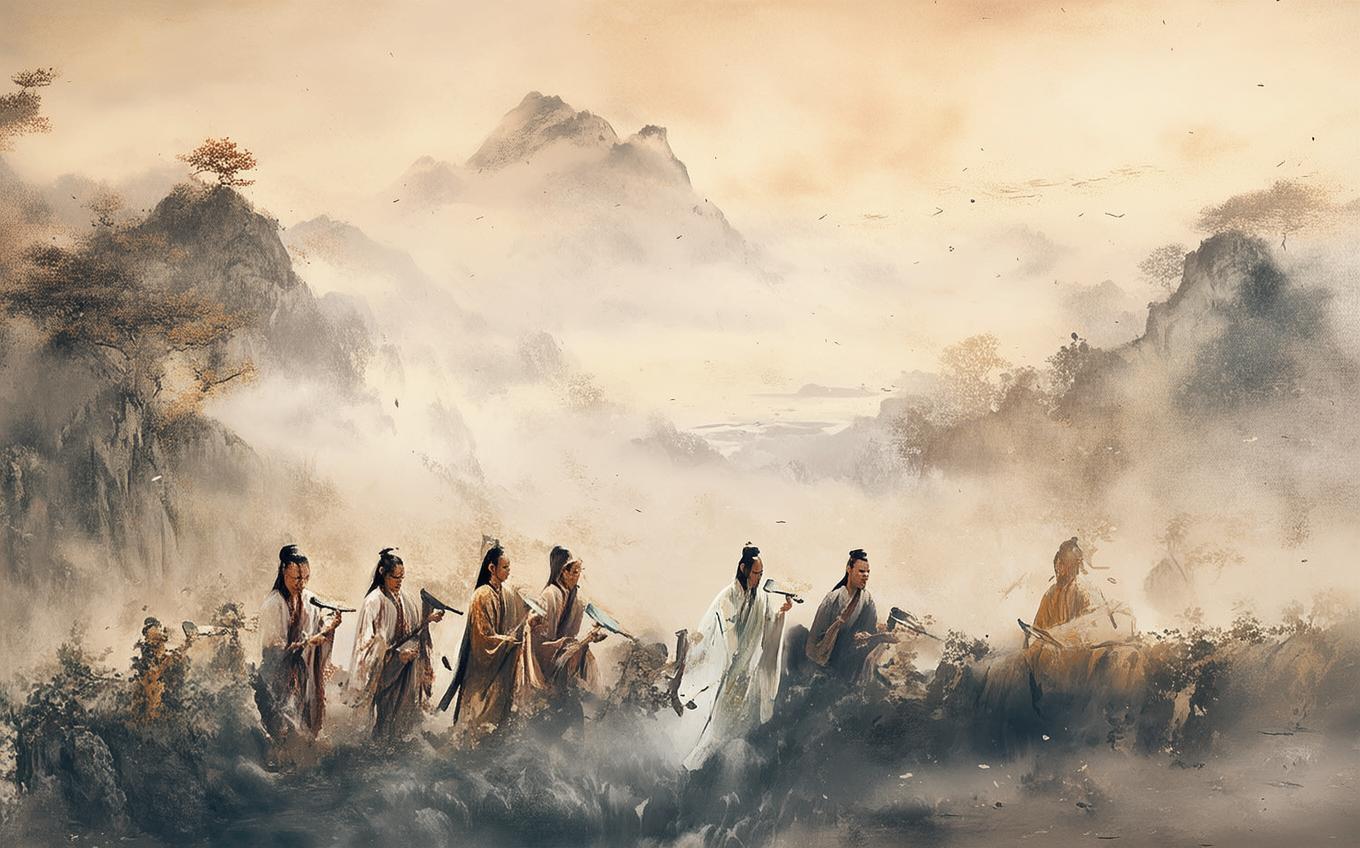
"鼓吹曲辞鼓吹铙歌吐谷浑" is not the title of a lyric poem by a single well-known poet in the way many readers might expect. Instead, it belongs to the Yuefu tradition, a body of songs and ballads connected to court music, military performance, and ceremonial singing in early and medieval China. The phrase can be understood as part of the classification used in literary anthologies: 鼓吹曲辞 refers to drum-and-wind musical pieces, 鼓吹铙歌 to martial or triumphal songs, and 吐谷浑 to the Tuyuhun, a powerful polity on China’s northwestern frontier.
Because works in this category are often preserved through anthology titles rather than modern classroom fame, they offer a valuable window into how poetry functioned beyond private emotion: as music, propaganda, ritual, and historical memory. In Chinese literary history, such pieces are significant because they show the close relationship between verse and state power. They also reveal how the Chinese court imagined border peoples, warfare, and imperial order.
The Poem: Full Text and Translation
The title "吐谷浑" in the 鼓吹铙歌 tradition is best understood as a frontier and martial song associated with the courtly performance culture of conquest and political display. Since anthology traditions sometimes preserve variant texts, and because these older musical pieces are transmitted unevenly, readers should understand the poem as part of a larger performative tradition rather than as a purely private literary composition.
Below is the commonly cited text associated with this title:
吐谷浑
Tǔ yù hún
Tuyuhun
马如龙
Mǎ rú lóng
The horses move like dragons.
人如虎
Rén rú hǔ
The men are like tigers.
长剑倚天外
Cháng jiàn yǐ tiān wài
Long swords seem to lean beyond the sky.
白日照旌鼓
Bái rì zhào jīng gǔ
The bright sun shines on banners and war drums.
一战静尘沙
Yī zhàn jìng chén shā
In a single battle, dust and sand are stilled.
威名动寰宇
Wēi míng dòng huán yǔ
Their mighty name shakes the world.
Line-by-Line Analysis
The opening line, “吐谷浑”, serves as both title and subject. It immediately places the audience on the frontier. For medieval Chinese listeners, Tuyuhun was not an abstract word but the name of a real political and military power in the northwest, connected with steppe culture, cavalry, and border conflict. The title alone evokes distance, danger, and the imperial gaze toward lands beyond the central plains.
“马如龙” — “The horses move like dragons.”
This line creates grandeur through comparison. In Chinese culture, the dragon is not a monster but a symbol of power, vitality, cosmic force, and majestic movement. To compare warhorses to dragons elevates cavalry into something almost supernatural. The line captures speed and momentum, but also prestige. Horses were essential to frontier warfare, and strong cavalry often symbolized military supremacy.
“人如虎” — “The men are like tigers.”
The comparison shifts from animals of myth to animals of raw force. The tiger in Chinese symbolism represents courage, ferocity, and martial strength. If the horses suggest magnificent motion, the men suggest deadly resolve. Together, dragon and tiger form a powerful pairing: one celestial, one terrestrial; one fluid, one violent. The line reduces soldiers to an archetype of bravery, emphasizing collective military power rather than individual personality.
“长剑倚天外” — “Long swords seem to lean beyond the sky.”
This is a highly exaggerated image, but exaggeration is exactly the point in martial song. The swords are imagined as so tall and imposing that they reach toward heaven itself. Chinese poetry often uses hyperbole to expand the scale of battle into the cosmic realm. The line does not aim at realistic description. Instead, it dramatizes military presence as something that almost breaks the boundary between earth and sky.
“白日照旌鼓” — “The bright sun shines on banners and war drums.”
The imagery becomes more ceremonial here. 旌 (battle banners) and 鼓 (drums) are not merely equipment; they are symbols of command, order, and state authority. The sunlight makes the battlefield visible and public. Nothing is hidden. The army stands under heaven, illuminated, legitimized, and made spectacular. This is one reason such poems were suitable for court performance: they transform war into pageantry.
“一战静尘沙” — “In a single battle, dust and sand are stilled.”
This line is striking because it moves from motion to stillness. Frontier warfare often conjures images of galloping horses and swirling dust. Here, after battle, the dust settles. On one level, this suggests swift victory. On another, it implies the restoration of order from chaos. In classical Chinese political thought, the ideal ruler pacifies disorder. So the stilling of dust and sand is not only military success; it is a moral and political image of pacification.
“威名动寰宇” — “Their mighty name shakes the world.”
The ending broadens the scene from battlefield to universe. 寰宇 means the world, the realm under heaven. The reputation born from military action travels farther than the soldiers themselves. This final note is characteristic of triumphal verse: deeds become fame, and fame becomes political meaning. The poem closes not on suffering or loss, but on renown.
Themes and Symbolism
One of the poem’s main themes is martial glory. Unlike later lyric poetry that dwells on solitude, longing, or personal sorrow, this piece celebrates strength, movement, conquest, and public reputation. It belongs to a tradition in which poetry amplifies the authority of the state and the prestige of military achievement.
Another major theme is order imposed on the frontier. The poem presents warfare not as chaos for its own sake but as a force that brings stillness to “dust and sand.” This reflects a long-standing Chinese political ideal: that legitimate power should pacify turbulence and bring harmony under heaven.
The poem also relies on strong symbolic imagery:
- Dragon (龙 / lóng): majesty, cosmic force, extraordinary vitality
- Tiger (虎 / hǔ): courage, ferocity, martial prowess
- Sword (剑 / jiàn): heroic action, military authority, elite warrior culture
- Banners and drums (旌鼓 / jīng gǔ): command, ceremony, collective power
- Dust and sand (尘沙 / chén shā): the frontier, battle turbulence, instability
These symbols are concise and archetypal. They make the poem feel less like an individual confession and more like a performance designed to inspire awe.
Cultural Context
To understand this poem, it helps to know something about Yuefu and the frontier tradition in Chinese literature. Yuefu originally referred to the Music Bureau, a Han dynasty institution that collected and performed songs. Over time, “Yuefu” also came to describe a literary style modeled on such songs. Some Yuefu pieces preserve folk voices, while others became polished literary compositions by later writers. The category 鼓吹铙歌 is especially associated with military and ceremonial music.
The reference to 吐谷浑 (Tuyuhun) points to the northwestern frontier world, where Chinese dynasties interacted with non-Han polities through war, alliance, marriage, and trade. This frontier zone was culturally complex. It was not simply “China versus outsiders,” but a region of fluid identities and power struggles. Court poetry, however, often simplifies this complexity into images of victory and command.
The poem reflects several classical Chinese values:
- Collective honor over individual emotion
- Political legitimacy expressed through military success
- Admiration for disciplined force and visible order
- A worldview in which state power operates under heaven’s gaze
For modern readers, this is important. Not all Chinese poetry is quiet landscape meditation or intimate reflection. Some of it is public, official, and performative. This poem reminds us that the Chinese poetic tradition includes ceremony and empire as well as moonlight and homesickness.
Conclusion
"鼓吹曲辞鼓吹铙歌吐谷浑" is powerful not because it offers delicate introspection, but because it condenses the spectacle of frontier warfare into a series of bold, memorable images. Dragons, tigers, swords, banners, sunlight, and settling dust combine to create a vision of military force raised to mythic scale.
Its enduring appeal lies in this fusion of poetry, music, and political imagination. For today’s readers, the poem offers more than a glimpse of battle: it reveals how classical Chinese literature could transform historical conflict into symbolic language. Even across centuries, it shows the capacity of poetry to shape memory, project authority, and give human struggle a larger, almost cosmic form.
Comments (0)
No comments yet. Be the first to comment!