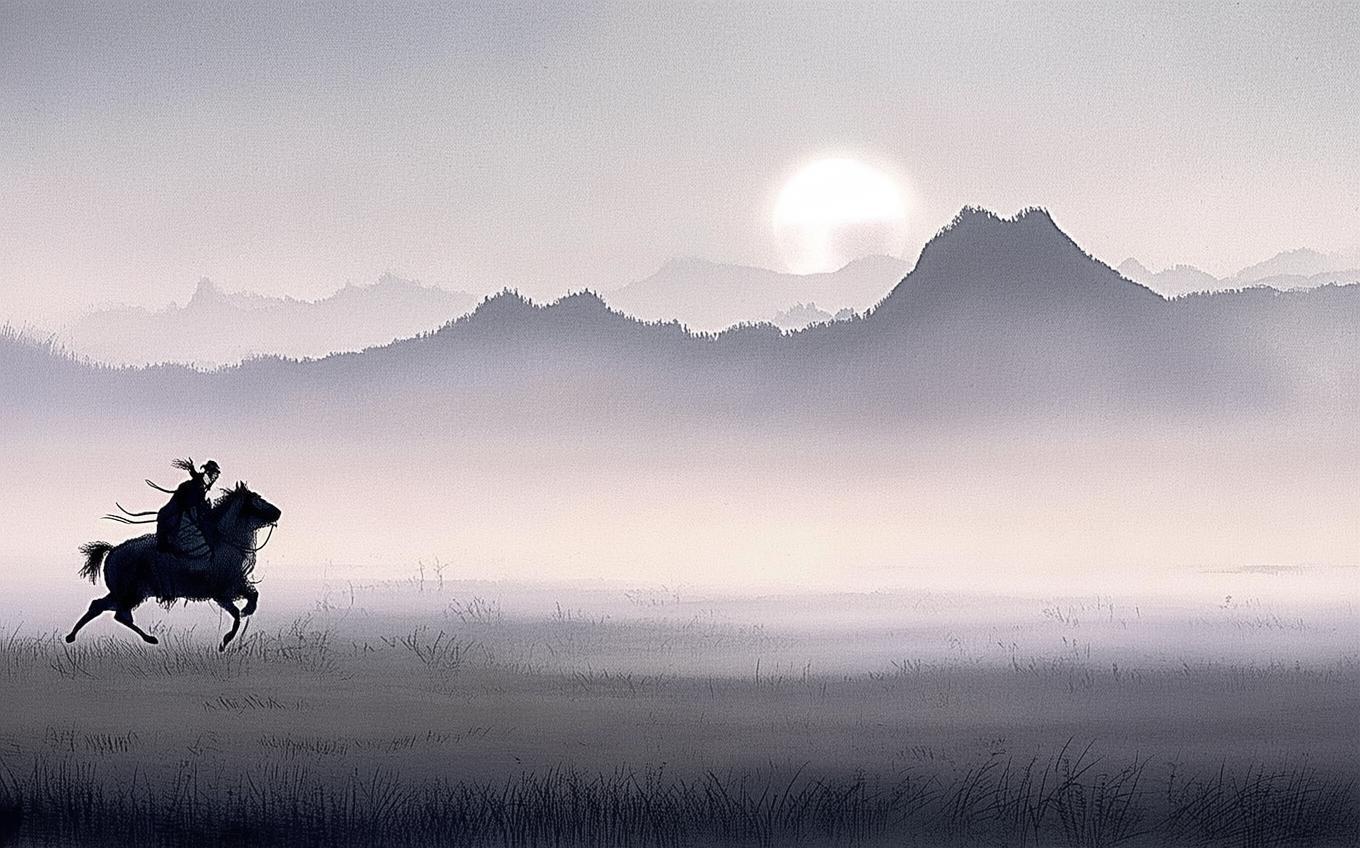
Introduction
Wang Changling (王昌龄, Wáng Chānglíng, ca. 698-756) was one of the great poets of the Tang dynasty, especially famous for his frontier poems. The Tang empire was powerful, cosmopolitan, and often engaged in military campaigns along its northern and western borders. Poems about soldiers, distant passes, moonlit deserts, and homesickness became an important genre known as “frontier fortress poetry” (biānsài shī, 边塞诗).
The poem commonly known as “出塞” (Chū Sài, “Crossing the Frontier”) belongs to the broader musical and literary tradition associated with 横吹曲辞 (Héngchuī qǔcí), “lyrics for horizontal flute songs.” These were originally connected with military music, often evoking the sound of flutes, horses, marches, and borderlands.
This poem is one of the most famous short poems in Chinese literature. In only four lines, it compresses centuries of history, the sorrow of war, and a longing for heroic protection.
The Poem: Full Text and Translation
秦时明月汉时关
Qín shí míng yuè Hàn shí guān
The bright moon of Qin times, the frontier passes of Han times,
万里长征人未还
Wàn lǐ cháng zhēng rén wèi huán
On the long campaign of ten thousand miles, the soldiers have not returned.
但使龙城飞将在
Dàn shǐ Lóngchéng Fēi Jiàng zài
If only the Flying General of Dragon City were still here,
不教胡马度阴山
Bù jiào Hú mǎ dù Yīnshān
He would not allow the northern cavalry to cross the Yin Mountains.
Line-by-Line Analysis
The first line, “秦时明月汉时关”, is one of the most memorable openings in Tang poetry. Wang Changling places two great ancient dynasties side by side: Qin (秦) and Han (汉). The Qin dynasty unified China in 221 BCE, while the Han dynasty expanded imperial power and fought many wars against northern nomadic peoples.
The phrase is beautifully compressed. The moon belongs to Qin times, and the frontier passes belong to Han times, yet both still seem present in the Tang poet’s world. This gives the poem a vast historical depth. The moon has watched over generations of soldiers; the passes have stood through centuries of conflict. The line suggests that border war is not a new tragedy but an old, recurring pattern.
The second line, “万里长征人未还”, brings the historical vision down to human suffering. “Ten thousand miles” does not need to be read literally; in Chinese poetry, 万里 (wàn lǐ) often means an immense distance. The soldiers are far from home, swallowed by the frontier. The phrase 人未还 means “the people have not returned,” and its plainness is powerful. Behind the grand language of empire are ordinary men who may never see their families again.
The third line, “但使龙城飞将在”, introduces a heroic wish. 飞将 (Fēi Jiàng, “Flying General”) refers to the Han dynasty general Li Guang (李广, Lǐ Guǎng), famous for his bravery and skill in fighting the Xiongnu. He became a legendary figure in Chinese memory: swift, fearless, and deeply respected.
The phrase 但使 means “if only” or “provided that.” The poem shifts from lament to longing. The speaker imagines that if a great defender like Li Guang were still alive, the suffering of the border might be prevented. This is not merely nostalgia for a hero; it is also a quiet criticism of the present. The Tang dynasty has military power, but perhaps it lacks the moral and strategic greatness associated with legendary commanders.
The final line, “不教胡马度阴山”, completes the heroic image. 胡马 (Hú mǎ) refers to the horses of northern peoples, often used in classical Chinese texts to represent nomadic cavalry. 阴山 (Yīnshān) is a mountain range in northern China and Inner Mongolia, long associated with the frontier between Chinese agricultural states and steppe powers.
The line imagines a secure border: enemy cavalry would not be allowed to cross the mountains. The word 不教 means “would not let” or “would not permit,” giving the line a firm, almost commanding tone. Yet because the hero is only imagined, the confidence is bittersweet. The poem ends with strength, but that strength belongs to a wished-for past.
Themes and Symbolism
One major theme is the continuity of war across history. By invoking Qin and Han, Wang Changling suggests that the frontier conflict of his own age is part of a much older cycle. Dynasties rise and fall, but the moon, the passes, and the soldiers’ suffering remain.
Another important theme is homesickness and human cost. The poem never directly describes a soldier’s wife, parents, or village, but the line 人未还 carries all of that emotional weight. The absence of return is enough to imply grief.
The poem also explores heroic memory. Li Guang, the “Flying General,” symbolizes courage, protection, and competent leadership. His presence in the poem is less a historical detail than a moral ideal. The poet asks: what kind of leader can truly protect the people?
The moon is a key symbol in Chinese poetry. It often represents distance, longing, and shared emotion. A person far away sees the same moon as those at home. Here, however, the moon is also historical. It shines across centuries, making human conflict feel both intimate and immense.
The frontier pass, or 关 (guān), symbolizes boundary and danger. It is a physical military site, but also a threshold between civilization and uncertainty, home and exile, life and death.
Cultural Context
Frontier poetry flourished during the Tang dynasty, when China had extensive contact and conflict with Central Asia, Tibet, Turkic peoples, and other powers along its borders. These poems often combine patriotic feeling with sorrow. They may praise courage, but they also reveal the loneliness and brutality of military life.
The title 出塞 means “going out beyond the frontier pass.” In Chinese cultural imagination, leaving the pass often meant entering a harsh and uncertain world. The soldier who “goes out” may gain honor, but he may also vanish into history.
The reference to Li Guang reflects the Chinese tradition of using historical figures as moral examples. Classical Chinese poetry often assumes that the reader knows earlier history. By mentioning the “Flying General,” Wang Changling does not need to explain the whole story. A single name evokes loyalty, bravery, military skill, and tragic grandeur.
The poem also reflects a Confucian concern with good leadership. War is not presented as glorious for its own sake. The poem’s deepest wish is not conquest, but protection: that the border be defended so that soldiers need not die endlessly far from home.
Conclusion
“横吹曲辞出塞曲,” represented here by Wang Changling’s famous “出塞,” is powerful because of its extreme compression. In four short lines, it moves from ancient dynasties to present grief, from moonlight to military history, from soldiers who never return to a legendary general who might have saved them.
Its beauty lies in the tension between grandeur and sorrow. The poem sounds patriotic, but it is not simple propaganda. It honors defense and heroism while quietly mourning the endless human cost of war.
For modern readers, the poem remains moving because it asks a timeless question: how many generations must look at the same moon over the same battlefields before people find a better way to protect both their homes and their humanity?
Comments (0)
No comments yet. Be the first to comment!