Introduction
"夜度娘" (Yè dù niáng) is a short ancient Chinese poem traditionally associated with the Southern Dynasties period, roughly the 5th to 6th centuries CE. It belongs to the world of Yuefu poetry, a form of song-poetry originally connected with music, folk performance, and the collection of popular songs.
The title can be understood as "The Woman Who Crosses at Night" or "Night-Crossing Girl." The word "度" here means "to cross" or "to pass over," and "娘" refers to a young woman. Some versions also write the title as "夜渡娘," using "渡," a character more directly associated with crossing water.
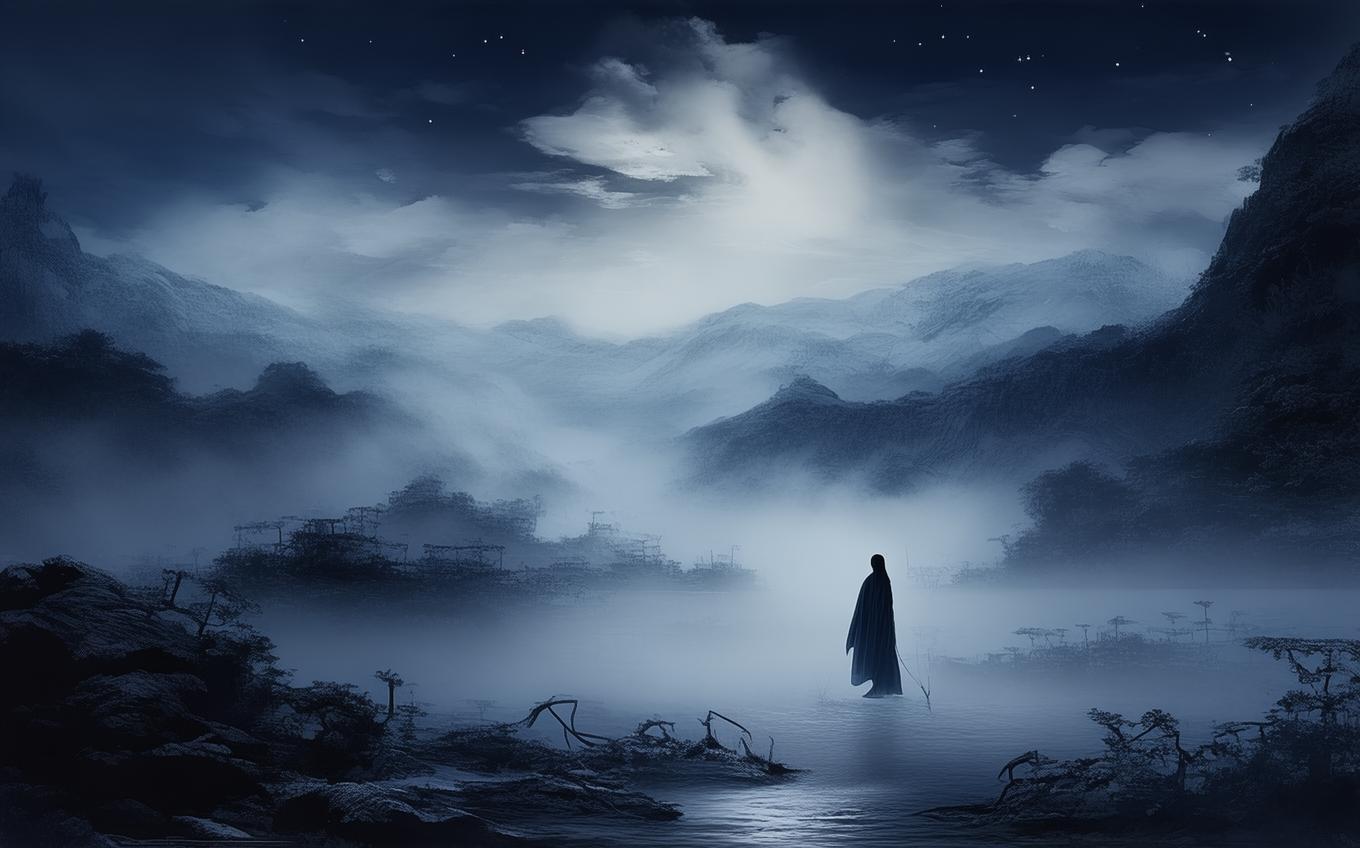
Although the poem is extremely brief, it is emotionally powerful. In only four lines, it presents a woman who travels through harsh night weather and dangerous waters, perhaps to meet her lover. The poem captures a central quality of classical Chinese lyric poetry: deep feeling expressed through simple, concrete images.
The Poem: Full Text and Translation
夜来冒霜雪
Yè lái mào shuāng xuě
At night she comes, braving frost and snow.
晨去履风波
Chén qù lǚ fēng bō
At dawn she leaves, treading through wind and waves.
虽得叙微情
Suī dé xù wēi qíng
Though she is able to speak a little of her tender feelings,
奈侬身苦何
Nài nóng shēn kǔ hé
What can be done about the suffering of my body and life?
Line-by-Line Analysis
夜来冒霜雪
Yè lái mào shuāng xuě
"At night she comes, braving frost and snow."
The opening line immediately places us in a harsh environment. The woman travels at night, when the world is dark, cold, and dangerous. "霜雪" means "frost and snow," suggesting not only physical cold but also emotional hardship.
The verb "冒" means "to brave," "to risk," or "to go in spite of danger." This is important: the woman is not simply walking through bad weather. She is actively enduring it. Her movement suggests urgency and determination.
In classical Chinese poetry, cold weather often symbolizes loneliness, separation, or emotional difficulty. Here, frost and snow become the outward form of the woman’s inner suffering. Love requires endurance.
晨去履风波
Chén qù lǚ fēng bō
"At dawn she leaves, treading through wind and waves."
The second line mirrors the first. She comes at night and leaves at dawn. This pattern suggests a secret meeting, possibly between lovers who cannot openly be together.
The phrase "风波" literally means "wind and waves." It may describe an actual river crossing, but it also carries symbolic meaning. In Chinese literature, wind and waves often represent danger, instability, and the difficulties of life.
The verb "履" means "to tread" or "to step upon." The image of a woman stepping through wind and waves is vivid and dramatic. She is vulnerable, yet courageous. The poem does not describe her appearance or personality directly; instead, it reveals her character through action.
Together, the first two lines create a powerful contrast:
- Night and dawn
- Coming and going
- Frost and snow
- Wind and waves
Her entire journey is framed by hardship. The meeting itself is hidden between the lines, almost absent. What the poem emphasizes is not the joy of love, but the cost of reaching it.
虽得叙微情
Suī dé xù wēi qíng
"Though she is able to speak a little of her tender feelings,"
The third line turns inward. After the physical journey, we hear the emotional reason behind it: she wants to express her feelings.
"叙" means "to tell," "to relate," or "to speak out." "微情" means "slight feelings" or "subtle emotions." The word "微" does not mean the feelings are unimportant. Instead, it suggests delicacy, intimacy, and restraint.
In classical Chinese love poetry, emotions are often expressed indirectly. Rather than saying "I love you" in a modern direct way, the poem uses modest language: "to speak a little of tender feeling." This restraint makes the emotion feel even more intense.
The line also implies that the meeting is brief. After enduring frost, snow, wind, and waves, she can only share "a little" of what she feels. The emotional reward is small compared with the physical suffering.
奈侬身苦何
Nài nóng shēn kǔ hé
"What can be done about the suffering of my body and life?"
The final line is a cry of pain. "奈……何" is a classical expression meaning "what can be done about..." or "how can one deal with..." It conveys helplessness.
The word "侬" is especially important. It is a first-person pronoun used in some southern Chinese dialects, often meaning "I" or "me." Its presence gives the poem a folk-song quality. This is not the elevated voice of a court official or philosopher; it sounds like the direct voice of an ordinary woman.
"身苦" means bodily suffering, but it can also suggest the hardship of one’s whole condition in life. The speaker is not merely tired from travel. She feels trapped in a painful situation.
The poem ends without resolution. We do not learn whether the lovers will meet again, whether their relationship is forbidden, or whether the woman’s suffering will end. This open ending is part of the poem’s power. It leaves the reader with the emotional weight of her question.
Themes and Symbolism
Love as endurance
The poem presents love not as pleasure, but as endurance. The woman must travel through cold, darkness, wind, and waves. Her love is measured by what she is willing to suffer.
This is a common theme in classical Chinese poetry: deep emotion is often proven through hardship rather than direct declaration.
The body and emotional suffering
The final line emphasizes "身苦," the suffering of the body. In many love poems, longing is emotional or spiritual. Here, however, love affects the body directly. The woman’s body is cold, tired, and exposed to danger.
This physicality makes the poem feel unusually immediate. The suffering is not abstract; it is felt in the skin, the feet, and the breath.
Night and secrecy
Night often symbolizes secrecy in Chinese love poetry. The woman comes at night and leaves at dawn, suggesting that the meeting cannot happen openly. Perhaps social rules, family pressure, class differences, or distance separate the lovers.
The poem does not explain the reason. Its silence allows readers to imagine many possible stories.
Wind and waves
"风波" is both literal and symbolic. It may refer to a dangerous river crossing, but it also suggests the turbulence of human life. In Chinese culture, natural images frequently carry emotional meaning. The outer landscape reflects the inner heart.
The woman’s voice
The poem’s emotional center is the female speaker. She is not passive. She travels, risks, speaks, and laments. Her voice is simple but forceful.
This is one reason Yuefu poetry is so valuable in Chinese literary history: it often preserves voices and emotions that are less visible in elite male poetry.
Cultural Context
The Southern Dynasties were a period of political division but also great cultural refinement. Poetry, music, painting, and calligraphy flourished. In southern China, especially around the lower Yangtze River region, lyrical songs about love, longing, and separation became especially influential.
"夜度娘" belongs to the tradition of Yuefu songs. The term "Yuefu" originally referred to the Han dynasty Music Bureau, which collected and performed songs. Over time, "Yuefu" became a poetic category. Many Yuefu poems have a song-like quality: they are short, emotionally direct, and often rooted in ordinary life.
Unlike the highly regulated poetry of the Tang dynasty, this poem feels closer to folk song. Its language is plain, and its emotional situation is easy to understand. Yet the poem is artistically sophisticated in its balance and imagery.
The poem also reflects certain values and tensions in traditional Chinese society. Romantic love existed, of course, but it often had to contend with family expectations, social hierarchy, arranged marriage, and gender restrictions. A woman crossing through harsh weather at night suggests a love that must move through obstacles.
At the same time, the poem reflects a broader Chinese literary habit: using nature to express human emotion. Frost, snow, wind, and waves are not just background details. They are emotional symbols. The landscape becomes a mirror of the heart.
Conclusion
"夜度娘" is only four lines long, but it contains a complete emotional world. A woman comes at night through frost and snow; she leaves at dawn through wind and waves. She manages to speak a little of her feelings, but her suffering remains unresolved.
The poem’s beauty lies in its simplicity. It does not explain too much. It gives us images, movement, and one heartbreaking question. Through this restraint, it allows readers to feel the weight of love, hardship, and helpless longing.
For modern readers, "夜度娘" remains moving because it captures something timeless: the distance people will cross for love, and the pain that can remain even after a moment of tenderness. Its voice, though ancient, still feels intimate and human today.


Comments (0)
No comments yet. Be the first to comment!