Introduction
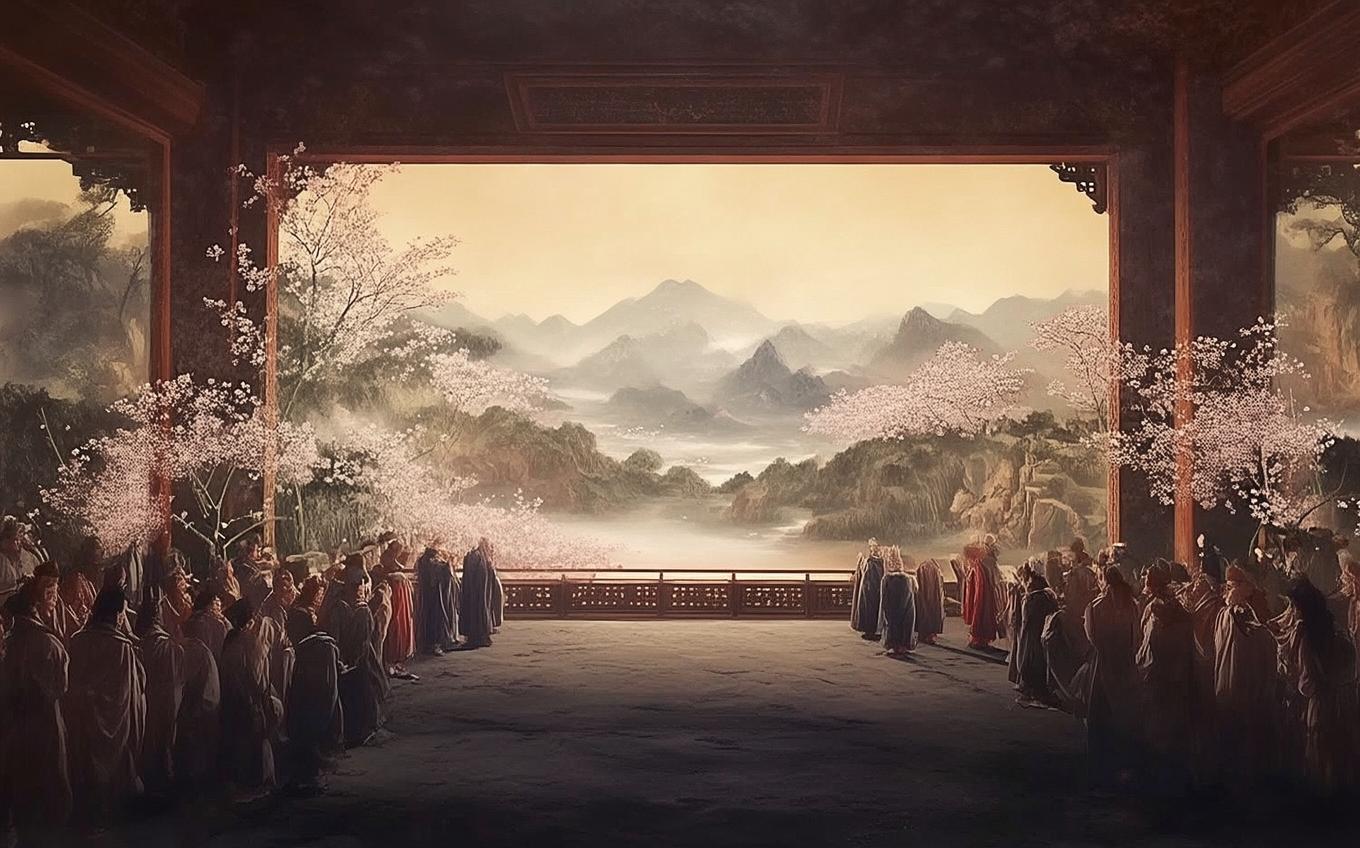
Emperor Taizong of Tang (598–649), born Li Shimin, is remembered not only as one of China’s most brilliant sovereigns but also as a man of letters who used poetry to express the ideals of his reign. His poem “正日临朝” (zhèng rì lín cháo), or Holding Court on the First Day of the Year, was composed for the grand New Year’s ceremony in the imperial palace. Far more than a simple record of ritual, the poem weaves together splendid images of a unified empire receiving tribute from all directions with the quiet, Confucian humility of a ruler who knows the weight of his mandate. This piece offers English readers a vivid window into Tang Dynasty pageantry, political philosophy, and the cosmic self-image of the Chinese emperor.
The Poem: Full Text and Translation
条风开献节,
tiáo fēng kāi xiàn jié,
A gentle breeze opens the festival of offerings,灰律动初阳。
huī lǜ dòng chū yáng,
The ash‑pitch‑pipes stir with the first sun of spring.百蛮奉遐赆,
bǎi mán fèng xiá jìn,
The hundred barbarians present their distant tribute,万国朝未央。
wàn guó cháo wèi yāng,
The myriad nations pay homage at Weiyang Palace.虽无舜禹迹,
suī wú shùn yǔ jì,
Though I lack the deeds of Shun and Yu,幸欣天地康。
xìng xīn tiān dì kāng,
I rejoice that heaven and earth are at peace.车轨同八表,
chē guǐ tóng bā biǎo,
Carriage tracks are standardized to the eight extremities,书文混四方。
shū wén hùn sì fāng,
Writing and script are unified across the four quarters.赫奕俨冠盖,
hè yì yǎn guān gài,
Shimmering and stately, the hats and canopies,纷纶盛服章。
fēn lún shèng fú zhāng,
Profuse and ornate, the ceremonial robes and insignia.羽旄飞驰道,
yǔ máo fēi chí dào,
Feathered banners fly along the imperial avenue,钟鼓震岩廊。
zhōng gǔ zhèn yán láng,
Bells and drums shake the rock‑solid corridors.组练辉霞色,
zǔ liàn huī xiá sè,
Silk‑woven ribbons gleam with the hues of rosy clouds,霜戟耀朝光。
shuāng jǐ yào cháo guāng,
Frost‑white halberds glitter in the morning light.晨宵怀至理,
chén xiāo huái zhì lǐ,
From dawn to dusk I cherish the highest principles,终愧抚遐荒。
zhōng kuì fǔ xiá huāng,
Yet all the while ashamed to govern the distant wilderness.
Line-by-Line Analysis
Lines 1–2: The Arrival of Spring and Ceremony
The opening couplet sets the poem in the first days of the lunar year. “条风” (tiáo fēng), literally “branch wind,” is the gentle east wind of early spring. It “opens” the “献节” (xiàn jié), a festival of offerings, signaling renewal. The second line refers to an ancient Chinese method of measuring the seasons: ashes of reed pith were placed in pitch‑pipes (律, lǜ), and when a certain solar term arrived, the earth’s qi would blow the ash out of the corresponding pipe. “灰律动初阳” tells us the pipe for the beginning of spring has just stirred, symbolizing the rebirth of yang energy. Together, these lines ground the political ritual in the rhythms of the cosmos.
Lines 3–4: Universal Homage
Here the emperor describes the morning’s tribute ceremony. “百蛮” (bǎi mán, hundred barbarians) and “万国” (wàn guó, myriad nations) are hyperbolic formulas for all foreign peoples. They bring “遐赆” (xiá jìn), gifts from faraway lands, and gather at “未央” (wèi yāng), the Weiyang Palace in Chang’an—the symbolic heart of the empire. The imagery asserts the Tang Dynasty’s political centrality and its claim to be the civilized hub toward which all corners of the known world gravitate.
Lines 5–6: The Virtuous Ruler’s Modesty
A sudden shift in tone: the emperor turns inward. He confesses that he has no achievements to match the sage‑kings Shun and Yu, legendary models of virtue and flood‑control. Yet he is grateful—“幸欣”—that heaven and earth enjoy peace. This self‑deprecation is a Confucian trope: a true king never boasts, even when the realm prospers. It frames the stunning ceremony not as a personal triumph but as a collective blessing.
Lines 7–8: Standardization and Unity
“车轨同八表” echoes the First Emperor of Qin’s historic unification of cart‑axle widths so that roads could be standardized across the vast empire. “八表” (bā biǎo, eight extremities) means all directions. “书文混四方” points to the unification of the writing system, again recalling Qin but now emblematic of Tang cultural cohesion. These two lines celebrate administrative and civilizational unity—the practical foundation under the ritual spectacle.
Lines 9–10: Splendor of the Courtiers
The focus returns to the visual feast. “赫奕俨冠盖”—towering, dignified headgear and carriage‑canopies—paints the officials in the courtyard. “纷纶盛服章” emphasizes the profusion of ceremonial robes embroidered with rank‑badges (章, zhāng), a kaleidoscope of color and order. The diction conveys not chaos but a richly woven hierarchy, a Confucian ideal where everyone knows their place and contributes to a harmonious whole.
Lines 11–12: Sound and Motion
Feathered banners (羽旄, yǔ máo) whip along the broad “驰道” (chí dào), the imperial highway reserved for the Son of Heaven. The percussive force of bells and drums reverberates through “岩廊” (yán láng), a poetic term for the sturdy palace corridors. Movement and sound electrify the scene; the ritual is not static, but a living, breathing display of power ascending from the human realm to heaven.
Lines 13–14: The Gleam of Arms and Silks
“组练” (zǔ liàn) are silk ribbons woven into armor, here shining with sunset‑like “霞色” (xiá sè, rosy‑cloud colors). Paired with “霜戟” (shuāng jǐ), halberds so polished they resemble frost, the couplet merges beauty with martial might. The morning light (朝光, cháo guāng) catches every reflective surface, suggesting that the emperor’s virtue illumines even weapons, transforming them from tools of violence into ornaments of a peaceful reign.
Lines 15–16: The Inner Confession
The closing couplet returns to the private voice. “晨宵怀至理”—morning and night, the emperor holds fast to the supreme principle, the Dao of good governance. Yet the final line undercuts this with “终愧” (zhōng kuì), “ultimately ashamed.” To “抚遐荒” means to soothe and govern the remote wilderness; the phrase implies that despite all the glory, the ruler feels unworthy of the task. This humility is the poem’s emotional and philosophical keystone, turning an otherwise panegyric scene into a meditation on the burdens of leadership.
Themes and Symbolism
Imperial Majesty and Cosmic Order
The poem’s central theme is the seamless fusion of political power with natural and moral order. Spring winds, musical pipes, and the dawn sun all converge on the moment the emperor holds court, suggesting that his rule is as inevitable and benevolent as the seasons.
Unity and Civilization
Standardized cart tracks and unified script serve as symbols of a harmonious empire. The tribute from “hundred barbarians” and “myriad nations” reinforces the Tang as the center of civilization, where cultural and administrative norms radiate outward.
The Confucian Virtuous Ruler
Taizong’s self‑comparison to Shun and Yu, followed by his admission of shame, embodies the Confucian ideal that a ruler must constantly examine his own virtue. Power is legitimate only when paired with humility and ceaseless moral effort.
Symbols of Ritual Splendor
Feathered banners, bells, drums, silk‑wrapped armor, and frosty halberds are not mere decorations. They materialize the emperor’s dual role as civilizer and protector, weaving together culture (wen) and martial strength (wu) into a single, luminous performance of state ideology.
Cultural Context
When Emperor Taizong wrote this poem in the early seventh century, the Tang Dynasty was entering its golden age. The Zhenguan reign (627–649) is still remembered as a benchmark of good governance, economic prosperity, and military confidence. Chang’an, the capital, was the largest city in the world and a bustling terminus of the Silk Road. Ambassadors and merchants from Central Asia, Persia, India, and beyond regularly attended court ceremonies, just as the poem describes.
The New Year’s court ritual was not a casual gathering but a solemn reaffirmation of the Mandate of Heaven. By welcoming tribute, promulgating the calendar, and displaying the unified codes of writing and measurement, the emperor demonstrated that harmony existed between heaven, the ruler, and all under heaven. The poem’s elaborate description of robes, hats, and weapons reflects the meticulous sumptuary laws of the Tang court, where every color and pattern signaled rank and responsibility. Taizong’s closing humility was both a genuine personal trait and a carefully crafted political message: the Son of Heaven remains accountable to a moral standard beyond himself, a key tenet of Chinese statecraft.
Conclusion
“正日临
Comments (0)
No comments yet. Be the first to comment!