Analysis of "十月诞辰内殿宴群臣效柏梁体联句" - Classical Chinese Poetry
Introduction
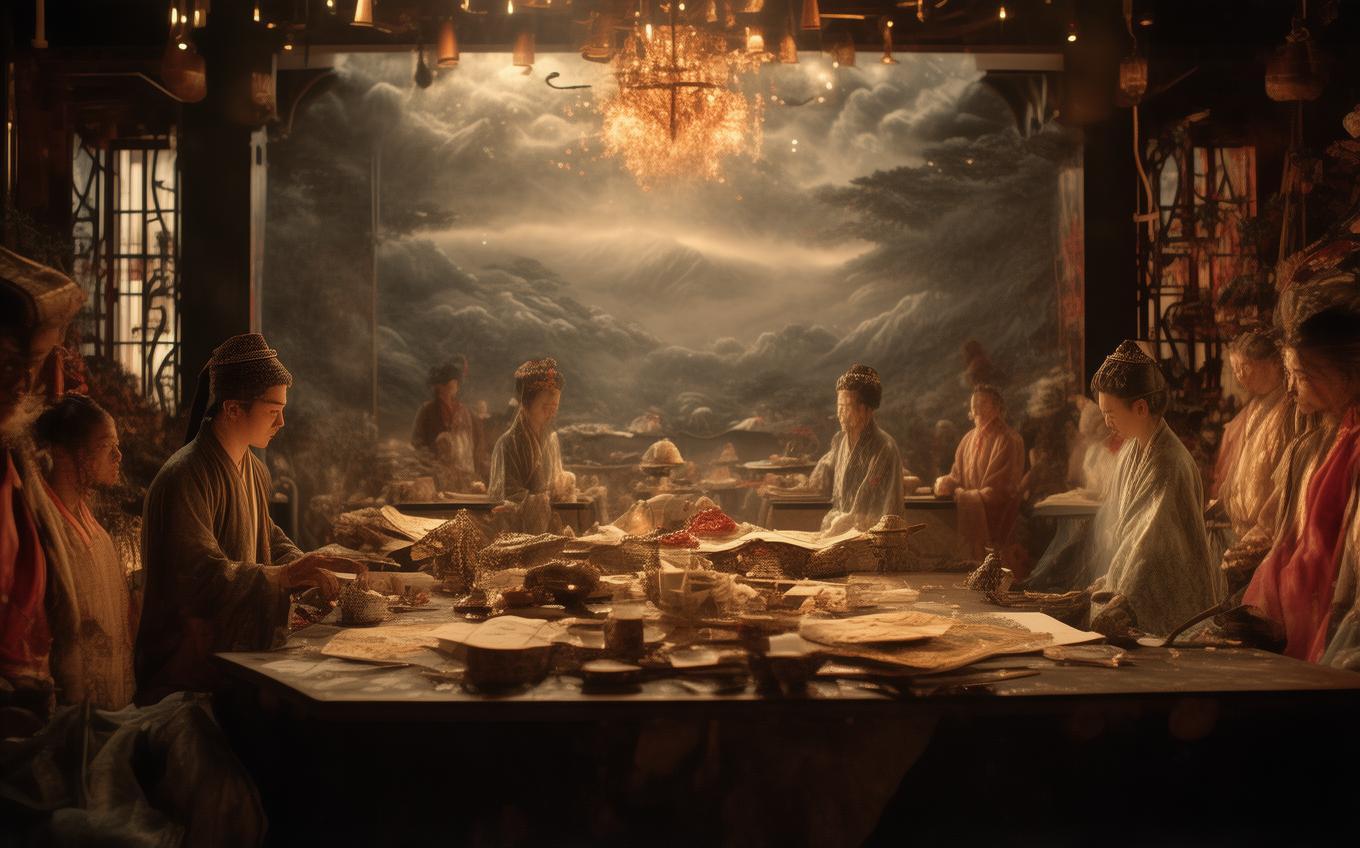
The poem “十月诞辰内殿宴群臣效柏梁体联句” (Shíyuè Dànchén Nèi Diàn Yàn Qúnchén Xiào Bǎiliáng Tǐ Liánjù) is a rare and dazzling artifact from the court of China’s only female emperor, Wu Zetian (武则天, 624–705 CE). The title translates to “At the Inner Palace Banquet for My Birthday in the Tenth Month, Composing a Linked Verse in Imitation of the Bo Liang Style with My Ministers.” It was composed around 700 CE, at the height of her Zhou dynasty, when she invited a select group of high officials to celebrate her birthday in the imperial palace. Rather than a solitary poetic meditation, this is a collaborative chain poem (liánjù) – each participant contributed a seven‑character line in praise of the occasion, weaving a collective tapestry of loyalty, humility, and imperial grandeur. The form deliberately mimics the ancient Bo Liang style, named after a famous banquet poem by Emperor Wu of the Han dynasty, thereby positioning Wu Zetian’s court within a glorious literary lineage.
This poem is significant not only for its historical context but also for its embodiment of Tang dynasty court culture and the symbolic role of poetry as a tool of political harmony. In the following analysis, we will explore the complete text, unpack each minister’s verse, and delve into the rich cultural tapestry that makes this work a fascinating window into medieval Chinese civilization.
The Poem: Full Text and Translation
The poem is presented line by line, with the speaker indicated in parentheses as recorded in the original collection Quan Tang Shi. All lines rhyme on the -ai ending (in Middle Chinese) – a technical constraint of the Bo Liang style that lends the verse rhythmic cohesion.
润色鸿业寄贤才,(帝)
Rùnsè hóngyè jì xiáncái, (dì)
“To polish the grand enterprise, we entrust it to the worthy and talented.” (The Emperor)
叨居右弼愧盐梅,(李峤)
Tāo jū yòubì kuì yánméi, (Lǐ Qiáo)
“Unworthily I hold the post of Right Assistant, ashamed I am no salt‑and‑plum seasoning.” (Li Qiao)
运筹帷幄荷时来,(宗楚客)
Yùnchóu wéiwò hè shí lái, (Zōng Chǔkè)
“Planning strategies within the tent, I am blessed by the times.” (Zong Chuke)
职掌图籍滥蓬莱,(刘宪)
Zhízhǎng tújí làn Pénglái, (Liú Xiàn)
“In charge of maps and registers, I exceed my station as at Penglai.” (Liu Xian)
两司谬忝谢钟裴,(崔湜)
Liǎng sī miù tiǎn xiè Zhōng Péi, (Cuī Shí)
“Serving in two bureaus by mistake, I decline comparison to Zhong and Pei.” (Cui Shi)
礼乐铨管效涓埃,(郑愔)
Lǐyuè quán guǎn xiào juān’āi, (Zhèng Yīn)
“In rites, music, and official selection, I offer but a trickle of dust.” (Zheng Yin)
陈师振旅清九垓,(赵彦昭)
Chén shī zhèn lǚ qīng jiǔgāi, (Zhào Yànzhāo)
“Arraying troops and rousing the armies, I cleanse the nine directions.” (Zhao Yanzhao)
欣承顾问侍天杯,(李适)
Xīn chéng gùwèn shì tiān bēi, (Lǐ Shì)
“Joyfully receiving imperial inquiries, I attend the heavenly cup.” (Li Shi)
衔恩献寿柏梁台,(苏颋)
Xián ēn xiàn shòu Bǎiliáng tái, (Sū Tǐng)
“Bearing favor, I present a toast of longevity at the Bo Liang Terrace.” (Su Ting)
黄缣青简奉康哉。(卢藏用)
Huáng jiān qīng jiǎn fèng kāng zāi, (Lú Cángyòng)
“With yellow silk and green bamboo slips, I serve peace and prosperity.” (Lu Cangyong)
Line‑by‑Line Analysis
Line 1 – The Emperor (Wu Zetian): The poem opens with the empress herself, setting a tone of entrusted statecraft. “润色鸿业” (rùnsè hóngyè) evokes the Confucian ideal that a ruler refines a vast, flourishing enterprise through virtue. By declaring that this task is “寄贤才” (entrusted to the worthy), she gracefully shifts the spotlight to her ministers – a classic display of humility and recognition that cements their loyalty.
Line 2 – Li Qiao (李峤): Li Qiao, a prominent chancellor, immediately downplays himself. “右弼” (yòubì) refers to the Right Assistant, a high‑level advisory position. “盐梅” (yánméi) is a metaphor drawn from the Book of Documents: salt and pickled plum are essential seasonings in cooking, symbolizing indispensable ministers who bring harmony to governance, much as the legendary minister Fu Yue did for King Wu Ding. To say “愧盐梅” (ashamed I am no salt‑and‑plum) is to deflect praise and acknowledge his own inadequacy before the throne.
Line 3 – Zong Chuke (宗楚客): A military strategist and diplomat, Zong Chuke alludes to the phrase “运筹帷幄” (yùnchóu wéiwò – “devising strategies within the commander’s tent”), made famous by Zhang Liang, the great early Han advisor. Claiming to be merely “blessed by the times” (hè shí lái) rather than by personal merit, he continues the ritual of ritualized self‑effacement.
Line 4 – Liu Xian (刘宪): Liu Xian was a director of the imperial library and archives. “蓬莱” (Pénglái) is a mythical island of immortals, but in Tang poetry it also came to designate the imperial library. He confesses that he “exceeds my station” (làn – literally “overflow” or “unworthy to fill”) in such a celestial post, likening the library to paradise and himself to a mere mortal trespassing there.
Line 5 – Cui Shi (崔湜): As a vice‑director in two ministries (liǎng sī), Cui Shi invokes historical paragons “钟裴” – Zhong Yao (a master calligrapher and statesman) and Pei Xiu (a famed cartographer) – both prodigiously talented officials. He “declines comparison” (xiè), playing down his own abilities as a polite convention while simultaneously flattering the emperor for recognizing such worthies.
Line 6 – Zheng Yin (郑愔): Zheng Yin oversaw rites, music, and the selection of officials. His “涓埃” (juān’āi) – “a trickle of dust” – presents his entire bureaucratic effort as infinitesimal before the imperial magnificence. The image is one of cosmic proportion: the ruler is the mountain, the minister merely a grain.
Line 7 – Zhao Yanzhao (赵彦昭): A military general enters the stage. “九垓” (jiǔgāi) refers to the nine cardinal directions (the eight compass points plus the center), meaning the whole world. By “cleansing” them, Zhao claims to bring peace and order through military might, yet by placing this after so many humble lines, the triumph remains subsumed under the empress’s overarching moral sway.
Line 8 – Li Shi (李适): This line shifts to the atmosphere of the banquet. Li Shi, a close advisor, is honored to answer the emperor’s questions (“顾问”) and to personally serve the “heavenly cup” (tiān bēi), a metaphor for the wine goblet of the Semi‑Divine ruler. The line glows with warmth and privileged intimacy.
Line 9 – Su Ting (苏颋): Now the poem explicitly connects to the ancient Bo Liang Terrace (Bǎiliáng tái), the very site of Emperor Wu of Han’s legendary poetry banquet. Su Ting says he offers a toast of longevity (a birthday wish) “at the Bo Liang Terrace,” thereby weaving Wu Zetian’s feast into a thousand‑year tapestry of imperial patronage. “衔恩” – “bearing favor” – underscores the vertical bond of gratitude.
Line 10 – Lu Cangyong (卢藏用): The final line, by the respected scholar Lu Cangyong, seals the poem with an official’s ultimate goal: “黄缣” (yellow silk) and “青简” (green bamboo strips) were writing materials for imperial edicts and historical records. To “奉康哉” (fèng kāng zāi – serve peace and prosperity) quotes the Book of Documents’ exclamation “康哉” (“Oh, how prosperous!”), closing the cycle on a note of well‑being and Confucian statecraft fulfilled.
Themes and Symbolism
Harmony through Hierarchy: Every line enacts the dance of lǐ (ritual propriety). The empress begins by elevating her ministers; they, in turn, magnify her by diminishing themselves – a symmetrical building of mutual respect that reflects the cosmic order.
Humility as Virtue: Each minister uses self‑denigrating language – “ashamed,” “unworthy,” “exceed,” “trickle,” “decline” – not out of genuine self‑doubt but as a social performance that reinforces the emperor’s supreme judgment in selecting them. This is the Confucian ideal of qiān (谦), the modesty that keeps the state in balance.
Continuity of Civilization: The deliberate echo of the Bo Liang Terrace ties Wu Zetian to the golden age of Han Emperor Wu. By reviving that form, the poem claims her Zhou dynasty as a legitimate, enlightened successor to past glories.
Birthday as Political Metaphor: The “诞辰” (dànchén) – the imperial birthday – is not a private affair but a renewal of the mandate. The ministers’ toasts and offers of service symbolize the life‑giving bond between a ruler and her realm.
Cultural Context
Wu Zetian’s reign (r. 690–705) was an extraordinary period. She formally established her own Zhou dynasty, breaking the Tang line, and surrounded herself with talented men who owed their positions directly to her favor. The “inner palace banquet” (内殿宴) was an exclusive affair, a stage where literature and politics merged seamlessly. The Bo Liang style originated from a 108 BCE poem composed by Emperor Wu and his ministers at the Bo Liang Terrace, each contributing a seven‑character line with a common rhyme. By imitating this, Wu Zetian demonstrated literary sophistication and asserted her court’s parallel to that classical model.
In medieval China, poetry was more than art – it was a mechanism of governance. Such collective compositions were public performances of unity. The birthdays of the emperor or empress were major state occasions, and the “献寿” (xiàn shòu) – offering longevity – was both a personal blessing and a political act of reassurance that the dynasty would endure.
Conclusion
“十月诞辰内殿宴群臣效柏梁体联句” is far more than a verse of flattery. It is a meticulously orchestrated ritual in words, where ten voices blend into a single harmonious declaration of peace, loyalty, and cultural continuity. Through its gentle courtesies and layered allusions, the poem captures the essence of Tang courtly life – a world where a birthday toast could also confirm the moral foundation of an empire. For modern readers, it opens a door to understanding how poetry once functioned as both a mirror of power and a medium of grace, reminding us that even in the most formal settings, the human longing for shared celebration and order finds beautiful expression.

Comments (0)
No comments yet. Be the first to comment!