Analysis of "王屋山送道士司马承祯还天台" - Classical Chinese Poetry
Introduction
In the rich tapestry of Tang dynasty poetry, farewell poems composed for Daoist recluses form a particularly luminous thread. “王屋山送道士司马承祯还天台” (“Seeing Off Daoist Sima Chengzhen at Wangwu Mountain to Return to Tiantai”) is a splendid example, traditionally attributed to Emperor Xuanzong of Tang (唐玄宗, also known as Li Longji 李隆基, r. 712–756). The poem was written on the occasion of bidding farewell to Sima Chengzhen (司马承祯, 647–735), one of the most revered Daoist masters of the era. Sima had been summoned from his remote hermitage to the imperial court to share his wisdom, and this poem marks his departure from the sacred Wangwu Mountain back to his beloved Tiantai range. Far more than a simple goodbye, the verse embodies the profound interplay between worldly authority and spiritual transcendence—a recurrent motif in Chinese literature and philosophy. Through elegant parallel couplets and resonant Daoist imagery, the poem invites us to reflect on the value of retreat, the purity of nature, and the enduring fragrance of a virtuous life.
The Poem: Full Text and Translation
紫府求贤士,
zǐ fǔ qiú xián shì
In the Purple Palace a worthy sage was sought,清溪祖逸人。
qīng xī zǔ yì rén
By a clear stream we bid farewell to the hermit.江湖与城阙,
jiāng hú yǔ chéng què
Rivers and lakes, palaces and city gates—异迹且殊伦。
yì jì qiě shū lún
Their traces are different, their ranks far apart.间有幽栖者,
jiān yǒu yōu qī zhě
Yet there exist those who dwell in seclusion,居然厌俗尘。
jū rán yàn sú chén
Peacefully weary of the dusty world.林泉先得性,
lín quán xiān dé xìng
Forests and springs first nurture their inner nature,芝桂欲调神。
zhī guì yù tiáo shén
Magic fungus and cassia refine their spirit.地道逾稽岭,
dì dào yú Jī lǐng
The earthly path crosses over Ji Range,天台接海滨。
Tiān tāi jiē hǎi bīn
Mount Tiantai touches the shores of the sea.音徽从此间,
yīn huī cóng cǐ jiān
From this moment your voice and virtue depart,万古一芳春。
wàn gǔ yī fāng chūn
Yet for a myriad ages, a single fragrant spring remains.
Line-by-Line Analysis
The poem opens with a striking contrast between the imperial realm and the recluse’s world. “紫府求贤士” (Purple Palace) refers to the emperor’s own domain—the Forbidden City, a place of celestial power. By saying a “worthy sage was sought,” Xuanzong humbly acknowledges the court’s need for spiritual guidance, elevating Sima Chengzhen to the status of a rare and honored guest. Immediately, the second line “清溪祖逸人” transports us to a pristine natural setting: a clear stream where a farewell banquet (祖, referring to a ritual send-off) is held. The juxtaposition sets up the poem’s central tension between civilization and wilderness.
The third and fourth lines “江湖与城阙,异迹且殊伦” deepen this contrast philosophically. Rivers and lakes (jiāng hú) stand for the untamed freedom of the hermit’s life, while palaces and city gates (chéng què) represent political power. Their “traces” (迹) and “ranks” (伦) are fundamentally incompatible—a Daoist idea that the true sage follows a path wholly different from that of rulers.
With the fifth and sixth lines, the poet turns inward, expressing quiet admiration: “间有幽栖者,居然厌俗尘。” There exist those who “dwell in seclusion” (yōu qī zhě), completely at peace and “weary of the dusty world” (yàn sú chén). The “dusty world” is a classic Daoist and Buddhist metaphor for the material realm of attachments, noise, and desire. Sima Chengzhen is described not as escaping from duty but as having naturally transcended it—an idea that resonates with the ideal of wu wei (effortless action).
The seventh and eighth lines, “林泉先得性,芝桂欲调神,” introduce two powerful Daoist images. “Forests and springs” are where one’s original “inner nature” (xìng) is cultivated—a reference to the belief that human beings rediscover their authentic selves when immersed in nature. “Magic fungus” (zhī) and “cassia” (guì) are both symbols of immortality and purity in Daoist alchemy; to “refine the spirit” (tiáo shén) suggests that the hermit nourishes his shen (spirit) through these natural elixirs, preparing for eternal life.
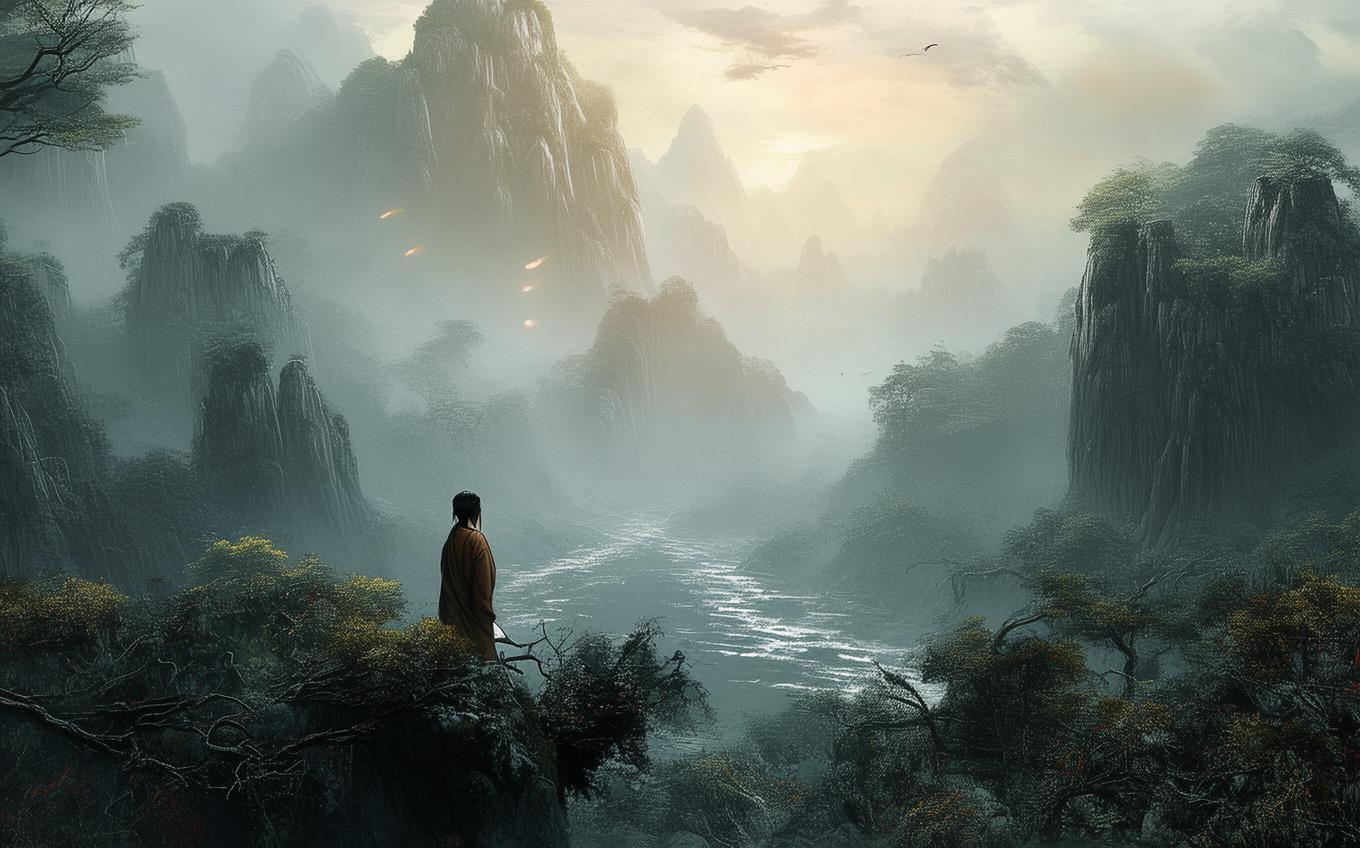
The geographical movement in lines nine and ten grounds the poem in actual travel: “地道逾稽岭,天台接海滨.” The “earthly path” will lead the master over the Ji Range and finally to Mount Tiantai, a sacred Daoist mountain that seems to touch the sea. This vast, unbounded landscape mirrors the limitless spiritual realm Sima Chengzhen inhabits. The final couplet, “音徽从此间,万古一芳春,” contains the poem’s most tender sentiment. Yīn huī (音徽) refers to a person’s virtuous reputation and the lingering beauty of their music—the very echo of their presence. Though the master departs, his moral influence will endure like “a single fragrant spring” for ten thousand ages. The image of fragrance (fāng) subtly recalls the cassia and fungus from earlier, tying the poem together with the scent of transcendence.
Themes and Symbolism
- The Recluse and the Ruler: A perennial theme in Chinese poetry is the tension between public service and private retreat. Here, the emperor himself praises the path of the recluse, showing that true virtue lies outside the palace walls. This reflects the Daoist belief that the sage ruler knows when to honor those who withdraw from the world.
- Nature as a Spiritual Realm: Mountains, streams, forests, and the sea are not mere scenery but sacred landscapes where the Dao (the Way) manifests. Wangwu and Tiantai mountains were both considered abodes of immortals, and the journey between them becomes a pilgrimage toward spiritual perfection.
- Transience and Permanence: The departure of the master is a moment of loss, but his yīn huī (virtuous influence) is eternal. The “fragrant spring” symbolizes the immortality of a pure spirit, a theme central to Daoist alchemy—physical death is not an end when one has cultivated the Dao.
- Alchemical Symbols: Zhi (fungus) and cassia are not just plants but ingredients in the elixir of immortality. They represent the inner transformation that the Daoist adept undergoes, turning the mundane body into something luminous and enduring.
Cultural Context
The Tang dynasty (618–907) witnessed a remarkable fusion of Buddhism, Daoism, and Confucianism, and the imperial family traced its ancestry to Laozi, the founder of Daoism. Emperor Xuanzong’s reign marked a high point in state patronage of Daoism, and Sima Chengzhen was among its most celebrated practitioners. The master’s school, the Shangqing (Highest Clarity) tradition, emphasized meditation, visualization of inner gods, and harmony with the natural cosmos. Summoning such a figure to court was both a personal quest for wisdom and a political act that legitimized the emperor’s rule as divinely sanctioned.
Wangwu Mountain (王屋山), located in modern-day Henan, was one of the ten great Daoist grotto-heavens. Tiantai Mountain (天台山) in Zhejiang was equally sacred, famed for its association with both Buddhist and Daoist enlightenment. Sima Chengzhen had originally lived on Tiantai; his return there from Wangwu thus completes a cycle of spiritual sojourn. The poem captures a historical event: in 711, Sima Chengzhen was summoned by Emperor Ruizong, and later by Xuanzong, but repeatedly chose to leave the court back to
Comments (0)
No comments yet. Be the first to comment!