Analysis of "早度蒲津关" - Classical Chinese Poetry
Introduction
Few figures in Chinese history embody the union of imperial might and poetic grace as perfectly as Emperor Xuanzong of Tang (唐玄宗, Táng Xuánzōng, reigned 712–756). Known to history as the brilliant ruler whose early reign saw a golden age of culture and power, he was also an accomplished poet. The poem “早度蒲津关” (Zǎo dù Pújīn Guān – “Crossing Pujin Pass at Dawn”) is one of his most polished compositions. Written during a journey from his eastern capital Luoyang back to Chang’an, the heart of the empire, the poem transforms a simple border crossing into a majestic meditation on peace, unity, and the responsibilities of a sage ruler. For English readers, it offers a rare glimpse into the mind of an emperor who saw his realm not only as a political map, but as a landscape alive with meaning.
The Poem: Full Text and Translation
钟鼓严更曙
Zhōng gǔ yán gēng shǔ
Bells and drums mark the strict night-watches as dawn breaks.山河野望通
Shān hé yě wàng tōng
Mountains and rivers: the open vista stretches wide and clear.鸣銮下蒲坂
Míng luán xià pú bǎn
With tinkling bells we descend from the Pu Slope.飞旆入秦中
Fēi pèi rù qín zhōng
Flying banners enter the heartland of Qin.地险关逾壮
Dì xiǎn guān yú zhuàng
The terrain is perilous – the pass becomes yet more majestic.天平镇尚雄
Tiān píng zhèn shàng xióng
Heaven is peaceful, yet the garrison still stands grand.春来津树合
Chūn lái jīn shù hé
Spring comes; trees by the ford close in lush and green.月落戍楼空
Yuè luò shù lóu kōng
The moon sets, leaving the frontier tower empty.马色分朝景
Mǎ sè fēn cháo jǐng
Horses’ coats gleam distinct in the fresh morning light.鸡声逐晓风
Jī shēng zhú xiǎo fēng
Roosters’ crows chase the dawn wind.所希常道泰
Suǒ xī cháng dào tài
What I hope is that the Constant Way be forever serene.非复候繻同
Fēi fù hòu xū tóng
No more like the old days of waiting for travel passes.
Line-by-Line Analysis
钟鼓严更曙,山河野望通
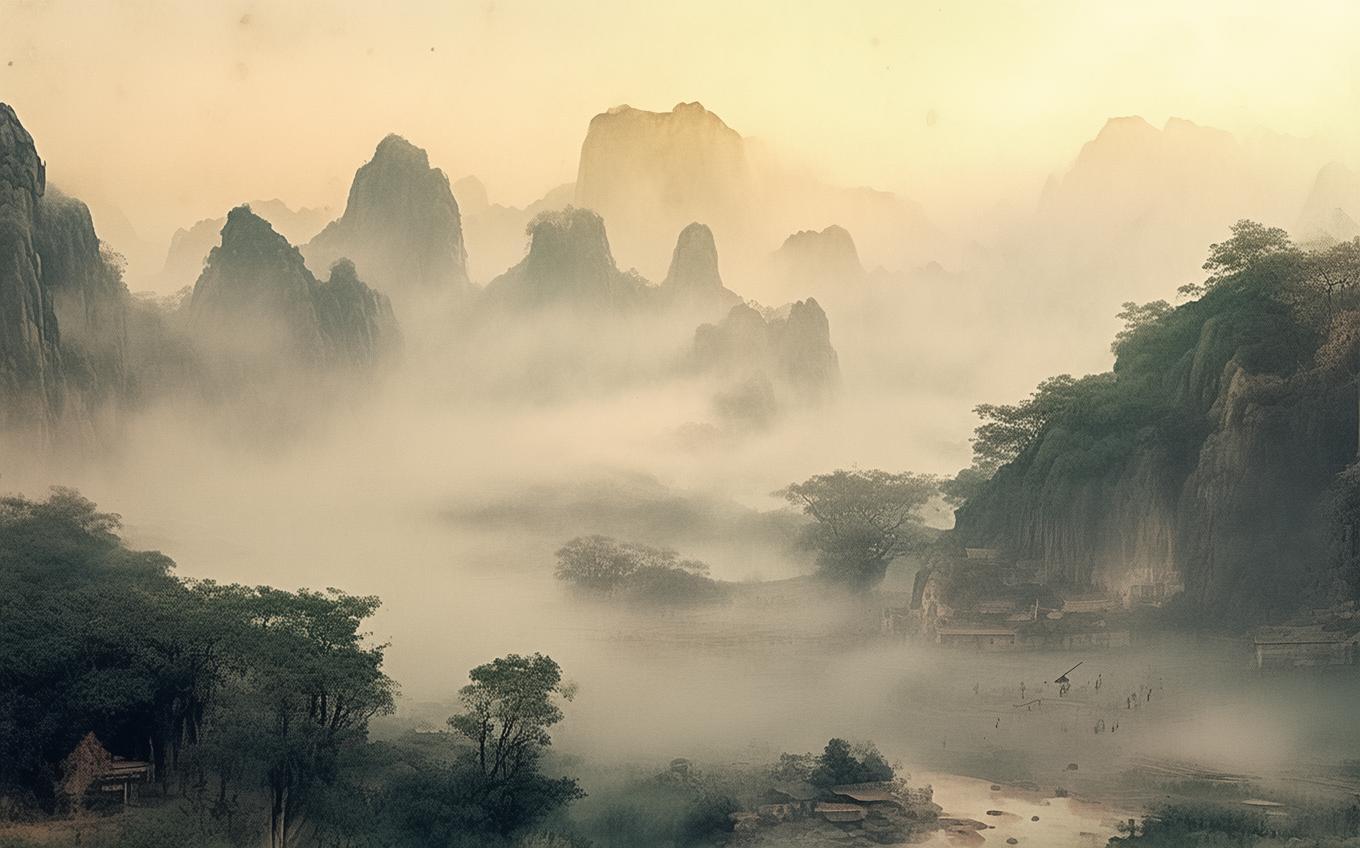
The poem opens with sound and space. In the Tang dynasty, city gates and watch stations used bells (zhōng) and drums (gǔ) to mark the strict divisions of the night watches. The word yán (严, “strict”) reminds us of a well-ordered realm where time itself is disciplined. As dawn arrives, the rigid night-watch lifts and the world opens: the view of mountains and rivers (shān hé) is unblocked, suggesting not just physical clarity but also an empire at ease, with no alarms to obscure the horizon.
鸣銮下蒲坂,飞旆入秦中
Now the imperial cortege moves. Luán (銮) refers to the bells on the emperor’s chariot; their “singing” (míng) marks the descent from Pu Slope, a strategic point near the Yellow River. The banners, described as “flying” (fēi pèi), signal swift, triumphant movement. Entering Qín zhōng – the old homeland of the Qin state, now the heart of the Tang empire – the emperor is ritually returning to the sacred political center.
地险关逾壮,天平镇尚雄
A philosophical couplet. The Pujin Pass is naturally imposing because the terrain is dangerous, yet the poet notes that the pass’s grandeur is enhanced by peaceful times, not diminished. Tiān píng (天平) literally means “heaven is balanced” – an idiom for cosmic harmony and peace under Heaven. The garrison remains mighty (xióng), but it is now a symbol of ordered strength rather than a sign of impending war. Xuanzong is praising a peace secured through virtue, not merely weapons.
春来津树合,月落戍楼空
Nature paints an image of that peace. Spring arrives and the trees by the ford grow so thick they seem to “join together,” concealing what might once have been a harsh border. The moon sets and the garrison tower stands empty. The emptiness is not a failure of defense, but the ultimate luxury of an era without conflict: no soldiers need pace the ramparts. The quiet tower is the poem’s most powerful political symbol.
马色分朝景,鸡声逐晓风
Here the focus shifts to intimate sensory detail. In the early light, the varied colors of the horses – perhaps a reference to the emperor’s own fine steeds – become distinct. The crowing of roosters seems to chase the morning breeze. This couplet grounds the grand imperial journey in the simple textures of a rural dawn, reminding us that the empire is made of real landscapes and common life, all now blessed by the emperor’s serene rule.
所希常道泰,非复候繻同
The final couplet turns inward to the emperor’s own wish. Cháng dào (常道), “the Constant Way,” refers to the eternal principles of good governance and the natural order. Xuanzong expresses his deepest hope: that the Way remain tranquil (tài). Then he makes a historical allusion: hòu xū (候繻) was the ancient practice of waiting at passes for a stamped silk pass (xū) permitting travel. In the Warring States period, China was split into warring kingdoms and travel was heavily restricted. Now, under a unified and peaceful Tang, no one needs such a passport. The emperor delights that his realm is a single family, with no internal borders to divide it.
Themes and Symbolism
The central theme is peace through sagely rule. Xuanzong fashions himself as the ideal Confucian monarch whose virtue radiates outward, making military might unnecessary even as it remains ready. The journey is not a tour of conquest, but a homecoming.
Key symbols weave this theme throughout:
- Dawn represents renewal and the enlightened reign of the emperor.
- Open vistas (shān hé yě wàng tōng) mirror an unobstructed political order.
- The empty garrison tower powerfully redefines strength: true security means nobody needs to guard the walls.
- The spring trees and farmyard roosters root imperial peace in the simple cycles of agricultural life.
- The discarded passport (hòu xū) of the final line is the ultimate symbol of a realm so unified that travel requires no permission – a vision of empire as one harmonious family under Heaven.
Cultural Context
Pujin Pass (蒲津关) was a vital strategic gateway on the Yellow River that linked Hedong (eastern Han territory) with the Guanzhong plain, the Tang homeland around Chang’an. Crossing it held immense symbolic weight: the emperor was re-entering the ancestral core of the empire after time in the eastern capital. The poem echoes the tradition of frontier poetry, but instead of soldiers’ loneliness, it sings the confidence of the ruler who has pacified the frontier.
The allusion in the last line taps into a deep historical memory. After the Qin unification, removing internal passes was a sign of peace. Emperor Wen of the Han dynasty famously abolished the need for travel documents to show the empire was one. By invoking this, Xuanzong places himself in the lineage of legendary unifiers, celebrating the Pax Tang – the Tang peace – that defined the first half of his reign.
Conclusion
“早度蒲津关” is much more than a royal travelogue. It is a vision of empire as a poetic space, where morning bells, wide rivers, and empty towers become metaphors for an ideal government. Emperor Xuanzong’s careful brushwork turns a border crossing into a quiet hymn to peace, reminding us that in the Chinese literary imagination, political harmony and natural beauty are two expressions of the same cosmic order. For modern readers, the poem still breathes with the freshness of a spring dawn over the Yellow River, and with the enduring hope that the Constant Way might truly be serene – a hope as relevant to our turbulent world as it was to the golden morning of the Tang dynasty.
Comments (0)
No comments yet. Be the first to comment!