Introduction
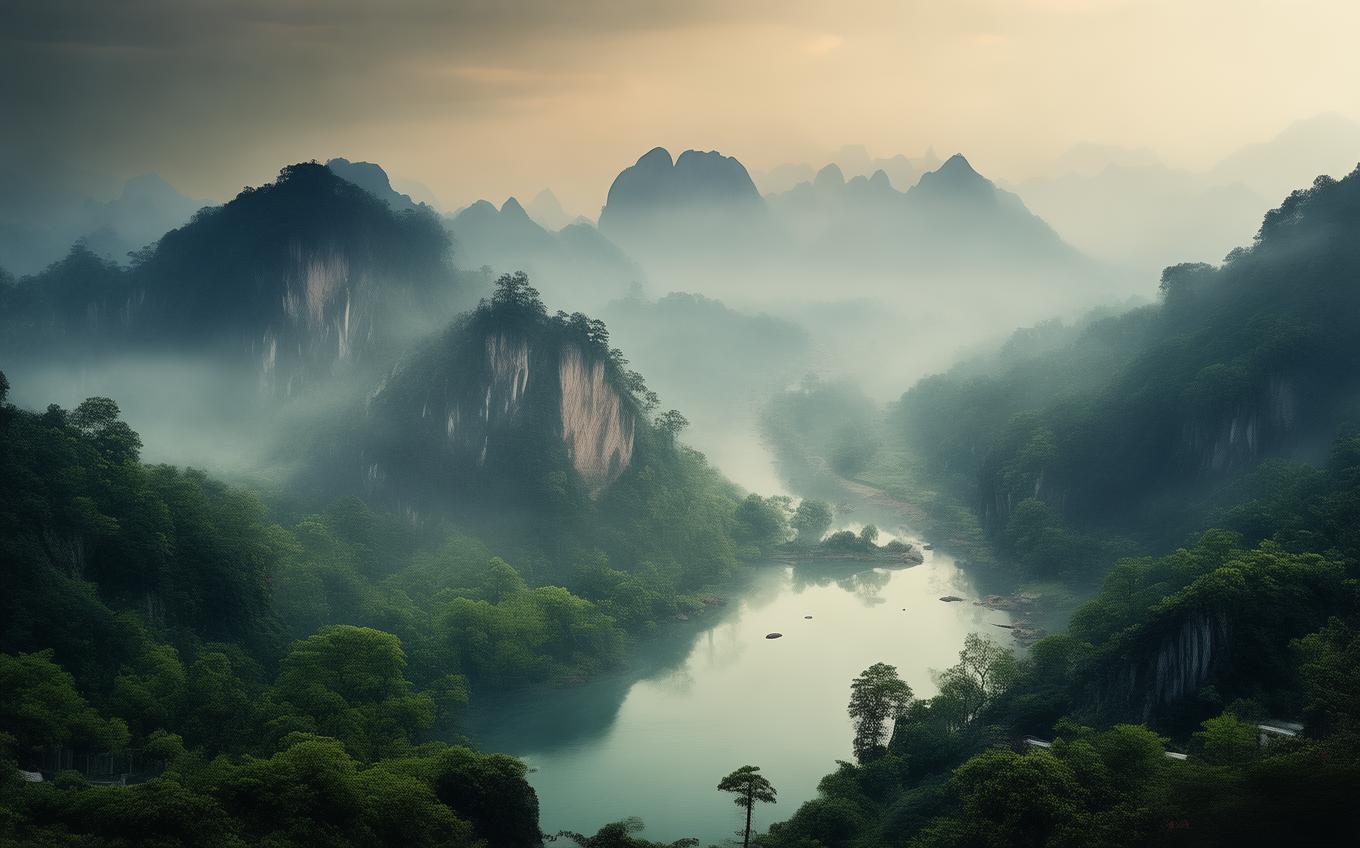
Wei Yingwu (韦应物, 737–792) was a Tang dynasty poet renowned for his tranquil, observant landscape verse and deeply personal reflections. Serving as an official in various provincial posts, he often found solace in nature, and his poems quietly capture fleeting moments of beauty and spiritual insight. “途经华岳” (Passing by Mount Hua) is one of his most admired nature poems, composed as he traveled past the sacred peak. In just eight lines of regulated verse, Wei Yingwu transforms a mere glimpse of a mountain into a meditation on awe, humility, and the yearning to transcend the ordinary. The poem remains a gem of classical Chinese literature, illustrating the profound connection between landscape, emotion, and philosophy that defines the Tang poetic tradition.
The Poem: Full Text and Translation
迢递瞰华岳,
tiáo dì kàn huá yuè
From afar I gaze upon Mount Hua,
决眦入归鸟。
jué zì rù guī niǎo
Straining my eyes as returning birds disappear into it.
寒空千嶂净,
hán kōng qiān zhàng jìng
The cold sky, a thousand cliffs scrubbed clean;
数峰出云表。
shù fēng chū yún biǎo
Several peaks rise above the clouds’ outer edge.
石壁疑削成,
shí bì yí xuē chéng
The stone walls seem cut by a blade,
众山何其小。
zhòng shān hé qí xiǎo
How small all other mountains appear!
便欲凌风翔,
biàn yù líng fēng xiáng
Immediately I want to ride the wind and soar—
卑栖安足道。
bēi qī ān zú dào
A lowly perch, how could it be worth mentioning?
Line-by-Line Analysis
迢递瞰华岳,决眦入归鸟。
The opening couplet sets the poet at a distance, looking up at the massive form of Mount Hua. “迢递” (tiáo dì, far away) not only indicates physical distance but also evokes the mountain’s loftiness. “瞰” (kàn) means to look down from above, yet here the poet is below the peak—this subtle inversion makes the viewer’s gaze feel elevated, as if the mountain itself draws the eye upward. The second line borrows a striking phrase from Du Fu: “决眦” (jué zì, splitting the eye sockets) is a hyperbolic image of intense staring. The poet watches homing birds vanish into the mountain, his vision straining to follow them until the birds and the rock face become one. This conveys both the immense scale of Mount Hua and the poet’s absorption in the scene, blurring the boundary between self and landscape.
寒空千嶂净,数峰出云表。
The middle couplets zoom in on the mountain’s details. The air is cold and crystalline, making the countless cliff faces appear “净” (jìng, pure, clean), as if washed by frost. In this clarity, a few summits pierce through the sea of clouds (“云表” – literally “cloud surface”). The contrast between the many hidden cliffs and the few visible peaks creates a visual hierarchy: the mountain is vast, but its highest points exist in another realm altogether. The cloud-wrapped peaks become a threshold between earth and sky, hinting at the transcendent.
石壁疑削成,众山何其小。
The sheer rock faces look so smooth and vertical that the poet wonders if they were shaped by a knife—a simile that conveys both artifice and supernatural sharpness. Then comes the breathtaking exclamation: “众山何其小” (how small all other mountains are). This echoes a famous Confucian sentiment, “登泰山而小天下” (When climbing Mount Tai, the world below seems small), yet here the poet does not even need to ascend. The very sight of Mount Hua dwarfs everything else, rendering the surrounding peaks insignificant. It is a moment of pure sublimity: the mountain’s majesty forces a radical reevaluation of scale, and with it, of one’s own place in the world.
便欲凌风翔,卑栖安足道。
The final couplet moves from observation to desire. Overwhelmed by the mountain’s lofty beauty, the poet wishes to “凌风翔” (líng fēng xiáng, ride the wind and soar), an image often associated with Daoist immortals who transcend earthly bounds. The last line dismisses “卑栖” (bēi qī, a lowly perch)—the mundane life of an official tied to the dusty world—as utterly unworthy of mention. The poem thus completes an arc from sensory immersion to spiritual aspiration. What began as a passing glimpse ends as a longing for liberation, leaving the reader suspended between the grandeur of nature and the limitations of human existence.
Themes and Symbolism
The poem’s central theme is the sublime encounter with nature—that mix of awe, humility, and exaltation one feels before a vast landscape. Mount Hua acts as a symbol of transcendent beauty and spiritual purity, its peaks a bridge to the heavens. The “returning birds” suggest a natural rhythm of belonging, while the poet remains an outsider looking in. The contrast between the great and the small (“众山何其小”) reinforces the insignificance of human concerns, a recurring motif in Chinese mountain poetry. The final image of “riding the wind” symbolizes the Daoist ideal of xian (immortal) freedom, casting the poet’s everyday life as a cage from which nature offers escape. Throughout, the poem uses clean, sharp imagery—cut cliffs, cold air, cloud partings—to create a world of crystalline purity that mirrors the poet’s inner longing for clarity and detachment.
Cultural Context
Mount Hua (华山, Huà Shān) is the Western Mountain of the Five Great Mountains of China, traditionally associated with the Daoist deity Shaohao and believed to be a dwelling place of immortals. Tang dynasty writers frequently made pilgrimages to sacred mountains, and the act of composing poetry en route became a cultural ritual—a way of inscribing personal experience onto a spiritually charged landscape. Wei Yingwu’s poem participates in this tradition while also subtly responding to Confucian and Daoist thought. The echo of “登泰山而小天下” invokes the Confucian idea that travel and high vantage points enlarge one’s moral vision; the closing desire to ride the wind aligns with the Daoist quest for unconstrained wandering (xiaoyao). Moreover, the contrast between the pure mountain and the “lowly perch” reflects a common tension in Chinese literati culture: the duty-bound official yearning for the hermit’s simplicity. In just eight lines, the poem encapsulates a whole philosophical complex.
Conclusion
More than a travel note, “途经华岳” is a masterpiece of compression and emotional resonance. Wei Yingwu transforms a fleeting moment—a distant gaze, a flock of birds, the play of clouds—into an enduring meditation on scale, beauty, and the human spirit. Its vivid language and layered allusions reward readers across the centuries, inviting each new audience to feel that same shiver of transcendence. In our own hurried world, the poem’s final lines ring as true as ever: there are sights so majestic that they make our daily preoccupations seem trivial, and even a mere glimpse can awaken the timeless desire to rise above them.
Comments (0)
No comments yet. Be the first to comment!