Introduction
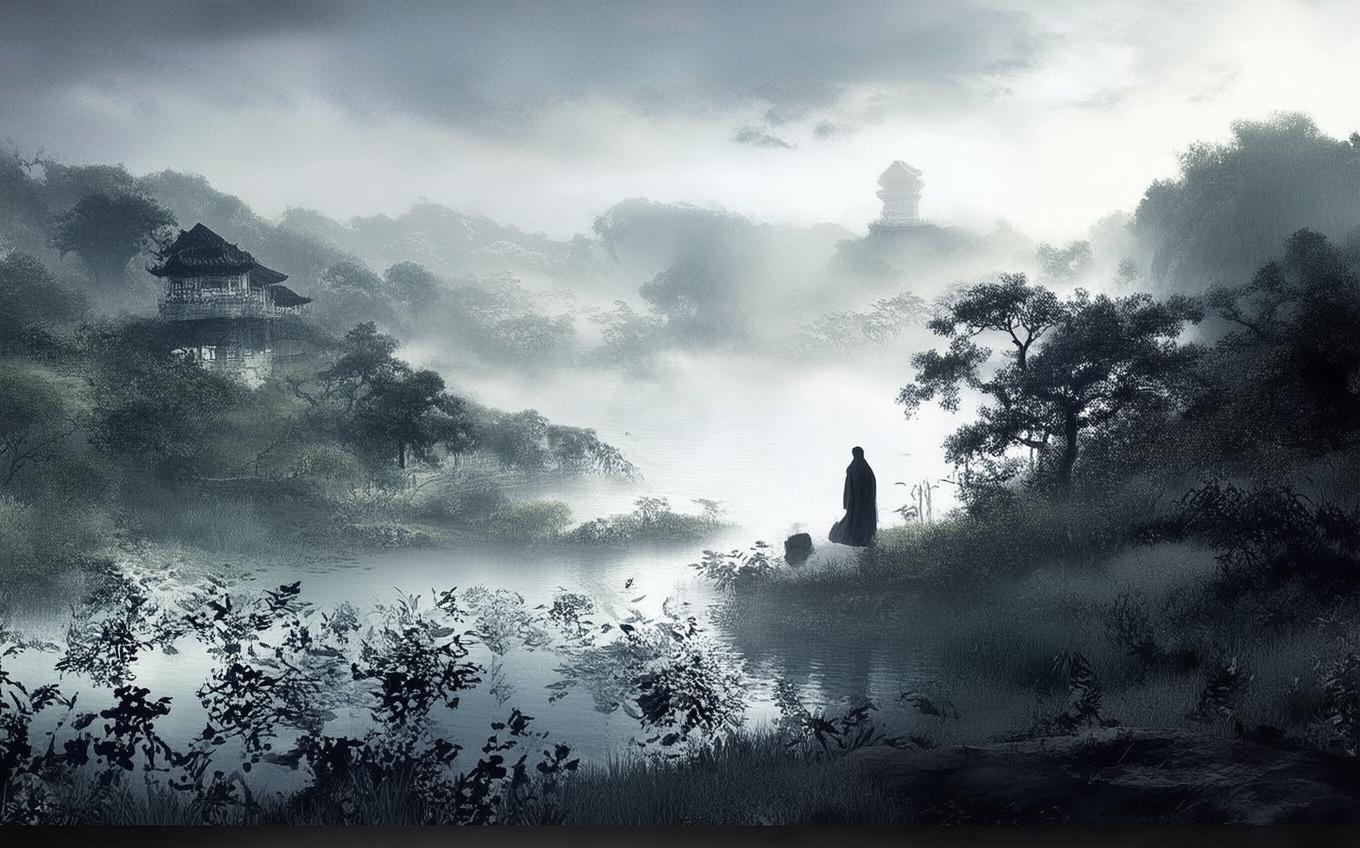
This poem comes from the brush of Emperor Xuanzong of Tang (唐玄宗, reigned 712–756), one of the most celebrated monarchs in Chinese history, whose reign marked both the dazzling cultural peak and the tragic turning point of the Tang dynasty. While Xuanzong is more often remembered for his love story with Yang Guifei and the catastrophic An Lushan Rebellion, he was also a devout patron of Daoism and an accomplished poet. “为赵法师别造精院过院赋诗” — roughly “For Dharma Master Zhao I Have Built a Separate Refined Monastery, and While Visiting It I Compose a Poem” — is a short, elegant tribute to a Daoist master for whom the emperor had constructed a private meditation hall. In just eight pentasyllabic lines, the poem expresses profound reverence for the Daoist path, blending imperial authority with sincere spiritual aspiration. It offers a rare glimpse into the personal faith of a ruler who sought transcendence beyond the throne.
The Poem: Full Text and Translation
宗师心物外,为道日损之。
Zōng shī xīn wù wài, wèi dào rì sǔn zhī.
The honored master has set his heart beyond worldly things; for the Dao, day by day he diminishes himself.炼药闭金灶,步虚礼玉京。
Liàn yào bì jīn zào, bù xū lǐ yù jīng.
He refines the elixir, closing the golden furnace; pacing the void, he pays homage to the Jade Capital.隔世诚难匹,遗形固可轻。
Gé shì chéng nán pǐ, yí xíng gù kě qīng.
Truly there is no equal to one remote from this age; to abandon the physical form is surely something light.愿奉无为化,斋心学道经。
Yuàn fèng wú wéi huà, zhāi xīn xué dào jīng.
I wish to receive the transformation of wu-wei; with a purified mind, to study the Daoist scriptures.
Line-by-Line Analysis
联句一 (First Couplet)
The opening line immediately sets a lofty, reverent tone. The “宗师” (zōngshī, grand master or patriarch) is Master Zhao, placed on a pedestal above the ordinary. “心物外” means his mind resides outside the material world — an embodiment of detachment. The second line alludes directly to the Daodejing (Chapter 48): “为学日益,为道日损” (“In the pursuit of learning, every day something is added; in the pursuit of the Dao, every day something is dropped”). By “diminishing himself,” the master sheds desires, ego, and worldly attachments — a core Daoist practice. The emperor, as speaker, acknowledges that true spiritual achievement lies not in accumulation but in subtraction.
联句二 (Second Couplet)
Here we enter the esoteric world of Daoist alchemy and ritual. “炼药” (liàn yào) refers to the compounding of the elixir of immortality, a pursuit closely associated with Tang court Daoism. The “golden furnace” is both a physical apparatus and a symbol of inner alchemical transformation. “步虚” (bùxū, pacing the void) is a ritualized sacred walk performed by Daoist priests, often accompanied by chanting, to ascend spiritually to the heavens. “玉京” (Yùjīng, Jade Capital) is the highest celestial realm in Daoist cosmology, the abode of the primordial deities. In two lines Xuanzong paints a complete picture: the master as both alchemist and celestial traveler, moving between earth and heaven.
联句三 (Third Couplet)
This couplet turns from description to reflection. “隔世” (gé shì) means separated from the ordinary world — the master lives in a different dimension of being. The emperor marvels that such a person is truly peerless (“难匹”). “遗形” (yí xíng) refers to shedding the physical body, either through death or through spiritual liberation. In Daoist thought, the body is a temporary vessel; to discard it lightly is the mark of an enlightened being. Xuanzong’s tone here carries a touch of yearning: he, bogged down by imperial duties, cannot so easily abandon corporeal constraints.
联句四 (Fourth Couplet)
The closing lines bring the focus back to the speaker himself. “无为化” (wúwéi huà) is the transformative influence of wu-wei — effortless action, the central Daoist virtue. The emperor no longer speaks of Master Zhao but of his own desire to receive this teaching. “斋心” (zhāi xīn) means to purify the heart-mind, a necessary preparation for true learning. “学道经” (xué dào jīng) is straightforward: to study the Daoist canon. The poem ends not with grand imperial decree, but with a humble personal wish — the Son of Heaven kneeling in spirit before the master and the Dao.
Themes and Symbolism
Detachment and Purification
The entire poem is structured around the Daoist ideal of shedding: diminishing desires (损), closing the alchemical furnace (闭), abandoning the body (遗形), and finally purifying the heart (斋心). This progression mirrors the steps of inner alchemy, where the practitioner gradually refines the self into pure spirit.
The Celestial Realm
Symbols of heaven and transcendence abound. The “玉京” (Jade Capital) is the ultimate destination of the Daoist adept, a place of eternal light and purity. “步虚” (pacing the void) suggests that the master already traverses the boundary between here and there, a liminal figure who brings the sacred into the mundane.
The Emperor as Seeker
Unusually for imperial poetry, the ruler presents himself as a supplicant. It is Master Zhao who stands at the pinnacle of achievement; the emperor merely “wishes” (愿) to receive the teaching. This inversion of status — the mightiest man in the empire learning from a recluse — highlights the supreme value Chinese culture placed on spiritual attainment over worldly power.
Cultural Context
Emperor Xuanzong’s forty‑three‑year reign (712–756) was the longest of the Tang dynasty and its cultural zenith. The court actively patronized Daoism, which had been declared the imperial religion by the early Tang emperors, who claimed descent from Laozi. Daoist temples, monasteries, and hermitages proliferated, and alchemical experiments were lavishly funded. By writing poems like this one, Xuanzong not only expressed personal piety but also performed the role of a sage‑king who harmonized governance with cosmic order.
“为赵法师别造精院过院赋诗” belongs to the genre of “题赠诗” (presentation poems), often exchanged between literati and religious figures. It reflects the Tang tradition of treating Buddhist and Daoist masters as mentors to the elite. The poem’s specific occasion — building a private meditation hall for a master — also reveals the intimate merging of imperial power and religious patronage. Behind the serene language, one senses the material reality: a new monastery, a favored master, an emperor taking time from state affairs to walk through its grounds and compose verses.
Conclusion
Compact, reverent, and deeply personal, this poem opens a window onto the spiritual heart of Tang China’s greatest emperor. It is not a loud declaration of power but a quiet meditation on letting go — a theme that resonates far beyond its eighth‑century context. Xuanzong’s desire to learn wu-wei and purify his mind speaks to a universal longing: the search for stillness amid the noise of life. In a world of endless striving, the poem reminds us that sometimes the truest form of mastery is to diminish, to close the furnace, and to open the heart to something larger. And for a moment, we see an emperor not on his throne, but on the threshold of the Jade Capital.

Comments (0)
No comments yet. Be the first to comment!