Introduction
The poem "千秋节宴" (Qiānqiū Jié Yàn, "The Thousand Autumns Festival Banquet") was composed by Emperor Xuanzong of Tang (唐玄宗, Táng Xuánzōng), also known as Li Longji (李隆基, Lǐ Lóngjī). Reigning from 712 to 756 CE, Xuanzong presided over a golden age of Chinese culture, yet his later years were marred by the catastrophic An Lushan Rebellion. The "Thousand Autumns Festival" was his own invention—a celebration of the emperor's birthday, declared a national holiday in 729 CE. On this day, lavish banquets were held, gifts were exchanged, and subjects offered their wishes for the emperor's longevity. This particular poem captures the splendor of such an occasion, weaving together imperial pageantry, Confucian harmony, and a subtle assertion of the ruler's virtue. It offers English readers a window into the political symbolism and aesthetic refinement of Tang court poetry, where even a birthday party became a statement of cosmic order.
The Poem: Full Text and Translation
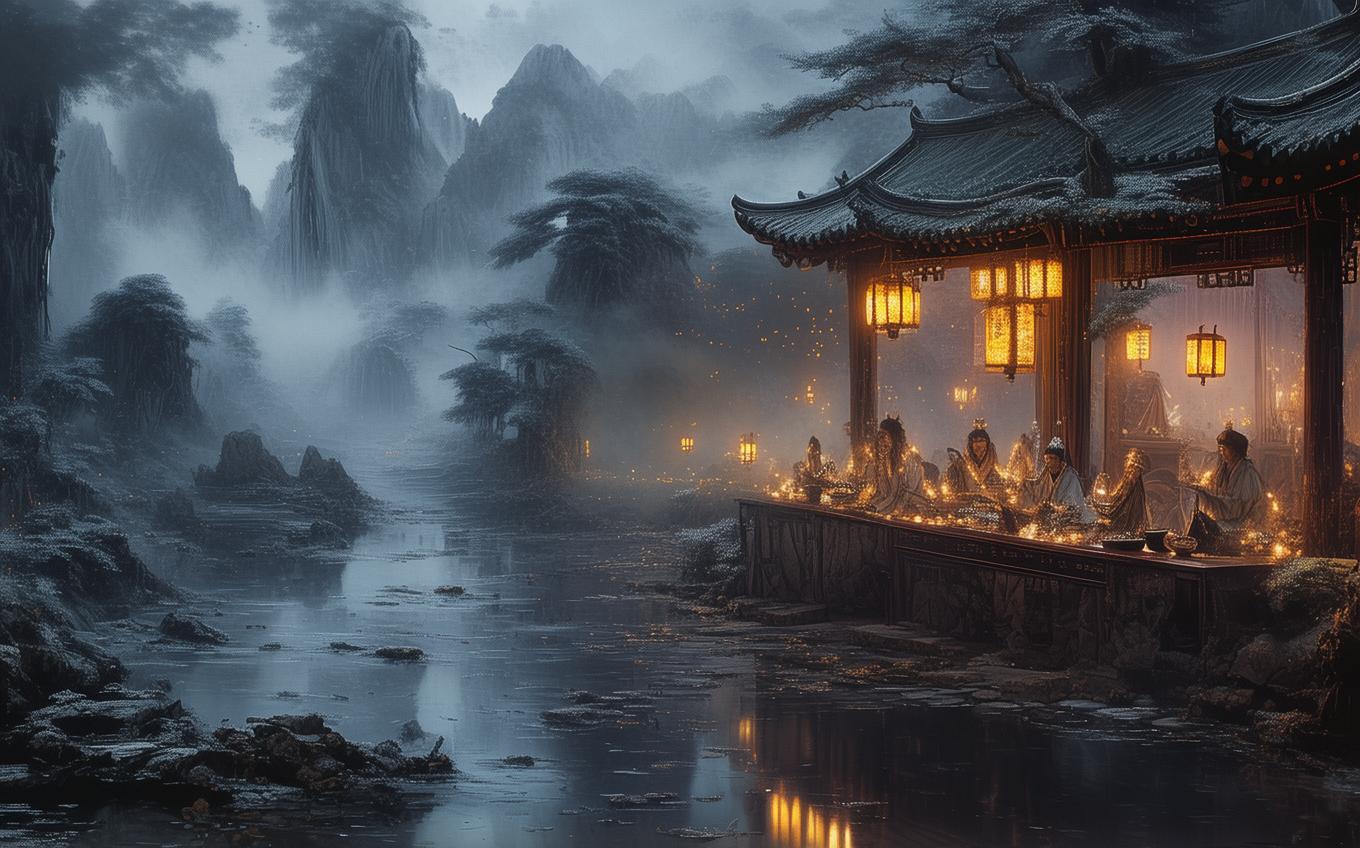
兰殿千秋节,称名万寿觞。
Lán diàn qiānqiū jié, chēng míng wàn shòu shāng.
In the Orchid Hall, on the Thousand Autumns Festival, it is named the Goblet of Ten Thousand Longevities.
风传率土庆,日表继天祥。
Fēng chuán shuài tǔ qìng, rì biǎo jì tiān xiáng.
The wind spreads celebration across all the land; the sun displays continued heavenly auspiciousness.
玉宇开花萼,金炉散异香。
Yù yǔ kāi huā è, jīn lú sàn yì xiāng.
In the jade palace, flower calyxes bloom; from golden braziers, exotic fragrances waft.
无言颂德茂,庶协道光昌。
Wú yán sòng dé mào, shù xié dào guāng chāng.
Without words we praise flourishing virtue, hoping to harmonize with the Way’s brilliant prosperity.
四海咸兄弟,群生遂乐康。
Sì hǎi xián xiōngdì, qún shēng suì lè kāng.
Within the four seas, all are brothers; every creature then finds joy and peace.
云霞纷绮丽,钟鼓合铿锵。
Yún xiá fēn qǐ lì, zhōng gǔ hé kēng qiāng.
Rosy clouds drift in ornate splendor; bells and drums resound in united cadence.
共乐乾坤泰,同欢日月长。
Gòng lè qián kūn tài, tóng huān rì yuè cháng.
Together we rejoice in the peace of Heaven and Earth; together we delight in the sun and moon’s endurance.
自匪常如此,何能荷圣皇。
Zì fěi cháng rú cǐ, hé néng hè shèng huáng.
If it were not always like this, how could we bear the grace of our sage emperor?
Line-by-Line Analysis
Couplet 1: The poem opens by setting the scene in the "Orchid Hall" (兰殿), a lushly named palace chamber that suggests elegance and refinement. The festival itself is immediately paired with the "Goblet of Ten Thousand Longevities" (万寿觞), a ritual drinking vessel whose name is a blessing in itself. By calling it “named” (称名) the goblet, the emperor draws attention to the act of naming—a sovereign’s prerogative—and links the concrete celebration to abstract wishes for eternal life. The alliteration of wàn shòu shāng rolls off the tongue, mimicking the raised cups.
Couplet 2: The celebration expands outward. The wind (风) becomes a messenger, carrying tidings of joy “throughout the land” (率土, literally “along the borders of the soil,” a classical phrase for the entire realm from the Book of Documents). The sun (日) mirrors the emperor’s radiance, “continuing heavenly auspiciousness” (继天祥). In Tang cosmology, a good ruler aligned with natural rhythms; here, the very elements endorse his birthday. The parallelism between wind (feng) and sun (ri) balances the terrestrial and celestial, a hallmark of regulated verse.
Couplet 3: The third couplet zooms into the banquet’s sensory details. “Jade palace” (玉宇) evokes an otherworldly abode—also a term for the heavens—blurring the line between the imperial court and the divine. The “flower calyxes” (花萼) are no random blossoms: Xuanzong famously built a “Calyx Pavilion” (花萼楼) to symbolize fraternal harmony with his brothers, a poignant political gesture after his own rise to power involved sidelining potential rivals. The “golden braziers” (金炉) and their “exotic fragrance” (异香) suggest luxury and tribute from distant lands, a reminder of Tang cosmopolitanism.
Couplet 4: Now a shift from external spectacle to internal morality. “Without words” (无言) they praise virtue—a Daoist-tinged concept where true merit is too profound for speech. “Flourishing virtue” (德茂) is the emperor’s desired attribute, and the line aspires to “harmonize with the Way’s brilliant prosperity” (道光昌). The character 庶 (shù, “hoping to”) introduces humility, as if the courtiers’ silent reverence might align them with the cosmic order. It is at once a description and a prayer.
Couplet 5: This couplet explicitly states a Confucian ideal: “Within the four seas, all are brothers” (四海咸兄弟). The phrase originates in the Analects, where the cultivated gentleman has no boundaries of kinship. Xuanzong appropriates it to paint his empire as a universal family. The second line, “every creature then finds joy and peace” (群生遂乐康), extends the brotherhood from humans to all living beings, echoing a Buddhist-influenced compassion. The adverb 遂 (suì) suggests a logical result—because the emperor is virtuous, the natural consequence is universal happiness.
Couplet 6: Returning to imagery, the sixth couplet paints the sky and the music. “Rosy clouds” (云霞) in “ornate splendor” (绮丽) are both a meteorological phenomenon and an auspicious omen, often depicted in Tang art swirling around divine mountains. The “bells and drums” (钟鼓) that “resound in united cadence” (合铿锵) are ritual instruments whose harmony symbolizes social order. The onomatopoeic kēng qiāng gives the beat a tangible sonic quality, contrasting with the visual clouds.
Couplet 7: The theme of collective joy intensifies. “Together we rejoice” (共乐) and “together we delight” (同欢) employ a quintessentially Tang dynasty spirit of shared celebration. “Peace of Heaven and Earth” (乾坤泰) references the Yijing hexagram Tai (泰), representing harmony and prosperity—the imperial wish for a reign without upheaval. “Sun and moon’s endurance” (日月长) is a direct metaphor for the emperor’s longevity, tying back to the birthday’s purpose.
Couplet 8: The closing couplet is a rhetorical flourish: “If it were not always like this, how could we bear the grace of our sage emperor?” (自匪常如此,何能荷圣皇). The logic is deliberately circular—the festival’s perfection proves the ruler’s sagehood, and that sagehood in turn makes the celebration possible. The word 荷 (hè, “bear, receive”) implies a weight of obligation; the emperor’s favor is something to be shouldered by grateful subjects. It is a polite self-deprecation that actually reinforces the sovereign’s centrality.
Themes and Symbolism
Cosmic Harmony and Rulership: The poem repeatedly aligns the human and natural worlds. Wind, sun, clouds, and the earth itself participate in the emperor’s birthday, reflecting the Chinese concept of tiānmìng (天命, Mandate of Heaven)—the belief that a virtuous ruler enjoys nature’s endorsement. The “peace of Heaven and Earth” (乾坤泰) is not merely a wish but a statement of how the empire should work.
Confucian Brotherhood and Universalism: By invoking the classic line “all within the four seas are brothers,” Xuanzong casts himself as the patriarch of a vast family. This softens the rigid hierarchy of imperial rule, presenting subordination as familial affection. The Tang dynasty, with its multi-ethnic elite and Silk Road connections, often celebrated such universalism.
Daoist and Buddhist Undercurrents: The “Way’s brilliance” (道光) and the ineffable virtue praised “without words” owe much to Daoist thought, while compassion for “all creatures” resonates with Buddhist values. Xuanzong actively patronized both religions, and this blending mirrors the eclectic spirituality of his court.
Calyx and Mirror Motif: Although the mirror (jìng, 镜) is not directly mentioned in this version of the poem, the “flower calyx” (花萼) symbolizes fraternal loyalty from Xuanzong’s famous pavilion. In other poems for the same festival, he writes of casting “thousand-autumn mirrors” to gift his ministers, symbolizing clarity of governance. The visual of blooming calyxes suggests the flowering of his reign.
Cultural Context
The Thousand Autumns Festival (千秋节, Qiānqiū Jié) was officially instituted in 729 CE, replacing an earlier birthday celebration and
Comments (0)
No comments yet. Be the first to comment!