Introduction
潼关口号 (Tóngguān Kǒuhào) – "Impromptu Verse at Tong Pass" – is a five-character quatrain composed by Tang Emperor Xuanzong (唐玄宗), personal name Li Longji (李隆基). Written in 723 CE during an imperial inspection tour of the western frontier, the poem stands at the intersection of poetry and statecraft. Emperor Xuanzong presided over a dazzling cultural renaissance and territorial zenith in the first half of his reign (the Kaiyuan era), yet his later years saw catastrophic military overreach and the devastating An Lushan Rebellion. In this short, deceptively simple poem, the emperor meditates on the formidable geography of Tong Pass – the strategic gateway between the two Tang capitals – and poses a political question: can walls and natural barriers replace virtuous rule? The poem has endured not only for its crisp imagery but for the tragic irony history would soon attach to it.
The Poem: Full Text and Translation
河曲回千里
Hé qū huí qiān lǐ
The Yellow River bends and winds for a thousand miles;
关门限二京
Guān mén xiàn èr jīng
The pass gate serves as a boundary between the two capitals.
所嗟非恃德
Suǒ jiē fēi shì dé
What I sigh over is not that we rely on virtue,
设险到天平
Shè xiǎn dào tiān píng
But that we set up strategic defiles all the way to heavenly peace.
Line-by-Line Analysis
Line 1: 河曲回千里
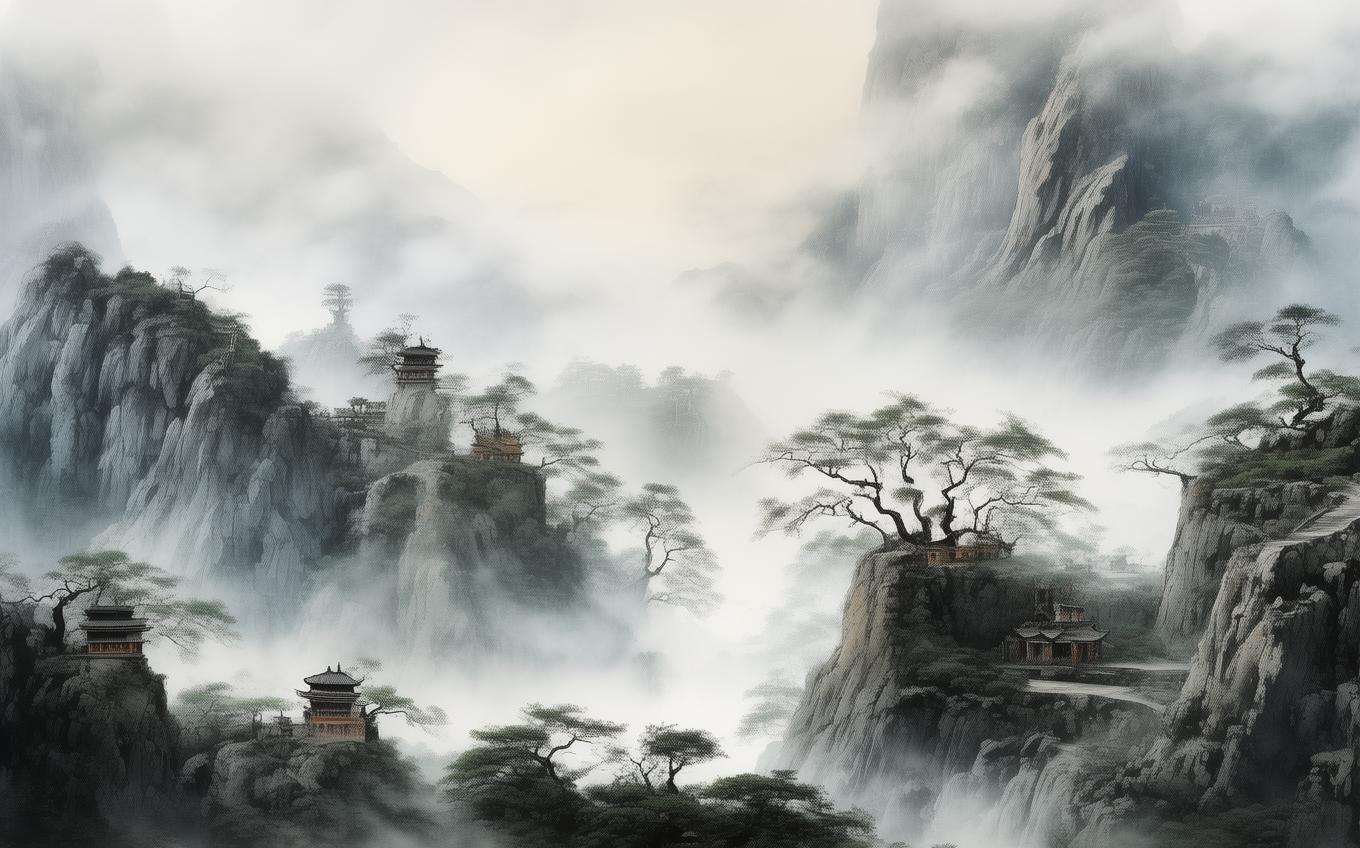
The poem opens with a sweeping view of the Yellow River as it twists violently around the great bend at Tong Pass. The character 回 (huí) means “to turn back” or “meander,” suggesting a river so serpentine it seems to double back on itself. Paired with “thousand miles,” the line conveys both the vast scale of the landscape and a sense of defiant motion. The river here is not merely a scenic backdrop; it acts as a natural moat carved by nature over millennia, a colossal defensive barrier that inspires awe and a feeling of invulnerability.
Line 2: 关门限二京
The focus shifts from nature to human engineering. 关门 refers specifically to the fortified gate of Tong Pass. 限 (xiàn) means “to restrict,” “to demarcate,” or “to serve as a boundary.” The two capitals are Chang’an (长安, modern Xi’an) in the west and Luoyang (洛阳) in the east – the twin political and cultural hearts of the Tang Empire. Tong Pass sits precisely at the throat of the narrow corridor linking them, controlling all east-west movement. By declaring that the pass “restricts” the two capitals, the emperor underscores its role as a hinge on which the empire’s security balances.
Line 3: 所嗟非恃德
At this midpoint, the tone shifts from description to reflection. 所嗟 (suǒ jiē) means “that which I sigh about” – a personal, rueful exclamation. The line builds a subtle contrast: the poet-emperor acknowledges that safety should ideally rest on 恃德 (shì dé), “relying on virtue.” In Confucian statecraft, a ruler’s moral power (dé) is the ultimate guarantee of order; walls are secondary. By saying “what I sigh over is not that we rely on virtue,” Xuanzong implies that the very need to discuss military fortifications is a sign that virtue alone feels insufficient.
Line 4: 设险到天平
The final line delivers the punch. 设险 (shè xiǎn) means “to establish defiles” or “to set up strategic barriers.” The emperor points to the continuous effort to fortify passes and citadels right up to 天平 (tiān píng), “heavenly peace” or “the equilibrium of Heaven.” On one level, this is an expression of imperial ambition: the Tang will use every geographical advantage to achieve a reign of perfect stability. Yet the word 到 (“reaching all the way to”) carries a faint weariness. It suggests an unending chain of fortifications, a reliance on physical might that stretches even into the realm of heaven itself – a realm where virtue, not stone, should rule. The poem ends without a neat resolution, leaving the tension between military pragmatism and moral governance hanging in the air.
Themes and Symbolism
Virtue vs. Fortification
The central theme is the classic Confucian dilemma: should a state secure itself through the ruler’s moral authority (dé) or through physical defenses? Emperor Xuanzong’s sigh acknowledges the ideal while confessing the reality – the empire has chosen the path of walls. This tension was deeply personal; as sovereign, he bore ultimate responsibility for both the empire’s spiritual and military health.
Strategic Geography as Symbol of Imperial Power
Tong Pass is not just a place; it’s a symbol of control, centrality, and the knife-edge between peace and chaos. The Yellow River’s “thousand-mile” bend and the pass “restricting two capitals” map imperial authority onto the very terrain, as if nature itself endorses Tang rule. The symbolism carries a warning: to take that geography for granted is to court disaster.
Irony and Foreshadowing
Although Xuanzong could not have known it, the poem became tragically prophetic. In 756 CE, during the An Lushan Rebellion, the Tang general Geshu Han was ordered to abandon the strong defensive position at Tong Pass and engage the rebels in open battle – a fatal decision. The pass fell, Chang’an was occupied, and the emperor fled to Sichuan. The “strategic defiles” built for “heavenly peace” proved useless when leadership and virtue failed. This historical echo gives the poem a haunting afterlife.
Cultural Context
Emperor Xuanzong composed 潼关口号 in the eleventh year of the Kaiyuan era (723), a golden age of Chinese civilization. The Tang Empire stretched from the Pamirs to the Korean peninsula; its capital Chang’an was the largest and most cosmopolitan city on earth. In such a confident climate, an imperial poem about frontier defenses could be read as a boast of consolidated power. Yet the poem also reflects deep-seated anxieties inherited from earlier dynasties. Chinese political thought, shaped by the Confucian classic Mencius, had long warned that “the right time is not as good as the advantageous terrain, and the advantageous terrain is not as good as the harmony among people.” Xuanzong’s emphasis on terrain over virtue can be seen as a subtle self-critique – a ruler admitting that human solidarity is harder to achieve than building walls.
Tong Pass itself had been a strategic fulcrum since the Han dynasty, guarding the fertile Wei River valley. For the Tang, it was the eastern shield of the capital region. The poem’s terminology – 关门 (pass gate), 限 (restrict), 设险 (establish defiles) – all belong to the vocabulary of military geography, but by placing them in a lyric poem, Xuanzong elevates the language of statecraft into art. This fusion of the political and the poetic is characteristic of Tang literary culture, where many emperors and high officials were accomplished poets.
Conclusion
潼关口号 packs an entire state philosophy into twenty Chinese characters. Its stark images of the twisting Yellow River and the stone gate dividing two capitals are easy to visualize; its sigh over virtue versus fortification rings across the centuries. For modern readers, the poem is more than a travel note by a medieval emperor. It is a meditation on the limits of military power, the fragility of empires, and the timeless truth that walls – however majestic – can never replace righteousness. In an age where “heavenly peace” remains a universal aspiration, Xuanzong’s quiet, uneasy quatrain still invites us to ask whether our own defenses are anchored in the right things.
Comments (0)
No comments yet. Be the first to comment!