Introduction
The Tang dynasty (618–907) is often celebrated as the golden age of Chinese poetry, and no poet embodies its romantic spirit more than Li Bai (701–762). Known for his love of wine, moonlight, and the natural world, Li Bai’s verses frequently merge human emotion with cosmic wonder. The poem 过大哥山池题石壁 (Guò Dàgē Shān Chí Tí Shíbì)—roughly “Inscribing on a Stone Wall at Big Brother Mountain’s Pool”—is a short, dream-like quatrain that captures his longing to transcend the mundane. Likely composed during one of his many wanderings, the poem transforms a simple visit to a mountain pool into a glimpse of a hidden immortal realm. For English readers, it offers a perfect window into the Taoist-infused imagination that makes Li Bai a timeless figure in world literature.
The Poem: Full Text and Translation
大哥山前池水绿,
Dà gē shān qián chí shuǐ lǜ,
Before Big Brother Mountain, the pool water rests in vivid green;
天女来浴春风香。
Tiān nǚ lái yù chūn fēng xiāng.
A heavenly maiden comes to bathe, the spring breeze steeped in scent.
君王欲问花源事,
Jūn wáng yù wèn huā yuán shì,
The king would ask about the flowered fountain’s mystery—
云里仙舟望渺茫。
Yún lǐ xiān zhōu wàng miǎo máng.
Beyond the clouds, an immortal boat fades into vastness, dim and distant.
Line-by-Line Analysis
Line 1: 大哥山前池水绿
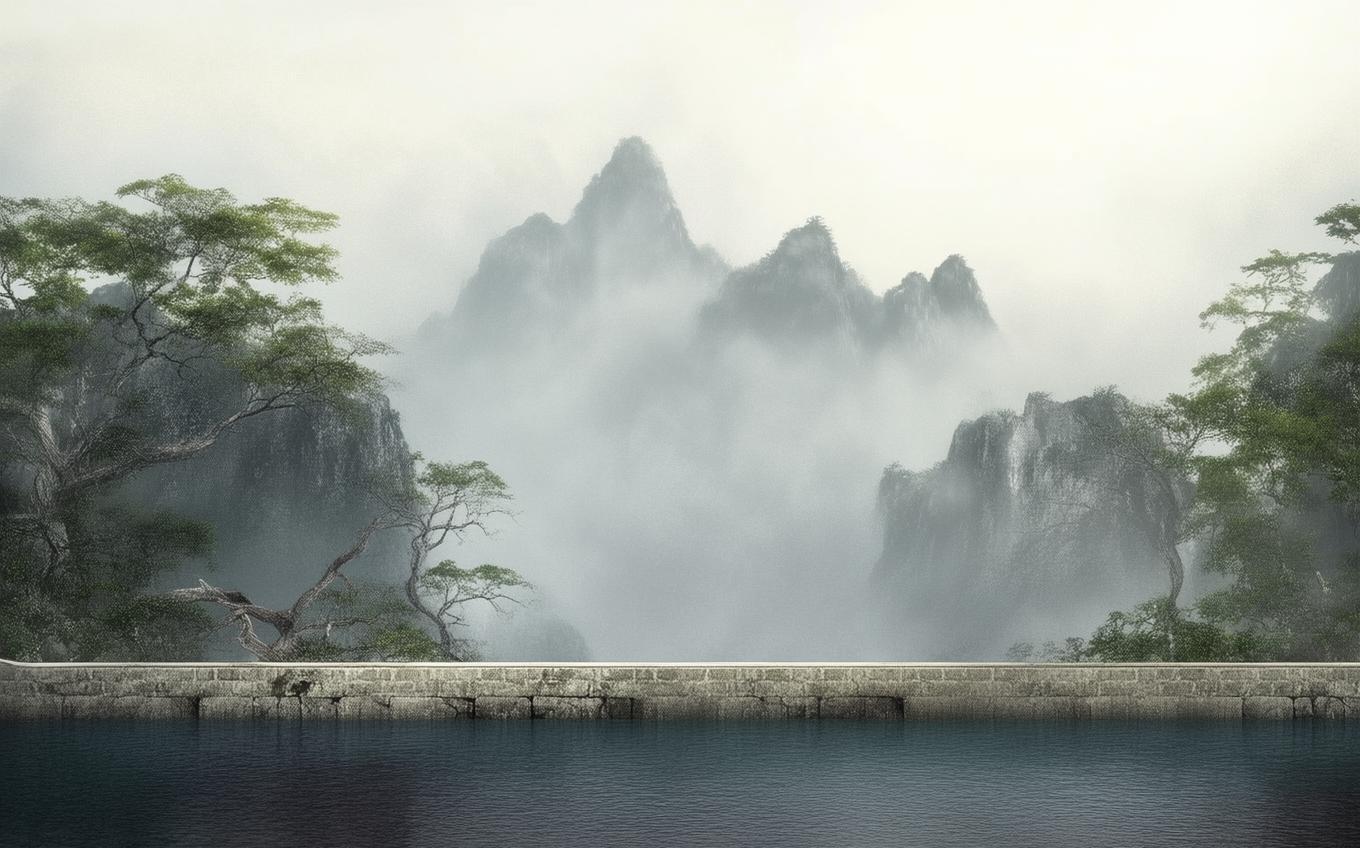
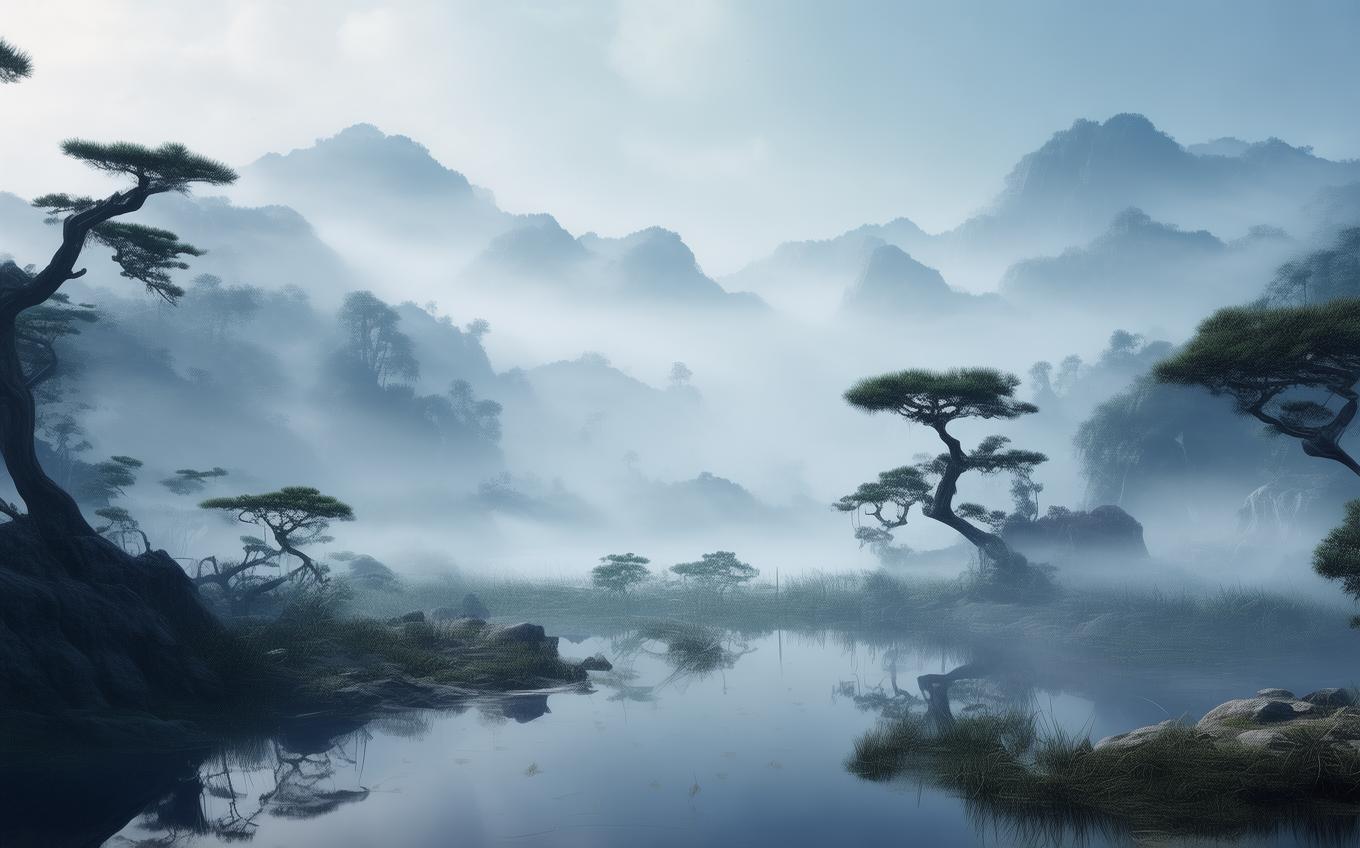
The poem opens with a deceptively simple image: a green pool lying at the foot of 大哥山 (Big Brother Mountain). The mountain’s name is striking—it carries a familiar, almost affectionate tone, as if Li Bai is addressing a friendly giant. The adjective 绿 (lǜ, green) does more than describe a color; in classical Chinese poetry, green water often suggests depth, purity, and a connection to the unseen world. The stable, grounded mountain contrasts with the fluid, reflective pool, setting the stage for a transformation from the physical to the mythical.
Line 2: 天女来浴春风香
Suddenly, the scene is no longer ordinary. A 天女 (tiānnǚ, heavenly maiden or celestial nymph) appears, bathing in the pool. Her arrival brings 春风香—the fragrance of spring breeze. This line collapses the boundary between reality and legend: a mountain pool becomes a goddess’s bathing place. The fragrance adds a synesthetic quality, as if the entire landscape is infused with her divine presence. Li Bai does not say he sees her; he simply states her coming as fact, inviting the reader into a shared mythic vision.
Line 3: 君王欲问花源事
Here the focus shifts to a 君王 (jūn wáng, king or sovereign), who wants to inquire about 花源 (huā yuán, the flower source). The phrase 花源 is an unmistakable allusion to 桃花源 (Táohuā Yuán, the Peach Blossom Spring), a utopian hidden paradise described by the poet Tao Yuanming, where people live in harmony, unaware of the outside world. The king’s desire to “ask about” this realm suggests he is a seeker of lost paradises, a ruler who longs for a realm beyond his own. Li Bai subtly positions himself—or the imagined traveler—as someone who knows the way, or at least yearns to find it.
Line 4: 云里仙舟望渺茫
The poem ends with a vision of an immortal boat drifting far away among the clouds. 仙舟 (xiān zhōu, immortal or fairy boat) is a classic Taoist motif: a vessel that can carry one to the islands of the immortals. 渺茫 (miǎo máng) paints a scene of boundless, misty indistinctness—the boat is visible yet utterly unreachable. The king’s question remains unanswered; instead, we are left with a fading image of transcendence, suspended between hope and the infinite. The poem, like the boat, dissolves into mystery.
Themes and Symbolism
The Quest for Immortality and Transcendence
Li Bai was deeply influenced by Taoist philosophy, which cherishes harmony with nature and the pursuit of spiritual freedom. The heavenly maiden and the immortal boat symbolize the poet’s own longing to break free from earthly limits. The act of bathing itself is purifying, a ritual of renewal that hints at a return to an original, uncorrupted state.
Nature as a Portal to the Divine
The mountain, the green pool, and the spring breeze are not just scenery—they are thresholds. In Chinese landscape poetry, mountains often serve as connectors between heaven and earth. Here, Big Brother Mountain becomes a guardian of a hidden paradise, accessible only through poetic imagination.
The Inaccessible Utopia
The reference to 花源 (Peach Blossom Spring) anchors the poem in a shared cultural dream of a lost, ideal world. The king’s unfulfilled question and the disappearing immortal boat underscore a bittersweet truth: the perfect realm can be glimpsed, but never possessed. This tension between yearning and elusiveness gives the poem its quiet power.
Cultural Context
Written during the Tang dynasty, a period of relative stability and cultural flourish, Li Bai’s poetry often reflected both the confidence of the age and a personal desire to escape its social constraints. He spent years wandering famous mountains, seeking Daoist masters, and writing poems that blended folklore, alchemical imagery, and immediate sensory delight. The motif of a mountain pool visited by a goddess echoes ancient tales like the Goddess of the Luo River, while the Peach Blossom Spring allusion ties directly to the eremitic ideal—retreating from politics into a self-contained, harmonious community. For Tang readers, such a poem was both an aesthetic pleasure and a spiritual prompt, reminding them of the limits of worldly power and the beauty of letting go.
Conclusion
“过大哥山池题石壁” is a miniature masterpiece of evocation. In just twenty-eight characters, Li Bai leads us from a quiet mountain pool to a vanishing immortal boat, weaving together sensory freshness and philosophical depth. The poem’s beauty lies in what it does not say: the king’s question hangs in the air, the maiden’s presence is fleeting, and the boat fades into the infinite. For modern readers across cultures, this poem remains a gentle invitation to pause, to look closely at the natural world, and to feel, for a moment, that the boundary between the real and the magical is as thin as mist. Li Bai reminds us that some of the most profound journeys are taken not with feet, but with the heart and the imagination.
Comments (0)
No comments yet. Be the first to comment!