Introduction
In the long and luminous history of Tang Dynasty poetry, few verses are as hauntingly personal as the short quatrain "题梅妃画真" (Tí Méi Fēi Huà Zhēn), or Inscribed on a Portrait of Consort Mei. The poem is traditionally attributed to Emperor Xuanzong (唐玄宗, Táng Xuánzōng), also known as Minghuang, one of the most celebrated and tragic figures in Chinese imperial history. Written after the catastrophic An Lushan Rebellion, it captures the aging emperor’s grief and longing for his lost beloved, Consort Mei, whose memory he tries to salvage through a painted silk portrait. The poem is a masterpiece of understated sorrow, where personal loss intertwines with the collapse of a golden age, offering English readers a poignant window into the aesthetics of memory, regret, and ephemeral beauty in Chinese culture.
The Poem: Full Text and Translation
忆昔娇妃在紫宸,
Yì xī jiāo fēi zài zǐ chén,
I recall that enchanting consort of old, dwelling in the Imperial Palace,
铅华不御得天真。
Qiān huá bù yù dé tiān zhēn.
Unadorned by leaden powders, she possessed a natural, heaven-sent purity.
霜绡虽似当时态,
Shuāng xiāo suī sì dāng shí tài,
Though the frost-white silk still resembles her bearing of those days,
争奈娇波不顾人。
Zhēng nài jiāo bō bù gù rén.
Alas, those bewitching eyes no longer turn to look upon me.
Line-by-Line Analysis
Line 1: 忆昔娇妃在紫宸
The poem opens with a flash of vivid recollection: yì xī (recollecting the past) immediately establishes a tone of elegy. Jiāo fēi (enchanting consort) is a term of deep affection, stressing charm and delicacy rather than rank. Zǐ chén (Purple Imperial Palace) sets the scene within the grandeur of the Tang court, at its zenith before rebellion tore it apart. The poet does not name the consort — the title tells us it is Mei Fei, or Consort Mei — thereby making the memory more intimate and universal. The line contrasts a glorious past with the painful present, a technique common in classical Chinese nostalgia poetry.
Line 2: 铅华不御得天真
Qiān huá refers to the white lead powder used as a cosmetic foundation by noblewomen. To say she bù yù (did not apply) such artifice is the highest praise: her beauty was tiān zhēn, a natural innocence and purity granted by Heaven. This is not merely physical description; in the Confucian and Daoist-influenced aesthetic, unadorned simplicity is a moral quality. Consort Mei’s rejection of ornamentation signals a soul untainted by courtly intrigue, all the more tragic that such purity was destroyed by rebellion and jealousy (notably from the famous Yang Guifei). The emperor’s praise is thus both a lament for lost beauty and a defense of her virtue.
Line 3: 霜绡虽似当时态
Shuāng xiāo (frost-white silk) is the medium of the portrait: a fine, luminous fabric evoking coolness, fragility, and the whiteness of winter plum blossoms (Mei Fei’s namesake flower). The painting succeeds in capturing dāng shí tài, the demeanor or posture of those bygone days. The word suī (although) brings in the crucial tension — the image is faithful, yet fatally insufficient. Art can preserve a gesture, a curve of the shoulder, but it cannot restore life. The coldness of “frost” silk also mirrors the emotional chill of bereavement.
Line 4: 争奈娇波不顾人
Zhēng nài (alas, how can it be helped?) is an exclamation of helpless frustration. Jiāo bō (bewitching waves) is an exquisite synecdoche: the “charming ripples” are her eyes, those luminous orbs that once met his gaze with love and intelligence. Now they are frozen, unable to gù rén (turn and regard the person). The portrait has eyes, but they do not see; presence and absence collide in this final, devastating revelation. The emperor doesn’t just miss her appearance — he longs for the living reciprocal glance, the human recognition that even the finest art cannot provide. The line is often read as the helpless cry of an aging man facing the irreversibility of time and death.
Themes and Symbolism
The central theme is loss and the failure of art to replace life. The poem functions as an ekphrasis — a poetic meditation on a visual artwork — but it does not celebrate the painting’s success; instead, it underscores its ultimate failure. The portrait is a beautiful shell, as cold and lifeless as the white silk it is painted on.
Natural purity vs. Artifice: The phrase qiān huá bù yù dé tiān zhēn sets up a moral-aesthetic contrast. Cosmetics, like political scheming, are a layer of falseness. Consort Mei’s natural grace aligns her with Daoist ideals of spontaneous authenticity (ziran), and her loss is also the loss of that uncorrupted ideal within the court.
The gaze and the void: The “bewitching waves” of her eyes become the poem’s focus because in Chinese thought, the eyes express the spirit (shen). The portrait’s inability to return the gaze symbolizes death’s finality. This theme resonates with the broader Tang aesthetic of wu gan (object-induced emotion), where a physical thing triggers a profound melancholic introspection.
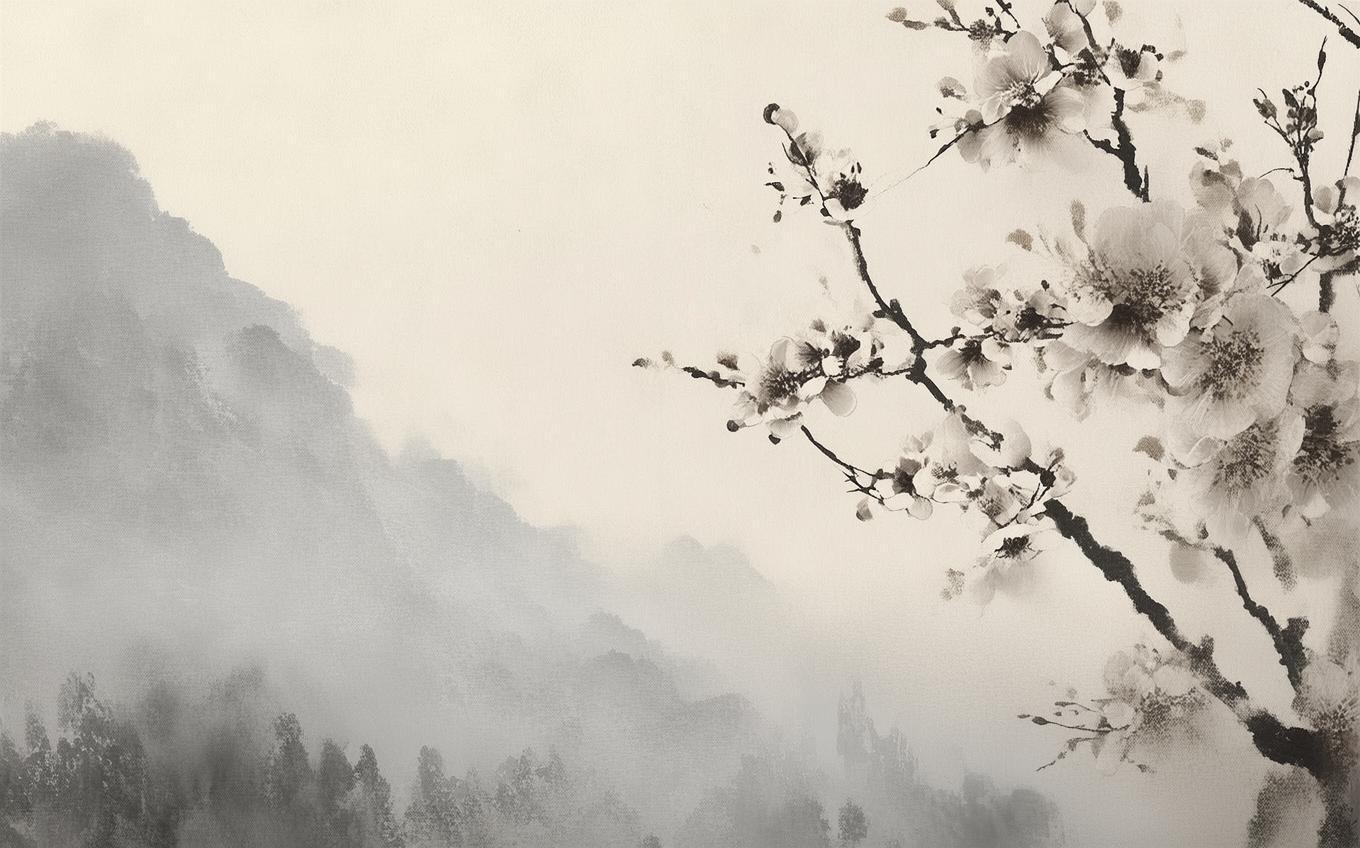
Plum blossoms: Although plum blossoms are not directly mentioned in the poem, they are present in the title and cultural memory. Consort Mei loved plum blossoms, and the emperor planted them for her. The white silk (shuāng xiāo) and her unadorned purity both evoke the winter plum — delicate, resilient, and blooming alone in the cold, a symbol of noble reclusion and untimely death.
Cultural Context
Consort Mei, born Jiang Caiping, was a cultured and intelligent woman who became Emperor Xuanzong’s favorite before the arrival of Yang Guifei. Jealousy between the two consorts is legendary. When the An Lushan Rebellion (755–763 CE) forced the court to flee, Consort Mei was left behind in the fallen capital and died, possibly murdered. Yang Guifei, who accompanied the emperor, was soon after strangled by mutinous troops. Xuanzong returned to an empty palace, a figure of immense tragedy, his glorious reign shattered.
“题梅妃画真” is traditionally believed to have been inscribed by the emperor himself upon commissioning a portrait of Consort Mei after the rebellion. In Chinese literature, the poem is admired for its raw emotional honesty: an emperor, the Son of Heaven, reduced to a lonely old man speaking to a silent picture. This moment humanizes the ruler and embodies the Confucian tension between public duty and private grief. It also reflects the Tang Dynasty’s keen awareness of the transience of power and beauty — a central theme in much of its greatest poetry.
Conclusion
“题梅妃画真” endures because it transforms a deeply private moment of mourning into a universal meditation on memory and mortality. In four lines of exquisitely restrained language, it captures the chasm between representation and reality, and the piercing ache of a glance that will never be returned. For modern readers, whether familiar with Chinese history or not, the poem’s power lies in its stark simplicity: we all know what it is to revisit a portrait of a lost loved one and feel that shattering silence. Emperor Xuanzong’s lament, written onto frosty silk over twelve hundred years ago, remains a mirror in which we glimpse our own capacity for love, loss, and the yearning for one more look backward from those bewitching eyes.
Comments (0)
No comments yet. Be the first to comment!