Introduction
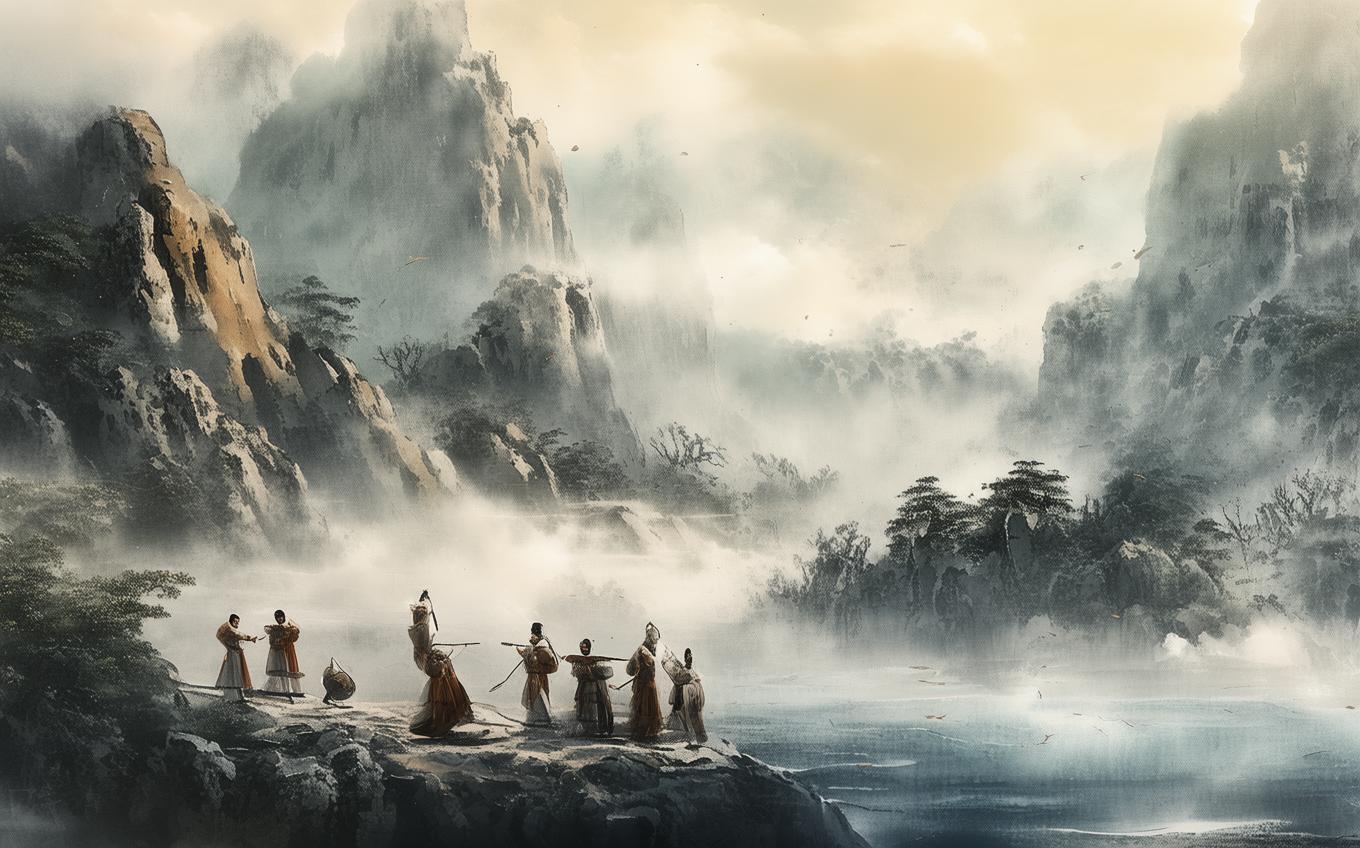
"鼓吹曲辞 鼓吹铙歌 奔鲸沛" (Gǔchuī Qǔcí, Gǔchuī Náogē, Bēn Jīng Pèi) belongs to the great tradition of early Chinese court and military song. Rather than being a personal lyric by a single famous poet such as Li Bai or Du Fu, it is part of the Yuefu (Yuèfǔ) heritage—the body of songs collected, preserved, and sometimes reshaped by official music institutions. "鼓吹" refers to ceremonial wind-and-drum performance, and "铙歌" refers to martial songs performed in state or military settings. The title "奔鲸沛" suggests overwhelming force, often likened to the surging of a gigantic whale through water.
This poem is significant because it preserves the grand, public voice of early Chinese poetry. Unlike intimate lyric poems about private sorrow or friendship, this kind of composition celebrates collective power, imperial authority, military action, and cosmic-scale energy. For English-speaking readers, it offers a valuable glimpse into how poetry in early China could function not just as literature, but also as ritual, political performance, and sound.
The Poem: Full Text and Translation
Because early Yuefu texts sometimes survive in variant editions, the wording of this poem may differ slightly across sources. The version below presents the received text commonly associated with "奔鲸沛".
奔鲸沛,荡海垠。
Bēn jīng pèi, dàng hǎi yín.
The rushing whale surges forth, sweeping the edges of the sea.
浮云卷,疾风振。
Fú yún juǎn, jí fēng zhèn.
Floating clouds roll up; a fierce wind shakes the world.
长戟扬,猛士奋。
Cháng jǐ yáng, měng shì fèn.
Long halberds are raised high; brave warriors spring into action.
旌旗烈,金鼓震。
Jīng qí liè, jīn gǔ zhèn.
Banners blaze brightly; bronze drums and bells thunder.
威四极,清胡尘。
Wēi sì jí, qīng hú chén.
Power reaches the four ends of the earth, sweeping away frontier dust.
功既成,告明神。
Gōng jì chéng, gào míng shén.
When the achievement is complete, it is announced to the shining spirits.
Line-by-Line Analysis
The opening line, "奔鲸沛,荡海垠", is immediately majestic. The image of a whale in violent motion is not meant to be naturalistic in a modern sense; it is hyperbolic and ceremonial. The whale represents an unstoppable force, something enormous and elemental. The verb "荡" ("to sweep" or "to surge across") makes the scene feel expansive, as if military power were as irresistible as an oceanic upheaval. This is a classic feature of courtly martial poetry: human action is magnified through images drawn from nature at its most overwhelming.
The second line, "浮云卷,疾风振", shifts from sea to sky. Clouds roll and winds shake the air. This pairing creates a sense that the entire cosmos responds to the movement introduced in the first line. In Chinese poetic tradition, wind and clouds often signal political change, military momentum, or a hero’s rising force. Here they do not merely decorate the scene; they amplify the scale of the event. The poem suggests that military action is not local or ordinary—it is world-shaping.
In "长戟扬,猛士奋", the poem turns from natural imagery to human agents. The halberd (jǐ) is an iconic ancient weapon, and its appearance grounds the grandeur of the opening in the reality of warfare. The phrase "猛士奋" presents warriors not as individuals with personal stories, but as embodiments of courage and disciplined energy. This is not introspective poetry. It is public poetry, designed to stir resolve, inspire awe, and display organized strength.
The fourth line, "旌旗烈,金鼓震", is especially theatrical. Banners, drums, and metal percussion are central to ancient Chinese military display. They serve practical purposes in command and coordination, but in poetry they also represent the visible and audible order of the state. The banners "blaze," while the drums "shake" the surroundings. The army is not chaotic; it is splendid, rhythmic, and charged with legitimacy. The line helps us imagine not just a battle, but a ceremonial performance of power.
The fifth line, "威四极,清胡尘", makes the political meaning explicit. "四极" means the four extremities of the world—a traditional way of saying "everywhere." The phrase "胡尘" literally means "barbarian dust," an expression often used in older Chinese texts for border threats or non-Han enemies from the frontiers. For modern readers, this term should be understood historically rather than adopted uncritically; it reflects the worldview and political language of the period. In the poem, this line celebrates the restoration of order through military success.
The final line, "功既成,告明神", moves from battle to ritual conclusion. Victory is not purely human. Once success is achieved, it is reported to the spirits or divine powers. This reflects an important aspect of early Chinese political culture: military action, kingship, and cosmic legitimacy were closely linked. Triumph becomes complete only when acknowledged within a sacred order. The poem thus ends not with private grief or reflection, but with formal completion and reverence.
Themes and Symbolism
One major theme of the poem is overwhelming force. The rushing whale, rolling clouds, violent wind, raised halberds, and resounding drums all contribute to an atmosphere of irresistible momentum. The poem celebrates not just victory, but the energy of mobilization itself.
A second theme is state power and collective action. No individual speaker steps forward to express personal emotion. Instead, the poem presents an organized public world in which soldiers, banners, weapons, music, and ritual all work together. This is typical of martial Yuefu poetry, where collective identity matters more than individual psychology.
A third theme is the union of nature, politics, and ritual. The whale and sea, clouds and wind, battlefield display, and final offering to the spirits all suggest that political authority in early China was imagined in cosmic terms. Success in war reflects not only human strength but also alignment with a larger moral and sacred order.
The central symbols are powerful and clear. The whale symbolizes vast, unstoppable force. Clouds and wind symbolize change, movement, and the stirring of destiny. Halberds, banners, and drums symbolize disciplined military order. The spirits at the end symbolize legitimacy beyond mere force—the idea that power must be ritually affirmed.
Cultural Context
This poem emerges from the world of Yuefu and court performance, where poetry was closely connected to music, ceremony, and government. In ancient China, poems were not always silent texts for solitary reading. Many were sung, chanted, or performed in highly structured settings. A title such as "鼓吹铙歌" points us to that performative background: drums, wind instruments, metal percussion, and martial rhythm.
Historically, such poems reflect a period when imperial rule depended heavily on military strength, frontier campaigns, and the symbolic display of order. The state needed language that could glorify action, unify listeners, and place warfare within a framework of legitimacy. This kind of poem answered that need.
Culturally, the poem also reflects important Chinese values. One is the importance of order over chaos: banners align troops, drums regulate movement, victory clears threatening "dust," and ritual completes political action. Another is the belief that human affairs should correspond to a larger cosmic structure. The poem does not treat war as random violence; it presents it as purposeful, sanctioned, and integrated into a moral universe.
For modern readers, this may feel very different from later Tang poetry, where poets often dwell on loneliness, exile, friendship, moonlight, or the sorrow of war. In contrast, "奔鲸沛" belongs to an earlier and more ceremonial mode. Its purpose is not introspection but proclamation.
Conclusion
"鼓吹曲辞 鼓吹铙歌 奔鲸沛" is a striking example of how ancient Chinese poetry could be grand, public, and ritualized. Its language is compressed, but its imagery is vast: whale, sea, wind, clouds, weapons, banners, drums, and spirits all combine to create a vision of military power on a cosmic scale.
Its enduring appeal lies in that intensity. Even today, readers can feel the force of its movement and sound, and can see how poetry in early China was deeply bound to ceremony, politics, and collective identity. The poem reminds us that literature is not always private confession; sometimes it is a voice of a civilization declaring its order, power, and place in the universe.
Comments (0)
No comments yet. Be the first to comment!