Introduction
The phrase “留客住” (liú kè zhù) means “to ask a guest to stay.” In classical Chinese poetry, this idea often appears not as a direct command, but through landscape, atmosphere, and emotional suggestion. One of the best-known poems connected with this theme is 《山中留客》 (Shān Zhōng Liú Kè, “Detaining a Guest in the Mountains”) by 张旭 (Zhāng Xù), a Tang dynasty poet and calligrapher.
Zhang Xu lived during the flourishing age of the Tang dynasty, a period often regarded as the golden age of Chinese poetry. He is especially famous for his wild cursive calligraphy, but his poems also show a vivid sensitivity to natural scenes. 《山中留客》 is brief, elegant, and memorable. It uses spring mountain scenery to persuade a guest not to leave too soon, revealing a deeply Chinese way of expressing feeling through nature.
The Poem: Full Text and Translation
山光物态弄春晖
Shān guāng wù tài nòng chūn huī
The mountain light and forms of things play with the spring radiance.
莫为轻阴便拟归
Mò wèi qīng yīn biàn nǐ guī
Do not plan to leave just because of a little passing cloud.
纵使晴明无雨色
Zòng shǐ qíng míng wú yǔ sè
Even if the sky is clear and bright, with no sign of rain,
入云深处亦沾衣
Rù yún shēn chù yì zhān yī
once you enter the depths of the clouds, your clothes will still be dampened.
Line-by-Line Analysis
The first line, “山光物态弄春晖”, presents the mountain world as alive and playful. 山光 means the light of the mountains, while 物态 refers to the shapes, appearances, and living forms of things. The verb 弄 can mean “to play with” or “to toy with,” giving the scene a sense of movement and delight. Spring sunlight is not merely shining; it is being enjoyed by the landscape itself.
This opening line creates an atmosphere of charm. The speaker wants the guest to notice that the mountain is not dull or gloomy. It is full of shifting light, color, and vitality. The poem begins with beauty rather than argument.
The second line, “莫为轻阴便拟归”, turns directly to the guest. 莫 means “do not,” and 轻阴 means a light shade or thin cloud cover. The speaker says: do not think of going home just because the sky has become slightly overcast.
This line captures a subtle social moment. The guest may be worried that clouds mean rain, and rain would make travel difficult. But the host gently resists this practical concern. The tone is not forceful. It is friendly, persuasive, and intimate.
The third line, “纵使晴明无雨色”, introduces a surprising turn. The speaker says that even if the weather were perfectly clear, with no sign of rain, the guest would still not remain completely dry. At first, this sounds like a contradiction. If there is no rain, why would one’s clothes become wet?
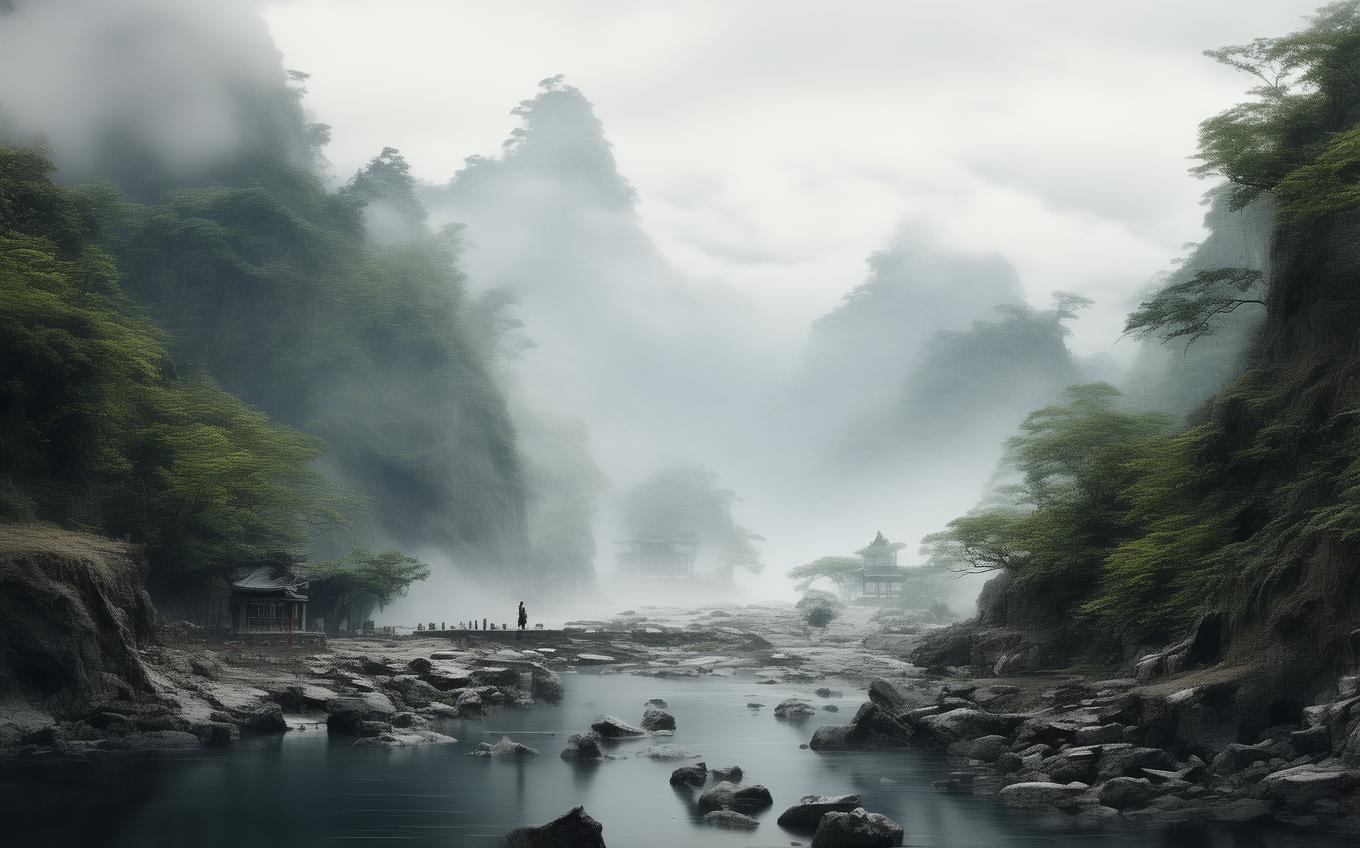
The answer comes in the final line: “入云深处亦沾衣.” In the deep mountains, mist and clouds gather. A traveler entering the cloud-filled heights will be dampened even without rainfall. The line suggests a real mountain experience: in high, misty places, the boundary between cloud, fog, and rain becomes uncertain.
But the meaning is more than meteorological. The speaker is saying: do not use the weather as a reason to leave, because the mountain has its own conditions. Dampness is part of its beauty. To enter the mountains is to accept a different world, one where ordinary distinctions such as clear and rainy become less important.
Themes and Symbolism
One major theme of the poem is hospitality. The title 《山中留客》 tells us that the speaker is trying to keep a guest from leaving. Yet the poem does not say, “Please stay because I want your company.” Instead, the speaker uses the mountain landscape itself as the reason to remain. This indirectness is typical of classical Chinese poetry, where emotion is often expressed through scenery.
Another important theme is the charm of nature. The spring mountains are not passive background. They are active, playful, and enveloping. The light, clouds, mist, and damp air create a living environment that invites the guest to linger.
The poem also explores the uncertainty of appearances. A light cloud may not mean rain; a clear sky may still lead to damp clothes. The natural world cannot be reduced to simple signs. This reflects a broader Chinese poetic sensibility: nature is subtle, changing, and often wiser than human plans.
The key symbol is cloud. In Chinese literature, clouds often suggest distance, mystery, spiritual depth, and the realm of mountains. Here, clouds are both physical and emotional. They make the mountain seem deep and alluring, but they also blur the guest’s excuse for leaving. To enter the clouds is to enter a richer, less predictable world.
Cultural Context
During the Tang dynasty, mountain landscapes held great cultural significance. Mountains were associated with retreat, contemplation, Daoist immortals, Buddhist monasteries, and freedom from official life. To visit the mountains was not only to enjoy scenery, but also to step away from the dust and pressure of the human world.
Hospitality was also an important value in traditional Chinese culture. Friends, guests, and fellow scholars often gathered to drink wine, write poetry, view landscapes, and enjoy conversation. A poem about asking a guest to stay could therefore carry emotional warmth without becoming sentimental.
The poem also reflects ideas close to Daoist philosophy. Daoism values naturalness, spontaneity, and harmony with the rhythms of the world. In 《山中留客》, the speaker does not try to control nature or deny its mist and dampness. Instead, he invites the guest to experience it as it is. The mountain’s clouds are not an inconvenience; they are part of the mountain’s truth.
At the same time, the poem shows the refined social art of classical Chinese expression. Rather than directly stating his personal wish, the host lets nature speak for him. The result is graceful and tactful. The guest is persuaded not by pressure, but by beauty.
Conclusion
《山中留客》 is a small poem with a spacious feeling. In only four lines, Zhang Xu gives us spring light, mountain clouds, a hesitant guest, and a host’s gentle wish for companionship. The poem’s beauty lies in its indirectness: the emotion of “please stay” is transformed into a meditation on weather, scenery, and the mysterious depth of the mountains.
The enduring appeal of the poem comes from its quiet wisdom. It reminds us that beauty often begins where certainty ends. A cloudy sky is not necessarily a reason to leave; sometimes it is an invitation to go deeper. In that sense, “留客住” is not only about keeping a guest for one more night. It is about asking someone to remain present long enough to experience the subtle richness of the world.

Comments (0)
No comments yet. Be the first to comment!