Introduction
“思归乐” (Sī Guī Lè, “A Song of Longing to Return”) is an old Yuefu-style title, associated with songs of homesickness, separation, and the desire to return to a beloved place or person. The poem discussed here is commonly attributed to the late Tang poet Wen Tingyun (温庭筠, Wēn Tíngyún, ca. 812–866), one of the most refined writers of lyrical and emotionally suggestive poetry in Chinese literary history.
Wen Tingyun lived during the late Tang dynasty, a period marked by political decline, social instability, and a growing taste for delicate, ornate, and emotionally intense poetry. He is especially famous for his influence on the development of ci poetry, a later lyric form closely connected with music and song.
This short poem is significant because it captures, in only four lines, a deeply Chinese poetic mood: longing that cannot be openly fulfilled, emotional distance measured not only by geography but also by dreams, moonlight, tears, and fading beauty.
The Poem: Full Text and Translation
泪滴珠难尽,
Lèi dī zhū nán jìn,
Tears fall like pearls, impossible to exhaust.
容残玉易销。
Róng cán yù yì xiāo.
Beauty fades; like jade, it is easily worn away.
倘随明月去,
Tǎng suí míng yuè qù,
If only I could follow the bright moon and go,
莫道梦魂遥。
Mò dào mèng hún yáo.
Do not say my dreaming soul is far away.
Line-by-Line Analysis
泪滴珠难尽
Lèi dī zhū nán jìn
“Tears fall like pearls, impossible to exhaust.”
The poem begins with tears. In classical Chinese poetry, tears are often compared to pearls because they are round, shining, and precious. But this comparison also creates emotional tension: pearls are beautiful, yet here they are produced by suffering.
The phrase 难尽 (nán jìn, “hard to exhaust” or “impossible to finish”) suggests that grief is not temporary. The speaker’s sorrow is continuous, as if the tears will never run dry. This is not a loud cry of despair; it is a quiet, endless weeping.
In Chinese poetic tradition, such restraint often makes the emotion stronger. The poet does not say directly, “I am heartbroken.” Instead, he lets the image of pearl-like tears reveal the depth of feeling.
容残玉易销
Róng cán yù yì xiāo
“Beauty fades; like jade, it is easily worn away.”
The second line turns from tears to physical appearance. 容 (róng) means face, appearance, or beauty. 残 (cán) means damaged, ruined, or withered. The speaker’s beauty is fading under the pressure of longing.
The comparison to jade is culturally important. In China, jade is not merely a precious stone; it symbolizes purity, refinement, moral beauty, and noble character. To say that beauty is like jade suggests something valuable and delicate. Yet the poem says that even jade can be 销 (xiāo)—worn down, diminished, or dissolved.
This line deepens the sadness: longing does not only affect the heart; it changes the body. Time, separation, and sorrow leave visible traces.
倘随明月去
Tǎng suí míng yuè qù
“If only I could follow the bright moon and go,”
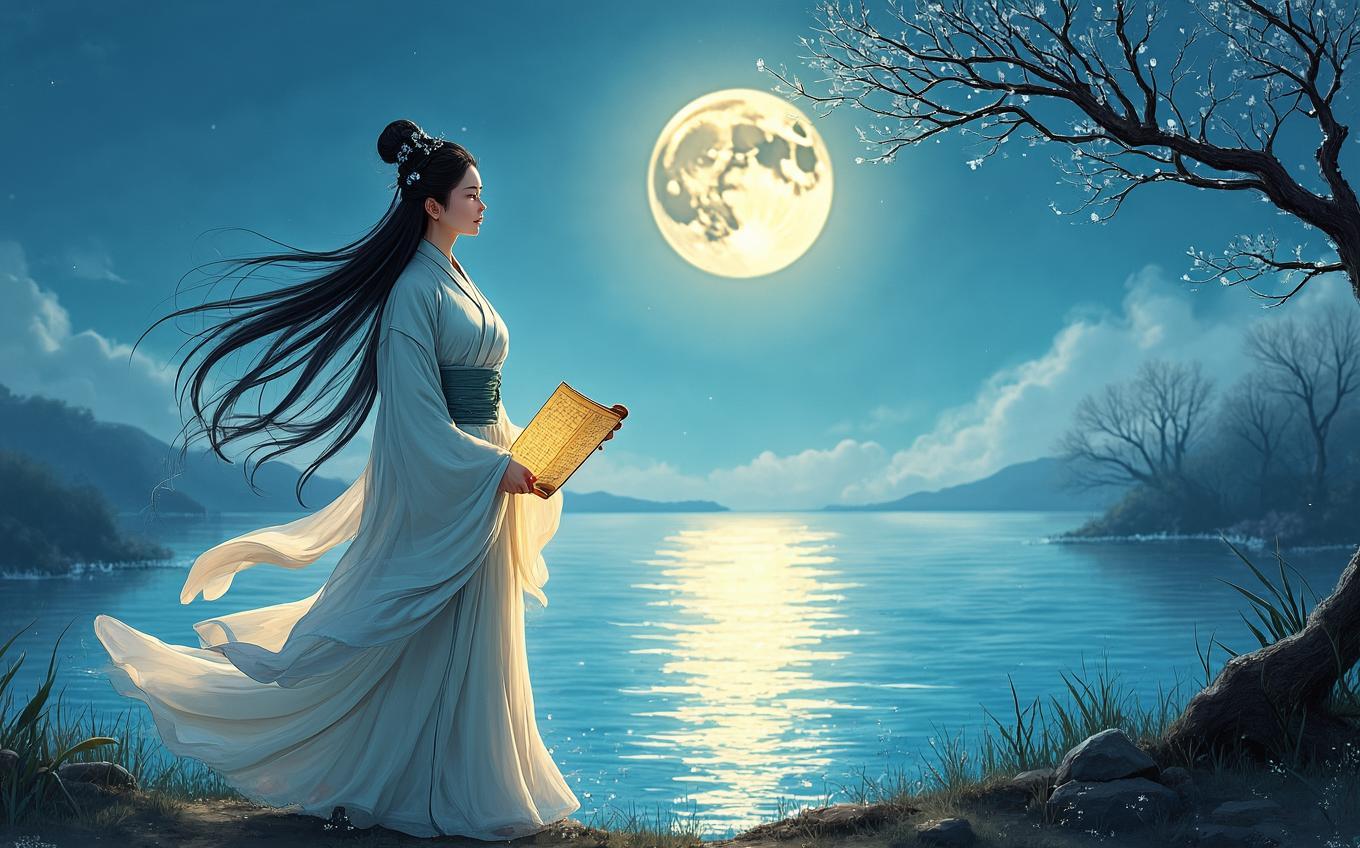
The third line introduces the moon, one of the most powerful symbols in Chinese poetry. The moon often represents distance, reunion, longing, and shared emotion. People separated by thousands of miles can still look at the same moon. Because of this, the moon becomes a bridge between lovers, friends, family members, or exiles.
The word 倘 (tǎng) means “if only” or “supposing.” It introduces a wish rather than a reality. The speaker cannot physically return, so the imagination turns to the moon. If the body cannot travel, perhaps the heart, soul, or dream can.
To “follow the bright moon” is a beautiful fantasy. Moonlight moves across mountains, rivers, borders, and rooms. It can enter places where the speaker cannot go. The moon becomes a vehicle for longing.
莫道梦魂遥
Mò dào mèng hún yáo
“Do not say my dreaming soul is far away.”
The final line completes the emotional movement of the poem. Even if the speaker is physically distant, the 梦魂 (mèng hún, “dreaming soul”) can travel. In classical Chinese literature, dreams often allow people to overcome separation. Lovers meet in dreams; homesick travelers return home in dreams; the dead and living encounter each other in dreams.
The phrase 莫道 (mò dào, “do not say”) has a gentle but firm tone. It seems to answer an imagined objection: “You are too far away.” The speaker replies: do not say that. In dreams, the soul is not bound by distance.
The poem ends not with actual reunion, but with spiritual nearness. This is typical of much classical Chinese poetry: fulfillment remains uncertain, but feeling itself becomes powerful enough to cross space.
Themes and Symbolism
Longing for Return
The title 思归乐 means something like “Song of Longing to Return.” The word 归 (guī) can mean returning home, returning to a loved one, or returning to one’s proper place in the world. In Chinese poetry, “return” is often emotional as much as geographical.
Here, the speaker longs to go somewhere—or to someone—but cannot. The poem’s power comes from that impossibility.
The Fragility of Beauty
The line 容残玉易销 connects emotional pain with the fading of beauty. This is common in poems written in a feminine voice, especially in palace poetry or love lyrics. A woman waits, weeps, and grows thin or pale through longing.
However, the image can also be read more broadly. Human life itself is fragile. Youth fades. Beauty fades. Even jade, a symbol of permanence and purity, can be worn away.
Tears as Pearls
The image of tears as pearls is both beautiful and tragic. Pearls suggest value, but here they are created by sorrow. The poem transforms suffering into art. This is one of the central achievements of classical Chinese poetry: pain becomes refined through imagery.
The Moon as a Bridge
The moon is perhaps the most important symbol in the poem. In Chinese literature, it often connects separated people. Famous poems by Li Bai, Du Fu, Su Shi, and many others use the moon as a symbol of shared longing.
In 思归乐, the moon is not only something to look at. It is something the speaker wishes to follow. It becomes a path of return.
Dream and Soul
The phrase 梦魂 suggests that the inner self can travel even when the body cannot. This reflects a poetic belief in the freedom of emotion and imagination. Physical distance matters, but dreams can overcome it.
The poem therefore moves from body to spirit: tears, fading beauty, moonlight, dream-soul. Each image becomes less physical and more ethereal.
Cultural Context
The poem belongs to the broader tradition of Yuefu poetry. Yuefu originally referred to the Music Bureau of ancient China, which collected folk songs and court music. Over time, “Yuefu” became a poetic category. Poets often wrote new works using old song titles, preserving the emotional atmosphere of earlier musical traditions.
The title 思归乐 suggests a song meant to express longing for return. Such longing was a major theme in Chinese culture because many people lived lives shaped by separation: soldiers stationed at frontiers, officials sent far from home, women waiting in inner chambers, scholars traveling for exams or government posts, and exiles longing for the capital or their native village.
In Confucian culture, home and family held deep moral meaning. To be separated from home was not only personally painful; it could feel like a disruption of one’s natural and ethical place in the world. At the same time, Daoist and Buddhist influences encouraged poets to think about the soul, dreams, impermanence, and the limits of worldly attachment.
This poem reflects all of these layers. It is a love poem, a homesickness poem, and a meditation on distance. Its emotional world is intimate, but its symbols—tears, jade, moon, dream—belong to a shared Chinese poetic language.
Conclusion
“思归乐” is a small poem with a large emotional space. In only four lines, it moves from tears to fading beauty, from moonlight to the traveling soul. Its language is delicate, but the feeling behind it is intense.
For English-speaking readers, the poem offers a window into one of the central moods of Chinese literature: longing across distance. Rather than describing emotion directly, the poet allows images to carry the feeling. Tears become pearls; beauty becomes jade; moonlight becomes a road; the dream becomes a form of return.
The poem’s enduring appeal lies in its quiet universality. Anyone who has missed a person, a home, or a lost time can understand its message: even when the body cannot return, the heart continues to travel.

Comments (0)
No comments yet. Be the first to comment!