Introduction
Yuan Lang (袁朗) was a poet of the early Tang Dynasty (618–907 CE), a period widely regarded as a golden age of Chinese poetry. Though not as famous as contemporaries like Wang Bo or Chen Zi'ang, Yuan Lang represents the refined court poetry tradition that flourished during the early Tang, when emperors frequently summoned talented scholars to compose verses at imperial banquets and gatherings. The title "秋日应诏" (Qiū Rì Yìng Zhào), meaning "Written on an Autumn Day in Response to an Imperial Command," tells us immediately that this poem was composed at the emperor's request—a common practice among court officials and literary attendants who were expected to demonstrate their poetic skill on demand.
The phrase "应诏" (yìng zhào) carries significant cultural weight: it indicates that the poet was not writing from spontaneous personal inspiration, but rather performing a formal literary duty for the imperial court. Despite this constraint, Yuan Lang's poem reveals remarkable artistry, weaving together autumn imagery, seasonal customs, and subtle praise of imperial grace into a compact eight-line regulated verse.
The Poem: Full Text and Translation
玉树凉风举,金塘细草萎。
Yù shù liáng fēng jǔ, jīn táng xì cǎo wēi.
Jade trees are lifted by the cool breeze; by the golden pond, fine grasses wither.
叶落商飙观,鸿归明月池。
Yè luò shāng biāo guān, hóng guī míng yuè chí.
Leaves fall at the Shangbiao Observatory; wild geese return to the Bright Moon Pond.
迎寒桂酒熟,含露菊花垂。
Yíng hán guì jiǔ shú, hán lù jú huā chuí.
To welcome the cold, cassia wine has matured; chrysanthemums, holding dew, hang low.
一奉章台宴,千秋长愿斯。
Yī fèng Zhāngtái yàn, qiān qiū cháng yuàn sī.
Once attending the banquet at Zhangtai, I wish for this to endure for a thousand autumns.
Line-by-Line Analysis
Lines 1–2: The Opening Landscape
The poem opens with a pair of images that establish both beauty and decline. "玉树" (yù shù), or "jade trees," is a term that can refer to beautiful trees glistening with dew or frost, but it also carries mythological associations with the legendary jade trees of the immortal realms. The cool breeze (凉风, liáng fēng) that "lifts" these trees suggests the arrival of autumn air—invigorating yet carrying the first hint of cold. The verb "举" (jǔ, "to lift" or "to raise") gives the image a sense of upward movement, as if the breeze is awakening or elevating the trees.
The second half of the couplet introduces contrast: "金塘" (jīn táng), the "golden pond," evokes a scene of warm, shimmering beauty—perhaps reflecting autumn sunlight or surrounded by golden foliage. Yet here, the "细草" (xì cǎo), the fine or delicate grasses, are "萎" (wēi)—withering, wilting, fading. This juxtaposition of the elevated jade trees and the withering grasses captures the dual nature of autumn: it is simultaneously a season of breathtaking beauty and of inevitable decline. The "golden" pond and "jade" trees also subtly evoke the opulence of the imperial setting, reminding us that this is a court poem.
Lines 3–4: Movement and Departure
The third line introduces "商飙" (shāng biāo), a term rich with classical resonance. "商" (shāng) is one of the five traditional Chinese musical notes, associated with autumn and the west in the ancient system of correspondences. "飙" (biāo) means a violent wind or whirlwind. Thus "商飙" refers specifically to the autumn wind—the fierce, seasonal gale that strips leaves from trees. The "商飙观" (Shāngbiāo guān) is the name of an observatory or viewing platform, likely a real or imagined imperial structure where one could observe the autumn winds. The falling leaves (叶落, yè luò) here are not gentle; they are driven by the seasonal force.
The fourth line offers a counterpoint of graceful movement: "鸿归" (hóng guī)—the return of wild geese. In Chinese poetry, wild geese (鸿 or 雁) are among the most potent symbols of seasonal change, migration, and longing. Their southward flight in autumn is a recurring motif, often associated with messages, separation, and the passage of time. The "明月池" (Míngyuè chí), or "Bright Moon Pond," is another evocative location name. The image of geese returning to a moonlit pond creates a sense of homecoming and natural order, even as the leaves fall and the grasses wither. There is a quiet reassurance in this image: despite autumn's decay, the natural world follows its rhythms.
Lines 5–6: Seasonal Customs and Fragile Beauty
The fifth line shifts from landscape to human activity: "迎寒" (yíng hán) means "to welcome the cold" or "to prepare for the cold." The "桂酒" (guì jiǔ), or cassia wine, is a traditional autumn beverage made from the fragrant osmanthus (cassia) flower. In Chinese culture, osmanthus wine is associated with the Mid-Autumn Festival and with the lunar myth of the Moon Goddess Chang'e and the cassia tree on the moon. The wine "熟" (shú)—matured, ripened, ready—suggests that the season has reached its fullness, and people are preparing to face the coming winter with warmth and conviviality.
The sixth line presents one of the most delicate images in the poem: "含露菊花垂" (hán lù jú huā chuí)—chrysanthemums, holding dew, hang low. The chrysanthemum (菊花, jú huā) is the flower most closely associated with autumn in Chinese culture, symbolizing nobility, resilience, and the ability to flourish when other flowers have faded. Here, the chrysanthemums are "含露" (hán lù)—literally "containing dew" or "holding dew in their mouths"—a phrase that captures the weight of moisture on the petals. The verb "垂" (chuí, "to hang down" or "to droop") adds a note of gentle melancholy: even the resilient chrysanthemum bows under the weight of autumn's dew. This image beautifully balances admiration for the flower's beauty with an acknowledgment of the season's heaviness.
Lines 7–8: The Court Banquet and Eternal Wishes
The final couplet shifts explicitly to the occasion of the poem. "章台" (Zhāngtái) is a name with layered historical associations. Originally the name of a palace terrace from the Warring States period, "章台" later became associated with the pleasure quarters of the Han Dynasty capital Chang'an. By the Tang Dynasty, it could refer to an elegant gathering place or, more broadly, to the imperial court itself. The "章台宴" (Zhāngtái yàn) is thus a grand banquet—likely the very occasion for which this poem was composed.
The final line, "千秋长愿斯" (qiān qiū cháng yuàn sī), expresses a wish that "this" (斯, sī)—the banquet, the moment, the imperial grace—might endure for "a thousand autumns" (千秋, qiān qiū). The phrase "千秋" is a conventional expression for "forever" or "for ages to come," and it carries strong imperial connotations: emperors were often wished "千秋万岁" (qiān qiū wàn suì), "a thousand autumns and ten thousand years," as a blessing of longevity. By using this phrase, Yuan Lang skillfully combines personal sentiment with courtly flattery—he expresses both genuine appreciation for the beautiful moment and appropriate reverence for the imperial occasion.
Themes and Symbolism
The Dual Nature of Autumn
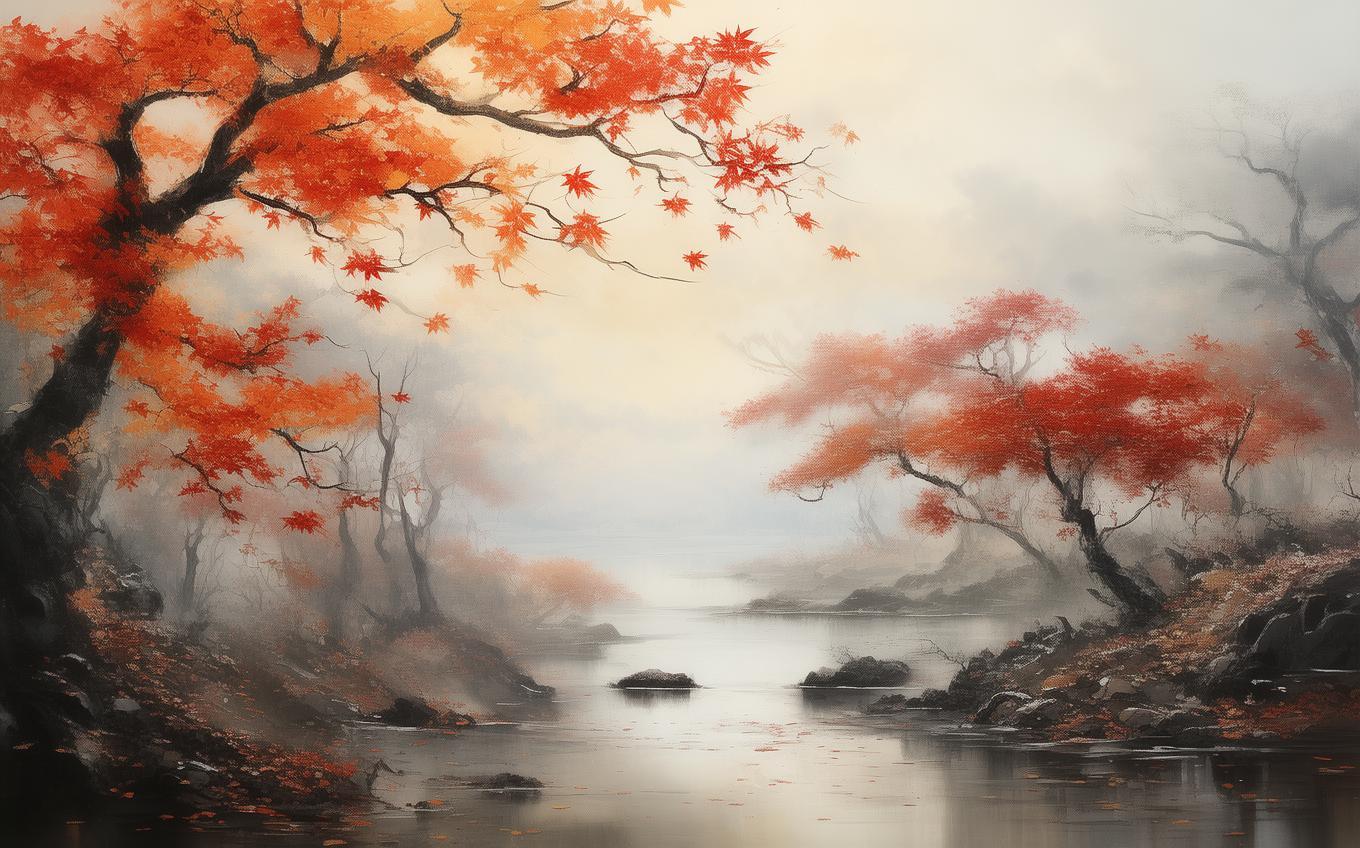
The poem's central theme is the complex, dual nature of autumn. Throughout Chinese literary tradition, autumn is simultaneously the most beautiful and the most melancholy of seasons. It is a time of golden harvests, clear skies, and fragrant flowers, but also of withering grass, falling leaves, and the inexorable approach of winter. Yuan Lang captures this duality masterfully: jade trees lifted by cool breezes stand beside withering grasses; cassia wine matures even as chrysanthemums droop under dew. This tension between beauty and decay gives the poem its emotional depth and philosophical resonance.
The Symbolism of the Wild Geese
Wild geese (鸿, hóng) are among the most richly symbolic creatures in Chinese poetry. Their annual migration southward in autumn makes them natural symbols of seasonal change, but they also represent communication across vast distances, loyalty to one's home, and the bittersweet nature of departure and return. In this poem, the geese "return" (归, guī) to the Bright Moon Pond—a word that carries connotations of homecoming and belonging. Their presence suggests that even in a season of loss, there is a natural order that brings things back to where they belong.
The Chrysanthemum: Resilience and Refinement
The chrysanthemum holds a special place in Chinese culture, particularly through its association with the great poet Tao Yuanming (陶渊明, 365–427 CE), who famously wrote about plucking chrysanthemums by the eastern fence. The flower came to symbolize the scholar-official who maintains integrity and grace even in adversity—blooming in the cold when other flowers have long since faded. In Yuan Lang's poem, the chrysanthemum "holding dew" and "hanging low" is a poignant image: it suggests that even the most resilient beauty must bow to the weight of time and circumstance, yet it does so with grace.
Cassia Wine and Seasonal Ritual
The mention of cassia wine (桂酒, guì jiǔ) connects the poem to the rich tradition of Chinese seasonal festivals and rituals. Osmanthus-scented wine was traditionally drunk during the Mid-Autumn Festival, a time for family reunions, moon-viewing, and the celebration of the harvest. The wine's "maturity" (熟, shú) suggests that the season has reached its peak—that the time is right for gathering, celebration, and the enjoyment of the fruits of the year's labor.
Cultural Context
The "应诏" (Yìng Zhào) Tradition
The practice of composing poetry "in response to imperial command" (应诏, yìng zhào) was an important institution in Chinese imperial courts, particularly during the Tang Dynasty. Emperors would often compose a poem themselves or set a topic, and court officials would be expected to respond with their own compositions. These poems served multiple purposes: they demonstrated the literary cultivation of the court, reinforced social bonds between the emperor and his officials, and created a shared cultural record of significant occasions.
Writing under such constraints required considerable skill. The poet had to produce something aesthetically pleasing and intellectually sophisticated while also fulfilling the social function of praising the imperial court and expressing loyalty. Yuan Lang's poem achieves this balance admirably—it is a beautiful meditation on autumn that also subtly honors the occasion and the imperial setting.
Autumn in Chinese Philosophy
The poem's treatment of autumn reflects deep-seated Chinese philosophical ideas about the nature of change and the cyclical patterns of existence. In Daoist thought, the changing seasons are manifestations of the Dao—the natural way of the universe. Autumn's decay is not something to be mourned but rather understood as part of an eternal cycle. The withering of grass and falling of leaves are necessary preludes to winter's rest and spring's renewal.
Confucian thought, meanwhile, emphasized the importance of proper seasonal observances and the harmony between human activity and natural rhythms. The preparation of cassia wine and the gathering for the banquet reflect this ideal of living in accordance with the seasons.
The Court Poetry Aesthetic
Yuan Lang's poem exemplifies the aesthetic values of Tang court poetry: elegance (雅, yǎ), restraint (含蓄, hánxù), and the skillful use of classical allusions. Every image in the poem is carefully chosen for its beauty and its resonance with literary tradition. The "jade trees" evoke both natural beauty and mythological splendor; the "golden pond" suggests imperial opulence; the "Shangbiao Observatory" and "Bright Moon Pond" are names that carry layers of cultural meaning. This density of allusion was highly prized in court poetry, where poets demonstrated their learning and refinement through the skillful deployment of classical references.
Conclusion
Yuan Lang's "秋日应诏" is a gem of early Tang court poetry—a poem that transforms the formal constraints of imperial command into an opportunity for genuine artistic expression. Through its eight carefully crafted lines, the poem captures the essence of autumn in all its complexity: the cool breeze that lifts the jade trees, the withering grasses by the golden pond, the falling leaves and returning geese, the matured wine and dew-laden chrysanthemums.
What makes this poem enduringly appealing is its ability to find beauty and meaning in the season of decline. Autumn, in Yuan Lang's vision, is not merely a time of loss but a time of ripeness, fulfillment, and natural order. The wild geese return home, the wine reaches maturity, and even the drooping chrysanthemum holds its dew with a kind of quiet dignity. The final wish—that the moment might endure for a thousand autumns—speaks to a universal human desire: to hold onto beauty, to preserve the fleeting moment, to wish that what is good might last forever.
For modern readers, the poem offers a window into a world where poetry was woven into the fabric of court life, where seasonal changes were occasions for reflection and celebration, and where the natural world was understood as a mirror of human experience. Its themes—the passage of time, the beauty of impermanence, the value of tradition—remain as relevant today as they were over a thousand years ago.
Sources and Verification
- Verified text and attribution: 袁朗, “秋日应诏” (Tang dynasty).
- Primary dataset: Chinese Poetry open corpus.
- Source record:
f8790539-a9ff-4935-b413-02b36e109943.
The Chinese source text and attribution are supplied from the verified record above. The English translation and commentary are educational explanations.
Comments (0)
No comments yet. Be the first to comment!