Introduction
Wei Zheng (魏征, 580–643) was one of the most respected statesmen of the early Tang dynasty. A forthright adviser to Emperor Taizong, he is remembered less as a professional poet than as a moral voice at court: the official who dared to correct the throne and who helped shape the ideal of a ruler guided by remonstrance, ritual, and concern for the people.
“奉和正日临朝应诏” belongs to a formal genre of Tang court verse. The title means a poem composed by imperial command, matching the emperor’s own composition, on the occasion of holding court on the first day of the year. It is not a private lyric of longing or landscape. It is a public act of praise, written to be heard in the same ceremonial space it describes. In Chinese literary history such poems matter because they show how classical allusion, political philosophy, and ritual spectacle were woven into a single performance. Wei Zheng uses the memory of ancient sage-kings not merely to flatter, but to set a standard: the present reign is glorious only insofar as it continues, and surpasses, the moral order of antiquity.
The Poem: Full Text and Translation
百灵侍轩后,万国会涂山。
Bǎi líng shì xuān hòu, wàn guó huì Tú shān.
A hundred spirits attended the Yellow Emperor; the myriad states assembled at Mount Tu.
岂如今睿哲,迈古独光前。
Qǐ rú jīn ruì zhé, mài gǔ dú guāng qián.
How could that equal the sagely wisdom of today, which surpasses antiquity and alone shines before all?
声教溢四海,朝宗引百川。
Shēng jiào yì sì hǎi, cháo zōng yǐn bǎi chuān.
Civilizing influence overflows the four seas; paying homage, it draws in the hundred streams.
锵洋鸣玉珮,灼烁耀金蝉。
Qiāng yáng míng yù pèi, zhuó shuò yào jīn chán.
Jade pendants ring with a clear chime; golden cicada ornaments glitter and blaze.
淑景辉雕辇,高旌扬翠烟。
Shū jǐng huī diāo niǎn, gāo jīng yáng cuì yān.
Fair sunlight gleams on the carved imperial carriage; tall banners lift a haze of kingfisher green.
庭实超王会,广乐盛钧天。
Tíng shí chāo wáng huì, guǎng yuè shèng jūn tiān.
The tribute displayed in court surpasses the Assembly of Princes; the grand music outdoes the harmonies of Heaven.
既欣东日户,复咏南风篇。
Jì xīn dōng rì hù, fù yǒng nán fēng piān.
We rejoice alike at the eastern sun upon every door, and once more chant the ode of the southern wind.
愿奉光华庆,从斯亿万年。
Yuàn fèng guāng huá qìng, cóng sī yì wàn nián.
We wish to offer this celebration of radiant glory, and from this day follow it for a hundred million years.
Line-by-Line Analysis
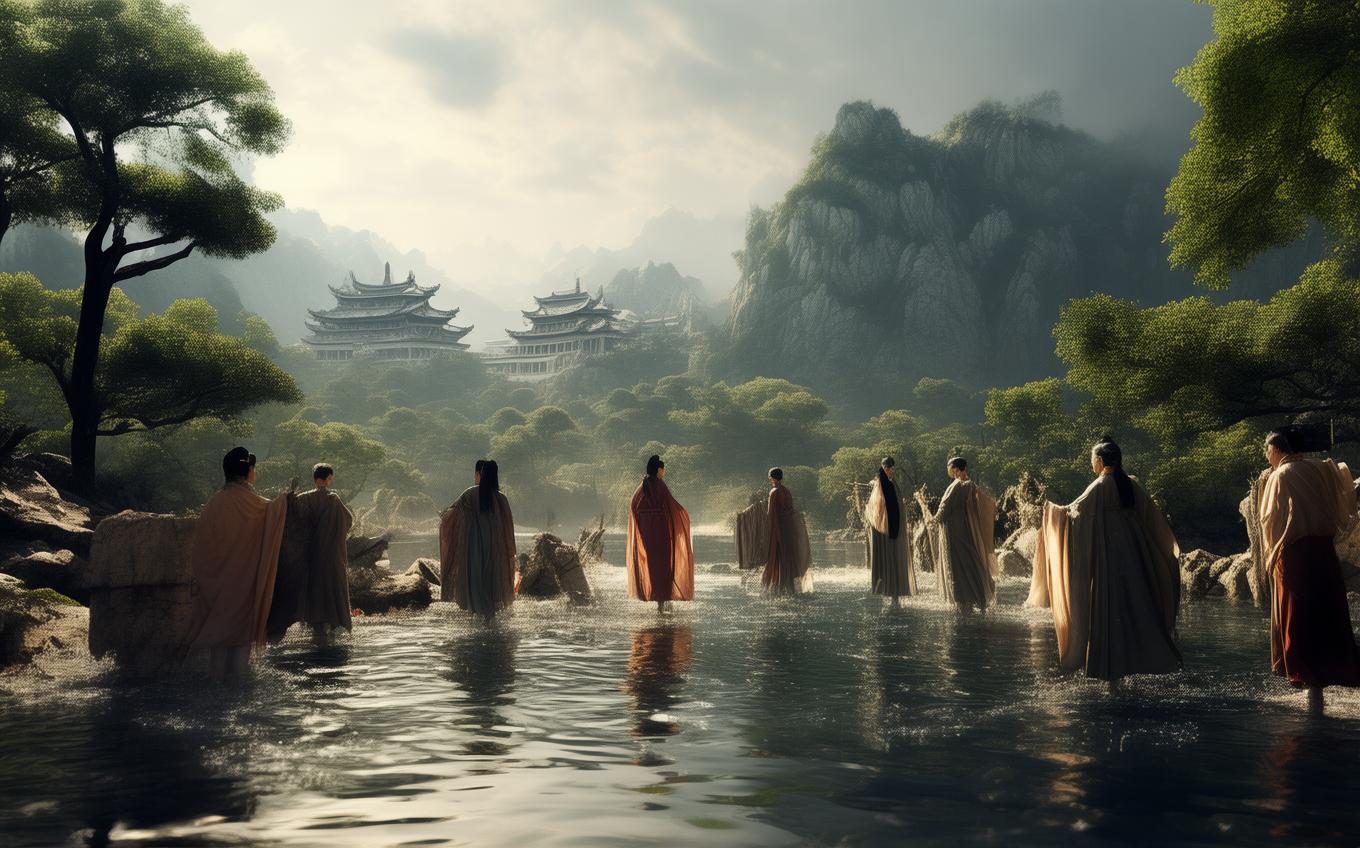
The poem opens by summoning two legendary gatherings. “A hundred spirits” waiting upon Xuanyuan, the Yellow Emperor, and “the myriad states” meeting at Mount Tu, where Yu the Great is said to have received the lords, establish the highest possible historical measure. Wei Zheng is not writing history so much as placing the New Year audience inside a genealogy of perfect order. Heavenly beings and earthly rulers alike once assembled around a sage. That memory makes the next claim sharper.
“How could that equal the sagely wisdom of today” is the poem’s turning point and its boldest gesture. Court poetry often says the present matches the past. Here the past is openly surpassed: the emperor “alone shines before all.” The word for sagely wisdom, ruizhe, is political as well as intellectual. It implies a ruler who sees clearly and governs by moral light. The hyperbole is conventional, yet in Wei Zheng’s voice it also functions as a charge. Glory is legitimate only when it is wiser than the ages it claims to outshine.
The third couplet moves from myth to the reach of government. “Civilizing influence,” shengjiao, is the Confucian idea that virtue teaches without force: reputation, ritual, and example spread farther than armies. “The four seas” means the whole known world. The second line borrows the old image of rivers returning to the sea. In classical usage, chaozong—“paying court to the ancestral source”—describes both tributaries flowing home and vassals coming to the sovereign. The hundred streams are therefore both landscape and politics. Unity is pictured as something natural, a gravity of allegiance.
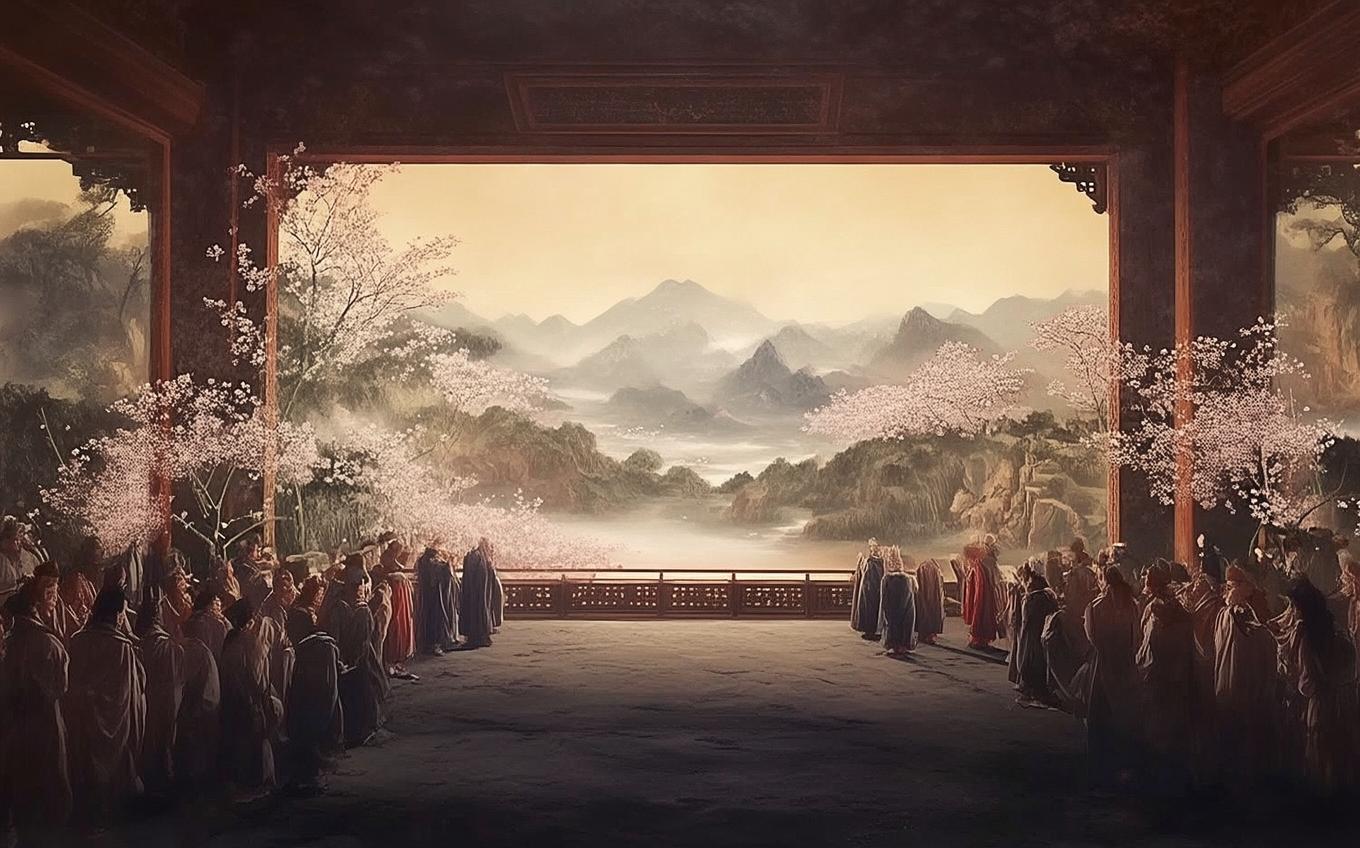
Then the poem descends from cosmic claim to the sensory facts of the audience hall. Jade pendants strike one another as officials move; the sound word qiangyang is bright, metallic, and orderly. The “golden cicada” is not a casual ornament. High ministers wore cicada decorations on their caps, so the glitter marks rank, discipline, and the presence of the advising class—the very class Wei Zheng himself embodied. Light and sound together announce a court that is both magnificent and hierarchically exact.
“Fair sunlight” on the carved carriage brings the season into the ceremony. The first day of the year is a threshold of renewal, and sunlight on the imperial conveyance makes the ruler the visible center of that renewal. Tall banners “lift a haze of kingfisher green”: color, height, and motion suggest prosperity without describing any single object too closely. The beauty is ceremonial rather than intimate. We are meant to see a state arranged for the eye of Heaven.
The sixth couplet measures the spectacle against two canonical splendors. “Tribute displayed in court” recalls the ancient Assembly of Princes, a ideal scene of lords bringing the produce of their lands. “Grand music” recalls juntian, the vast music of Heaven. To say the Tang court exceeds both is to claim that earthly ritual has become worthy of the cosmic order. The emotion is awe, but it is awe organized by precedent. Nothing here is wild or private; even excess is justified by classics.
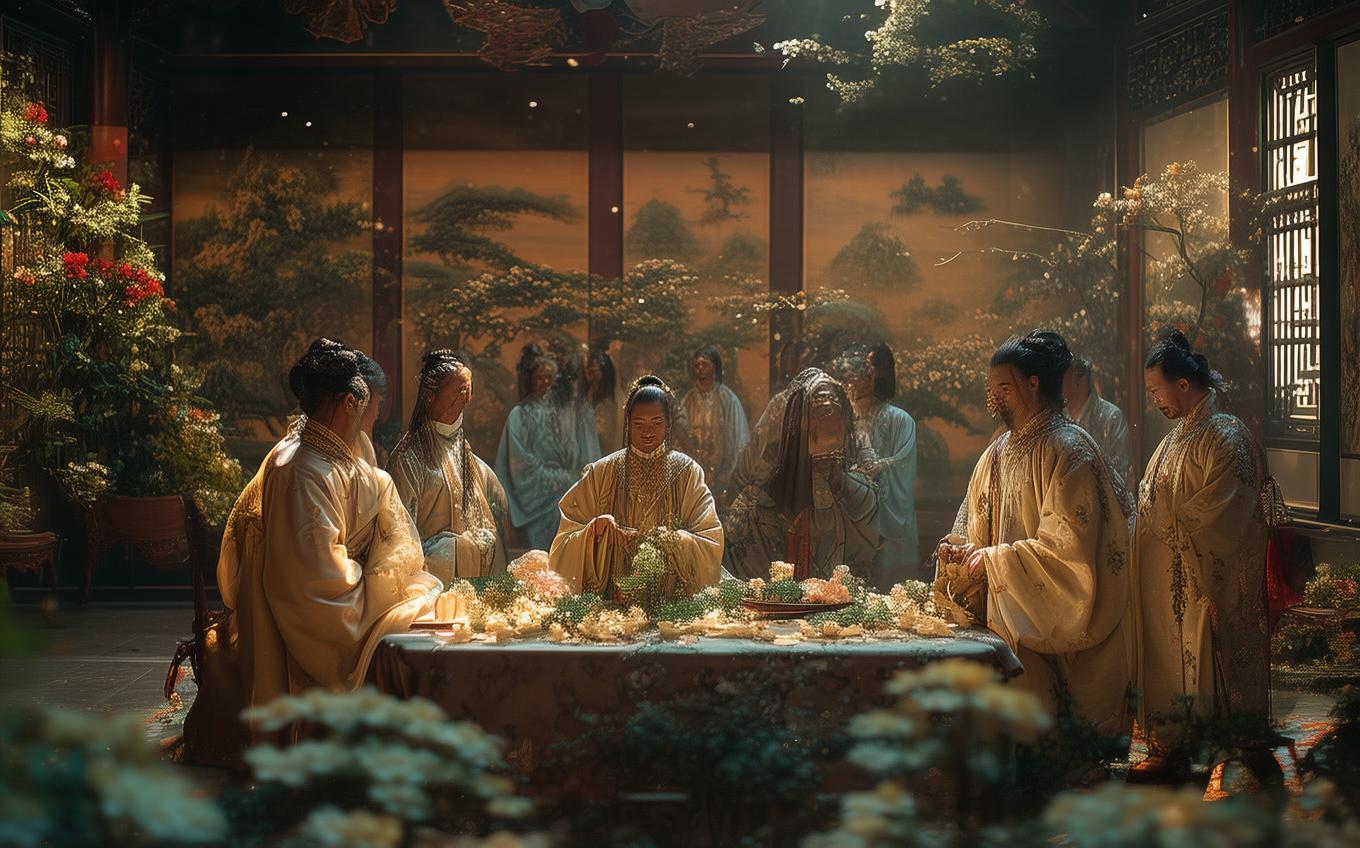
The seventh couplet turns from display to the people’s welfare, which is where Wei Zheng’s moral signature is most audible. Joy at “the eastern sun upon every door” pictures the New Year light reaching ordinary households, not stopping at the palace. The “ode of the southern wind” alludes to the song traditionally attributed to the sage-king Shun, whose warm wind was said to ease the people’s resentment and increase their wealth. Chanting it at a court feast is a reminder that pageantry is incomplete unless it recalls a ruler’s duty to relieve suffering. Praise and admonition share one line.
The close is a vow of duration. “Radiant glory” gathers sunlight, virtue, music, and imperial presence into one phrase. “A hundred million years” is not a prediction but a ritual wish: may the order inaugurated on this morning not decay. In a poem written to imperial command, the last word is loyalty. Read with Wei Zheng’s career in mind, it is loyalty offered to a standard—the continuing light of good government—rather than to splendor alone.
Themes and Symbolism
The dominant theme is rightful sovereignty. The emperor is celebrated as wiser than the Yellow Emperor and Yu, as the sea toward which all rivers run, and as the sun whose light should enter every door. Patriotism here is dynastic and moral at once: love of the realm is expressed as confidence that Tang rule restores, and improves upon, the golden ages.
A second theme is the harmony of cosmos, court, and common life. Spirits, feudal assemblies, ocean, streams, jade, banners, heavenly music, and household doors are placed on one scale. The New Year is the moment when political order and natural renewal are supposed to coincide.
Key symbols carry that argument:
- The Yellow Emperor and Mount Tu stand for the founding sages. They are the past that must be honored and then outdone.
- The four seas and the hundred streams symbolize universal assent. Geography becomes a metaphor for moral attraction.
- Jade pendants and golden cicadas symbolize an incorruptible officialdom: sound that is clear, rank that is visible, movement that is ritually controlled.
- Sunlight and the carved carriage identify the ruler with renewal and visibility. A good sovereign is not hidden; his light is public.
- The southern wind symbolizes benevolent government. It is the poem’s gentlest image, and the one most concerned with ordinary people.
- A hundred million years symbolizes continuity. The fear beneath the praise is impermanence; the wish is that virtue, not merely power, endure.
Loneliness and romantic love, common in other Chinese lyrics, are absent. The emotion is collective: awe, joy, and a formal hope that celebration will remain deserved.
Cultural Context
The poem belongs to the reign of Emperor Taizong, later idealized as the high point of the Zhenguan era, when the Tang court cultivated an image of disciplined splendor after the wars that ended the Sui. New Year’s court was not a private party. It was a ritual confirmation that the calendar, the dynasty, and Heaven’s favor were aligned. Officials attended in ranked dress; music, banners, and the display of tribute made political unity visible.
“Responding to an imperial command” was a test of learning as well as loyalty. A successful poem had to praise without abandoning classical measure. Wei Zheng meets that demand by arguing through allusion. The Assembly of Princes, the music of Heaven, and Shun’s southern wind would have been immediately recognizable to educated listeners. They place Tang ceremony inside a Confucian story: the best ruler imitates the sages, attracts the world by virtue, and treats the people’s comfort as the proof of his glory.
The poem therefore reflects several enduring Chinese political values. History is a moral mirror, not a dead archive. Ritual is not empty display; it trains the realm to see order. Remonstrance can hide inside praise: by invoking Shun’s wind and the light on every door, Wei Zheng defines the glory he celebrates as benevolent and shared. The hyperbole of “surpassing antiquity” should be read within this culture of admonitory compliment. To call a ruler greater than the sages was also to remind him what greatness had always required.
Conclusion
“奉和正日临朝应诏” is beautiful in the way a great ceremony is beautiful: balanced couplets, luminous objects, and a widening circle from myth to court to household. Its music is public, its images exact, and its ambition is to make one New Year morning feel continuous with the best moments of Chinese antiquity.
Its message is that splendor is justified only by wisdom, civilizing influence, and care for the people. That standard has not aged into mere court flattery. Readers today can still hear, beneath the jade and banners, a question every political celebration raises: does the light in the hall reach the doors outside it, and can it last? Wei Zheng’s answer is a wish, solemn and radiant—may it do so for a hundred million years.
Sources and Verification
- Verified text and attribution: 魏征, “奉和正日临朝应诏” (Tang dynasty).
- Primary dataset: Chinese Poetry open corpus.
- Source record:
8c4672e3-4f3d-46c3-afd3-bddc1a48aa73.
The Chinese source text and attribution are supplied from the verified record above. The English translation and commentary are educational explanations.
Comments (0)
No comments yet. Be the first to comment!