Introduction
Du Yan (杜淹, d. 628) was a notable poet and statesman of the early Tang Dynasty, serving during the reign of Emperor Taizong. He belonged to the distinguished Du clan of Jingzhao, a family that produced several prominent scholars and officials throughout the Tang period. Du Yan's career was marked by both political turbulence and literary achievement, and his surviving poems offer valuable glimpses into the cultural life of the early Tang court.
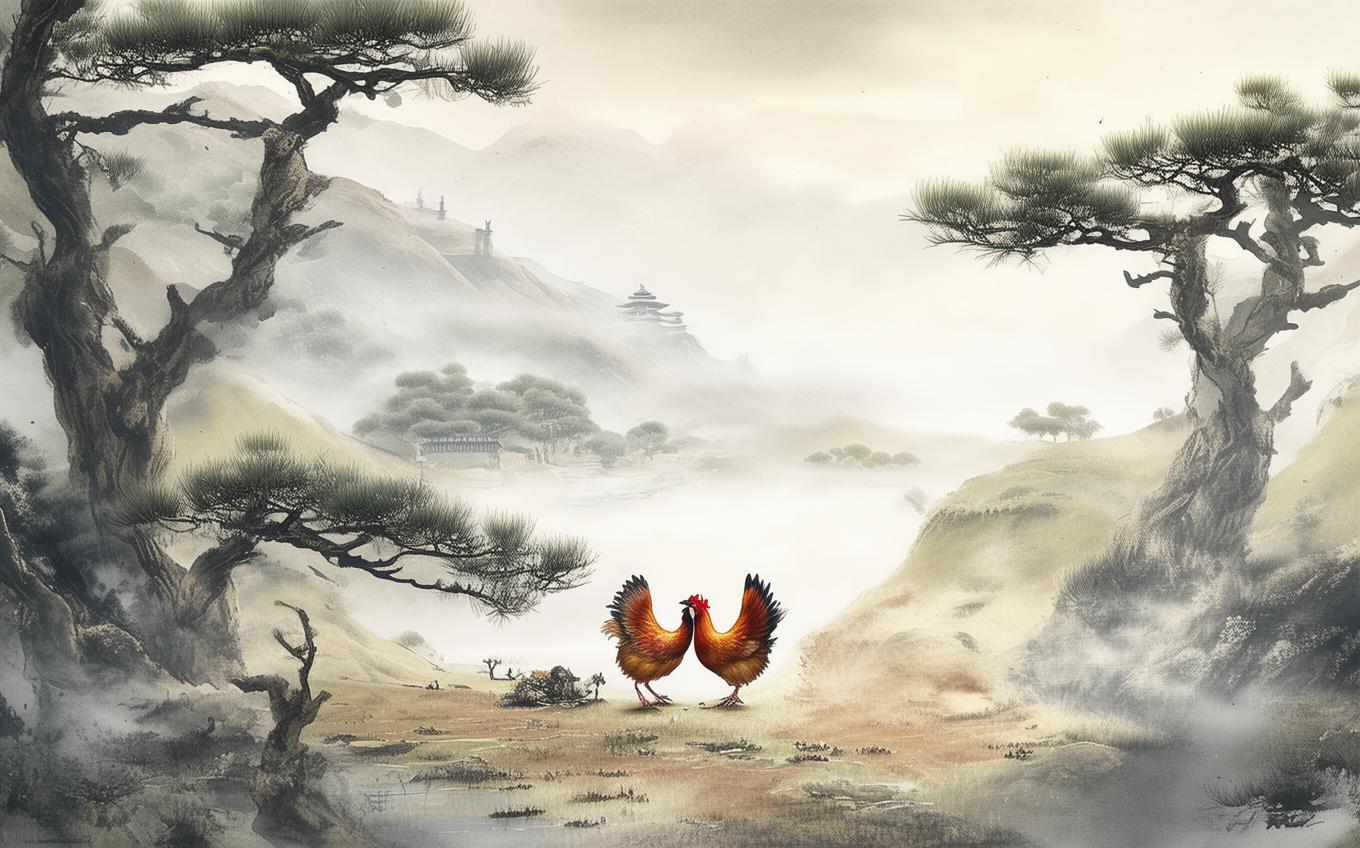
The poem "咏寒食斗鸡应秦王教" (Yǒng Hánshí Dòujī Yìng Qínwáng Jiào), which translates roughly to "On Cockfighting at the Cold Food Festival, Composed at the Command of the Prince of Qin," occupies a fascinating niche in classical Chinese literature. It belongs to the genre of "应教" (yìng jiào) poetry—verses composed at the explicit request of a patron, in this case the Prince of Qin (秦王), who would later become the great Emperor Taizong of Tang. The poem describes a cockfight held during the Cold Food Festival (寒食, Hánshí), a traditional Chinese holiday preceding the Qingming Festival, during which families refrained from lighting fires and ate only cold food.
What makes this poem particularly significant is its vivid, almost cinematic depiction of a blood sport that was immensely popular among the Tang aristocracy. Beyond its surface description of avian combat, the poem raises profound questions about glory, violence, and the nature of merit—questions that resonate far beyond the cockfighting pit.
The Poem: Full Text and Translation
寒食东郊道,扬鞲竞出笼。
Hánshí dōng jiāo dào, yáng gōu jìng chū lóng.
On the Cold Food Festival, along the eastern suburban road, raising their arm-guards, they race to release the birds from their cages.
花冠初照日,芥羽正生风。
Huā guān chū zhào rì, jiè yǔ zhèng shēng fēng.
The flowery combs first catch the sunlight; the mustard-powdered feathers now stir up a breeze.
顾敌知心勇,先鸣觉气雄。
Gù dí zhī xīn yǒng, xiān míng jué qì xióng.
Facing the enemy, one knows the courage in its heart; crowing first, one senses the heroic spirit.
长翘频扫阵,利爪屡通中。
Cháng qiào pín sǎo zhèn, lì zhǎo lǚ tōng zhōng.
Long tail feathers repeatedly sweep the battle formation; sharp talons time and again strike true to the mark.
飞毛遍绿野,洒血渍芳丛。
Fēi máo biàn lǜ yě, sǎ xuè zì fāng cóng.
Scattered feathers cover the green fields; spattered blood stains the fragrant thickets.
虽然百战胜,会自不论功。
Suīrán bǎi zhàn shèng, huì zì bù lùn gōng.
Though it may win a hundred battles, in the end, its merit will not be counted.
Line-by-Line Analysis
Stanza 1: The Setting and the Release
The poem opens with a precise temporal and spatial marker: "寒食东郊道" (Cold Food Festival, eastern suburban road). The Cold Food Festival was a solemn occasion of remembrance, yet here it serves as the backdrop for an aristocratic entertainment. This juxtaposition—a day of quiet reflection transformed into a spectacle of violence—immediately introduces a subtle tension that runs throughout the poem. The eastern suburbs of Chang'an, the Tang capital, were known gathering places for the elite, and the choice of location signals that this is no rustic peasant pastime but a refined courtly diversion.
The phrase "扬鞲竞出笼" captures the moment of release with remarkable energy. The 鞲 (gōu) refers to the leather arm-guard worn by falconers and cock handlers, and the verb "扬" (yáng, to raise) conveys a dramatic flourish. The word "竞" (jìng, to compete, to race) injects urgency, suggesting that even the act of releasing the birds is itself a kind of competition. The cages swing open, and the violence begins.
Stanza 2: The Splendor of the Combatants
Du Yan devotes the second couplet to the physical appearance of the fighting cocks, and his imagery is both beautiful and martial. The "花冠" (huā guān, flowery comb) refers to the fleshy crest atop a rooster's head, which in the sunlight takes on a brilliant, almost ornamental quality. The word "初" (chū, first, just now) suggests the freshness of the morning light and the pristine state of the birds before combat.
The "芥羽" (jiè yǔ, mustard-powdered feathers) is a fascinating cultural detail. Cockfighters in ancient China would dust their birds' feathers with mustard powder or attach small blades coated with irritants to their legs. When the powder flew into an opponent's eyes, it caused irritation and disorientation. This practice transforms the rooster from a natural creature into a weaponized instrument of sport. The phrase "正生风" (now stirring up a breeze) captures the moment when the birds begin to move, their treated feathers creating gusts that carry the mustard powder toward their enemies. Beauty and brutality coexist in a single image.
Stanza 3: The Psychology of Combat
The third couplet shifts from external description to internal characterization. "顾敌知心勇" (Facing the enemy, one knows the courage in its heart) attributes human-like psychological awareness to the fighting cocks. The poet reads courage in the way a bird turns to face its opponent, suggesting that true bravery is revealed not in victory but in the willingness to confront danger directly.
"先鸣觉气雄" (Crowing first, one senses the heroic spirit) continues this anthropomorphic treatment. In Chinese martial culture, the war cry has always held profound significance—it is both a declaration of intent and a psychological weapon. A rooster that crows before engaging demonstrates what the ancient Chinese called "气" (qì), the vital energy or spirit that animates all living things. A rooster with abundant 气 is not merely physically strong but spiritually formidable.
Stanza 4: The Fury of Battle
The fourth couplet delivers the poem's most intense action imagery. "长翘频扫阵" (Long tail feathers repeatedly sweep the battle formation) uses military vocabulary—"阵" (zhèn) specifically refers to a battle array or formation—to describe the rooster's movements. The long, arching tail feathers become like banners sweeping across a battlefield, and the word "频" (pín, repeatedly) conveys relentless, tireless aggression.
"利爪屡通中" (Sharp talons time and again strike true to the mark) introduces the physical damage of combat. The word "通中" (tōng zhòng) is particularly striking—it suggests not merely hitting but penetrating deeply, striking at the vital center. The adverb "屡" (lǚ, repeatedly, time and again) reinforces the sense of sustained violence. These birds are not engaging in a brief skirmish; they are locked in a prolonged struggle of attrition.
Stanza 5: The Aftermath
The fifth couplet shifts abruptly from the heat of battle to its aftermath, and the contrast is devastating. "飞毛遍绿野" (Scattered feathers cover the green fields) presents an image of almost pastoral beauty—feathers drifting across green grass—that masks the violence that produced it. The word "遍" (biàn, everywhere, all over) emphasizes the sheer scale of the destruction.
"洒血渍芳丛" (Spattered blood stains the fragrant thickets) introduces the poem's most visceral image. The word "渍" (zì, to soak, to stain) implies deep, penetrating saturation, not surface splatter. The blood has soaked into the "芳丛" (fāng cóng, fragrant thickets)—beautiful flowering shrubs that now bear the marks of violence. The juxtaposition of fragrance and blood creates a powerful sensory dissonance that forces the reader to confront the true cost of the spectacle.
Stanza 6: The Philosophical Turn
The final couplet delivers the poem's most profound insight. "虽然百战胜" (Though it may win a hundred battles) acknowledges the rooster's martial prowess in hyperbolic terms. A hundred victories—the phrase echoes the language of military achievement, evoking great generals and legendary warriors.
But the second half of the couplet undercuts everything that came before: "会自不论功" (in the end, its merit will not be counted). The word "会" (huì, in the end, ultimately) carries a sense of inevitability, while "不论功" (bù lùn gōng, merit not discussed, achievements not counted) delivers a devastating verdict. After all the courage, all the fury, all the blood—the rooster's achievements will never be recognized. It fights not for glory but for the entertainment of others, and when the fight is over, its victories mean nothing.
Themes and Symbolism
The Futility of Glory
The poem's central theme is the emptiness of martial glory when it serves no higher purpose. The fighting cock is the perfect symbol for this theme: it displays genuine courage, skill, and determination, yet its achievements are ultimately meaningless because it fights not for survival or protection but for the amusement of spectators. The final line—"会自不论功"—delivers this message with quiet devastation.
The Spectacle of Violence
Du Yan does not shy away from depicting violence, but he does so with an aesthetic sensibility that makes the reader complicit in the spectacle. The beautiful imagery—flowery combs catching sunlight, feathers drifting across green fields—seduces the reader into appreciating the scene before the blood-soaked reality becomes impossible to ignore. This mirrors the experience of the aristocratic spectators, who found entertainment in brutality while remaining insulated from its consequences.
The Cold Food Festival Setting
The choice of the Cold Food Festival as the temporal setting is significant. This festival commemorated Jie Zitui (介子推), a loyal retainer who was tragically killed when his lord, Duke Wen of Jin, accidentally set fire to the mountain where Jie had hidden himself. The festival's themes of loyalty, sacrifice, and unintended consequences resonate throughout the poem. The fighting cocks, like Jie Zitui, display loyalty and courage, yet their sacrifices go unrecognized.
The Cock as Warrior Symbol
In Chinese culture, the rooster holds a complex symbolic position. It is one of the twelve zodiac animals, associated with punctuality, courage, and yang energy. The rooster's crow drives away darkness and evil spirits. Yet in the context of cockfighting, this noble creature is reduced to an instrument of entertainment. Du Yan exploits this symbolic tension to question the nature of heroism itself.
Cultural Context
Cockfighting in Tang Dynasty China
Cockfighting has ancient roots in China, with records dating back to the Spring and Autumn period (771–476 BCE). By the Tang Dynasty, it had become a sophisticated aristocratic pastime, complete with specialized breeding programs, training techniques, and even dedicated cockfighting arenas. The Tang imperial court maintained professional cock handlers, and the sport was popular among both men and women of the upper classes.
The practice of attaching metal spurs or treating feathers with irritants like mustard powder was well-established by Du Yan's time. These techniques transformed natural avian combat into a more lethal and spectacular form of entertainment, reflecting the Tang aristocracy's taste for intensity and refinement in equal measure.
The Prince of Qin and Court Poetry
The poem's subtitle—"应秦王教" (composed at the command of the Prince of Qin)—reveals its origin as a piece of court poetry. The Prince of Qin was Li Shimin (李世民), who would later become Emperor Taizong, one of China's greatest rulers. Before his ascension, Li Shimin was known for his military prowess and his patronage of literature and the arts.
"应教" poetry was a specific genre in which poets composed verses at the request of a patron, often on a designated topic. These poems served multiple functions: they demonstrated the poet's skill, flattered the patron, and contributed to the cultural prestige of the court. Du Yan's poem, while fulfilling these functions, also smuggles in a subtle critique of the very entertainment it describes—a testament to the sophistication of Tang court poetry.
The Cold Food Festival
The Cold Food Festival (寒食) was observed for three days preceding the Qingming Festival, during which families refrained from lighting fires and ate only cold food. The festival honored Jie Zitui, whose story of loyalty and tragic death carried profound moral weight. By setting the cockfight during this solemn festival, Du Yan creates an implicit contrast between the values the festival commemorates—loyalty, sacrifice, remembrance—and the frivolous violence of the cockfight.
Philosophical Resonances
The poem's final line echoes Daoist and Buddhist ideas about the emptiness of worldly achievement. The concept that merit "will not be counted" (不论功) resonates with the Daoist notion of wu wei (无为, non-action) and the Buddhist teaching that attachment to achievement is a source of suffering. The fighting cock's hundred victories, impressive as they are, ultimately amount to nothing—a sobering reflection on the nature of all worldly striving.
Conclusion
Du Yan's "咏寒食斗鸡应秦王教" is far more than a simple description of a cockfight. It is a meditation on courage, violence, and the meaning of achievement, wrapped in the elegant language of Tang court poetry. The poem's power lies in its ability to present a vivid, almost cinematic depiction of avian combat while simultaneously undercutting the glory of that combat with its devastating final line.
For modern readers, the poem offers a window into the sophisticated cultural world of the Tang Dynasty, where aristocrats could appreciate both the beauty of a well-fought cockfight and the philosophical emptiness of the victory. It reminds us that the questions it raises—about the purpose of competition, the nature of courage, and the meaning of success—remain as relevant today as they were fourteen centuries ago.
The fighting cock that wins a hundred battles but receives no recognition is, in the end, a mirror held up to all of us who strive and compete in arenas where the ultimate stakes are lower than we care to admit. Du Yan's quiet observation, offered at the command of a prince, continues to resonate across the centuries, inviting us to consider what our own victories are truly worth.
Sources and Verification
- Verified text and attribution: 杜淹, “咏寒食斗鸡应秦王教” (Tang dynasty).
- Primary dataset: Chinese Poetry open corpus.
- Source record:
b0212665-b88b-4425-8c17-9c78aaca8203.
The Chinese source text and attribution are supplied from the verified record above. The English translation and commentary are educational explanations.
Comments (0)
No comments yet. Be the first to comment!