Introduction
Among the many luminous voices of Tang dynasty poetry, Li Bai (李白, Lǐ Bái, 701–762) stands as a colossal figure—a poet of wild imagination, untamed spirit, and deep emotional resonance. While he is most beloved for his exuberant drinking songs and moonlit wanderings, Li Bai also wrote intensely personal poems that capture the ache of solitude and the weight of a journey far from home. “初入秦川路逢寒食” (Chū rù Qín Chuān lù féng hán shí – “First Entering the Qin Chuan Road and Meeting the Cold Food Festival”) belongs to this quieter, more introspective side of his genius. The poem records a moment of transit: the poet is traveling into the Qin Chuan region (present-day Shaanxi, in China’s ancient heartland) when he encounters the Cold Food Festival, a traditional observance of mourning and remembrance. The convergence of raw landscape, bitter weather, and this somber rite creates a poem of profound loneliness and yearning, its sorrow as crisp and cold as the spring ice it describes.
The Poem: Full Text and Translation
秦川寒食路
Qín Chuān hán shí lù
On the Cold Food Festival road in Qin Chuan,
风日正凄凄
Fēng rì zhèng qī qī
the wind and sun are bleak and chill.
客泪堪斑竹
Kè lèi kān bān zhú
A traveler’s tears could stain the bamboo with spots like mottled legend,
离魂暂马嘶
Lí hún zàn mǎ sī
the parting soul, for an instant, the horse neighs.
水声冰下咽
Shuǐ shēng bīng xià yàn
The voice of water swallows its sobs beneath the ice,
沙路雪中迷
Shā lù xuě zhōng mí
the sandy track fades and loses itself in the snow.
肠断秦关北
Cháng duàn Qín guān běi
Heart-shattered north of the Qin Pass,
何年是帝畿
Hé nián shì dì jī
in what year will I reach the imperial domain?
Line-by-Line Analysis
Couplet 1: “秦川寒食路,风日正凄凄”
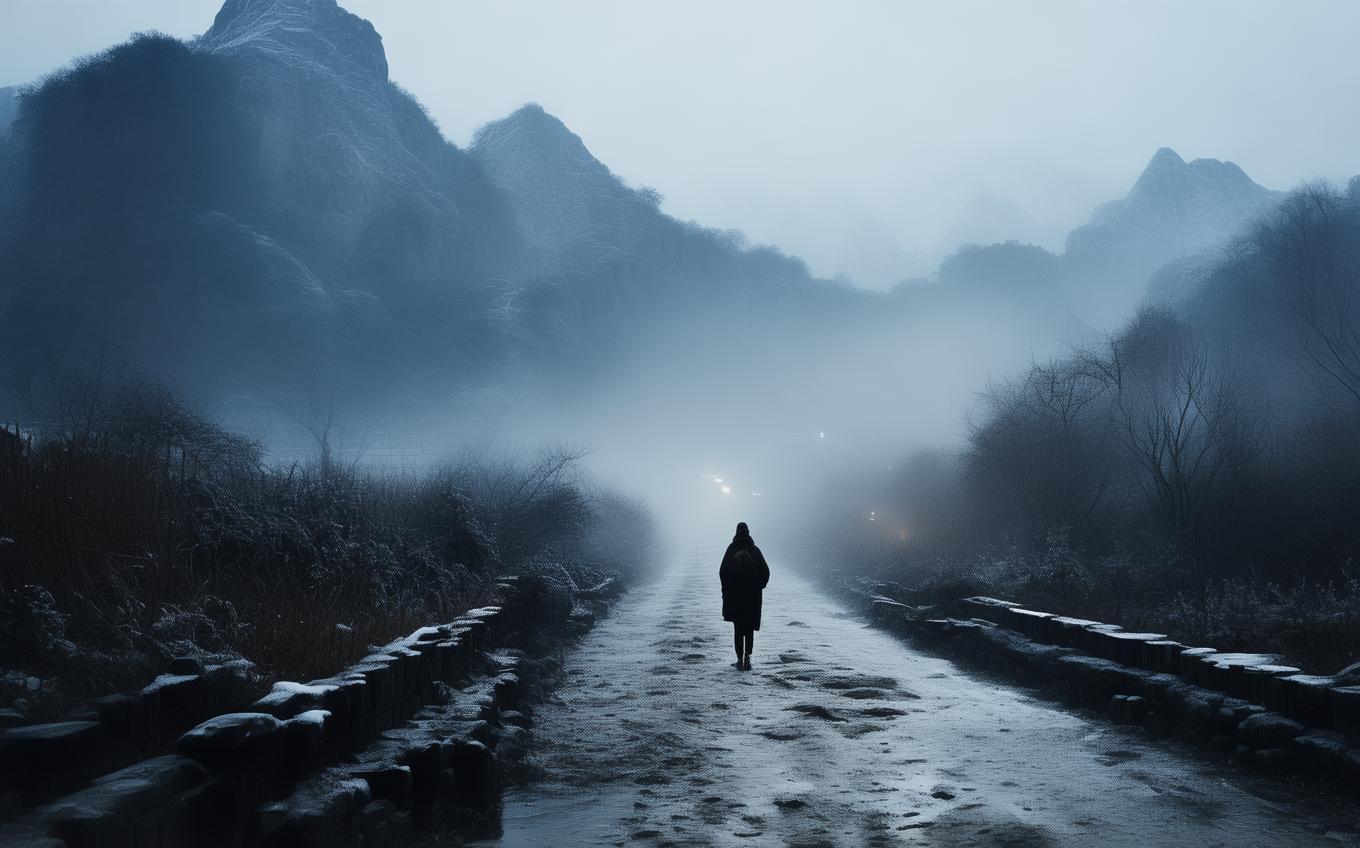
The poem opens with a stark, almost cinematic establishing shot. We are on a road in Qin Chuan, a region historically symbolizing the cradle of Chinese civilization and the path to the capital, Chang’an. But the time is the Cold Food Festival (寒食, hán shí), a day of no fire when only cold food is eaten, dedicated to remembering the dead. Immediately the festive is undercut by absence and sobriety. The phrase “风日” normally suggests pleasant spring weather, yet here it is “凄凄” – a word dense with chilling, desolate cold and a sound of whispered grief. Li Bai sets the emotional thermometer at freezing point from the very first breath.
Couplet 2: “客泪堪斑竹,离魂暂马嘶”
The poet identifies himself as “客” – a traveler, a guest in a strange land. His tears are so copious that they could mark the bamboo stalks like the legendary spotted bamboo of the Xiang River. This is a direct allusion to the myth of Emperor Shun’s two wives, Ehuang and Nüying, who wept so inconsolably at his death that their tears stained the bamboo forever. Li Bai layers his personal grief onto this ancient image of marital separation, suggesting that his own separation from home and loved ones is equally absolute. The next line is startling: “离魂” means the soul severed by parting, and “暂马嘶” – for a moment, the horse neighs. The horse’s cry pulls the poet back from his disembodied sorrow into the physical present, yet the sound only deepens the sense of isolation. The animal, too, seems to lament.
Couplet 3: “水声冰下咽,沙路雪中迷”
These two lines are a masterclass in synaesthetic landscape painting. Li Bai hears water moving beneath a surface of ice, but the sound is not joyful babbling – it “咽”, swallows or chokes, as if the stream itself is weeping silently. The visual field is equally obscured: a sandy path, already faint and intractable, vanishes into a shroud of snow. Movement is thwarted, sound is stifled; the traveler is held in an opaque, frozen world that mirrors his emotional paralysis. The alliterative density of sibilants in Chinese – shuǐ, shēng, bīng, shā, xuě – conjures the hissing whisper of sleet and solitude.
Couplet 4: “肠断秦关北,何年是帝畿”
The final couplet unleashes the accumulated ache. “肠断” (guts severed) is a common Chinese hyperbole for extreme heartbreak. The location is specified: north of Qin Pass, a strategic gateway that marks the boundary between the frontier and the civilized heartland. The poet is on the wrong side of that border, physically and metaphorically. “帝畿” means the imperial domain – the capital Chang’an, the center of culture, power, and belonging. The closing question, “what year will it be?” is not just temporal but existential. It is the cry of an exile who cannot see an end to his wandering, and the poem leaves us suspended in that unanswerable uncertainty.
Themes and Symbolism
Displacement and the Exile’s Gaze
The central theme is the pain of being far from home, heightened by the coincidence of a ritual that celebrates ancestral presence. The Cold Food Festival, which typically brings families together in shared remembrance, becomes here a cruel mirror of the poet’s solitude. To be a “客” (traveler, guest) at such a time is to be doubly absent.
Nature as Emotional Register
Li Bai endows the landscape with human emotions: the wind and sun are “bleak,” the water “chokes,” the snow “loses” the path. This is not mere pathetic fallacy but a philosophical alignment—in Chinese poetics, human feeling and the natural world are often one continuous fabric. The frozen, opaque environment externalizes the poet’s inner numbness.
Key Symbols
- 斑竹 (spotted bamboo): The mottled bamboo of legend becomes a vessel for inextinguishable grief. By invoking this myth, Li Bai casts his personal sorrow as part of an eternal, almost sacred, narrative of loss.
- 马嘶 (horse’s neigh): The horse is a listener, a witness, and perhaps a fellow sufferer. Its sudden cry acts as a punctuation mark – a raw, inarticulate sound that breaks through the frozen silence and pulls the soul back into the body.
- 冰与雪 (ice and snow): These are not simply weather conditions but symbols of obstruction, of emotional and physical paralysis. They block the road and muffle sound, turning the world into a static white labyrinth.
Cultural Context
The Cold Food Festival (寒食节, Hánshí Jié) falls on the day before the Qingming (Tomb-Sweeping) Festival in early April. Legend traces its origin to the loyal servant Jie Zitui, who died in a fire rather than seek reward. To commemorate him, people were forbidden to use fire and ate only cold meals. In Tang China, the festival was a major observance, a time for ancestor worship and quiet reflection. By embedding his poem in this specific ritual day, Li Bai draws on a collective cultural memory of mourning and self-denial, amplifying his own sense of exclusion.
Li Bai himself spent much of his life journeying, sometimes seeking political patronage, sometimes simply driven by his restless, wandering nature. This poem likely dates from one of his early attempts to enter official service, when he traveled toward Chang’an with high hopes but encountered the physical and psychological rigors of a harsh landscape. The “imperial domain” he yearns for is not just a city but a dream of recognition and stability – a dream that, for all his poetic fame, often eluded him.
Conclusion
“初入秦川路逢寒食” may be a small, sharp jewel among Li Bai’s vast body of work, but its bleak beauty cuts deep. The poem captures a universal human moment: the traveler, suddenly face to face with a festival that demands communal warmth, feels the cold more bitterly than ever. Through its meticulously drawn imagery – choked water, lost paths, the stained bamboo of departed loves – Li Bai transforms personal lament into an enduring testimony of what it means to be far from home. For modern readers, the poem remains a haunting reminder that places and seasons carry not just our footsteps but also our deepest, most unanswerable questions. When will the journey end? In what year will we finally feel we belong? Li Bai leaves us with that question, hovering like snow in a silent sky.
Comments (0)
No comments yet. Be the first to comment!