Introduction
Among the many gems of Tang Dynasty (618–907) poetry, Li Bai’s (李白, Lǐ Bái, 701–762) short poem “答司马承祯上劒镜” (Dá Sīmǎ Chéngzhēn Shàng Jiàn Jìng, “Reply to Sima Chengzhen on Presenting a Sword and Mirror”) is a crystalline example of how a great poet can fuse personal gratitude with deep Taoist symbolism in just twenty characters. Li Bai, often called the “Immortal of Poetry,” was as famous for his wild, wine-soaked verses as for his fascination with Taoist philosophy and alchemy. The recipient, Sima Chengzhen (司马承祯, Sīmǎ Chéngzhēn, 647–735), was a revered Taoist master and the twelfth patriarch of the Shangqing (Highest Clarity) school. When the elderly priest presented Li Bai with a sword and a bronze mirror—objects rich with protective and spiritual meaning—the poet replied with this exquisite quatrain. Though brief, the poem encapsulates core Taoist ideals of emptiness, illumination, and the power of ritual objects to reveal truth and ward off darkness. For English readers encountering classical Chinese poetry, this tiny masterpiece offers a perfect window into the elegant interplay between friendship, mystical thought, and material culture in medieval China.
The Poem: Full Text and Translation
宝镜似空水
Bǎo jìng sì kōng shuǐ
The precious mirror is like empty water;
剑如明月光
Jiàn rú míng yuè guāng
The sword is like the light of the bright moon.
照人肝胆切
Zhào rén gān dǎn qiè
It shines on a person’s innermost heart, incisively;
伏象鬼神藏
Fú xiàng guǐ shén cáng
Shapes are subdued, ghosts and spirits hide away.
Line-by-Line Analysis
Line 1: 宝镜似空水 (Bǎo jìng sì kōng shuǐ)
The poem opens with the mirror, immediately elevating it from a simple object to a metaphysical image. The Chinese bǎo jìng (宝镜) can be translated as “precious mirror” or “treasure mirror,” implying not just material value but magical efficacy. By comparing it to “empty water” (kōng shuǐ), Li Bai draws on a central Taoist and Buddhist notion: still water perfectly reflects the world because it is empty of distortion. A mind or object that is kōng (空, empty) is not vacant in the negative sense; rather, it is open, receptive, and free of self-imposed clutter. The metaphor suggests the mirror’s surface is so calm, so utterly without ripples of ego or impurity, that it can reflect the true nature of anyone who gazes into it. This first line sets a tone of serene clarity.
Line 2: 剑如明月光 (Jiàn rú míng yuè guāng)
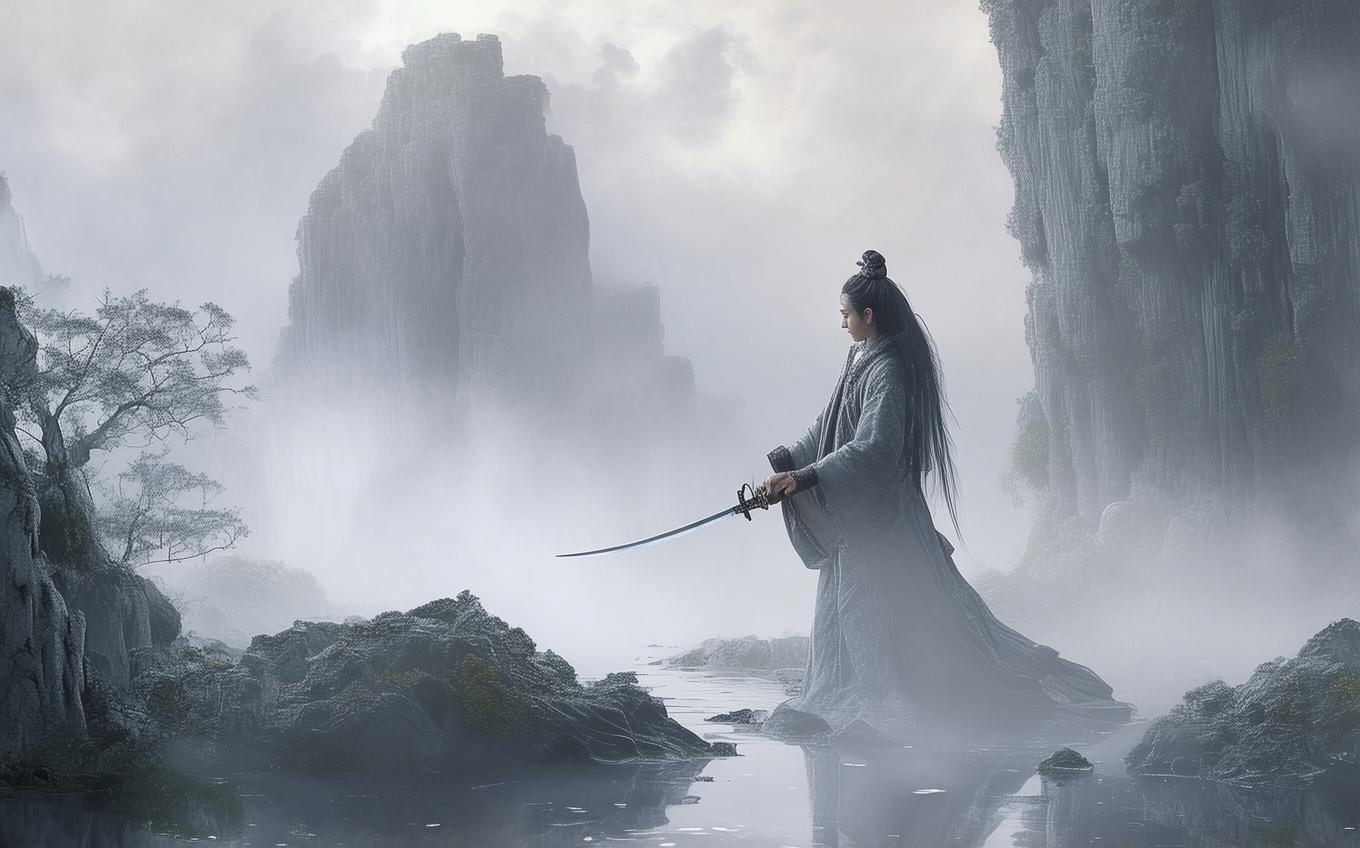
The focus shifts to the sword, and Li Bai couples it with another luminous image—“the light of the bright moon.” In Chinese poetry, the moon is a timeless symbol of purity, constancy, and quiet brilliance. To liken a sword to moonlight is to say it is not merely a weapon of steel but a beam of spiritual radiance. The sword’s edge becomes a cutting light that penetrates darkness. Importantly, moonlight is also yin energy—cool, reflective, and associated with wisdom rather than aggression. So the Taoist sword, given by a sage, is not about violence; it is an instrument of discernment that separates truth from falsehood, much like clear light dispels shadow.
Line 3: 照人肝胆切 (Zhào rén gān dǎn qiè)
This line, which can apply to both the mirror and the sword’s light, speaks to the objects’ psychological and moral function. The phrase gān dǎn (肝胆) literally means “liver and gall,” but idiomatically it signifies the depths of one’s heart, one’s innermost sincerity, courage, and honesty—the seat of visceral truth. Qiè (切) means “cutting, incisive, penetrating to the core.” Thus the mirror and sword together do more than reflect a surface image: they cut straight through external pretense to reveal a person’s true character. There is a gentle judgment implied, yet it is not harsh. In Taoist thought, true knowledge is this kind of clear, sharp recognition that leaves no place for self-deception.
Line 4: 伏象鬼神藏 (Fú xiàng guǐ shén cáng)
The final line reveals the protective power of these ritual objects. Fú (伏) means “to subdue, pacify, cause to lie low,” and xiàng (象) can be read as “images, forms, phenomena”—possibly even “elephants,” as the character literally can mean elephant, but in philosophical contexts it denotes the outward shapes of things. Guǐ shén (鬼神) are “ghosts and spirits,” all manner of negative or unruly supernatural forces. The verb cáng (藏) means “to hide, conceal, vanish.” So the combined effect of the mirror’s empty stillness and the sword’s moonlike radiance is so powerful that disturbing forms are tamed and malevolent spirits are forced into hiding. This line paints a picture of cosmic order restored, with the ritual gifts serving as exorcistic and harmonizing tools. It is a high compliment to Sima Chengzhen, whose bestowed objects make the unseen world tremble and retreat.
Themes and Symbolism
Taoist Spiritual Tools
At its core, the poem treats sword and mirror not as mere gifts but as talismans of inner alchemy. In Shangqing Taoism, bronze mirrors were used in meditation and ritual to visualize the true self, while swords symbolized the discernment that cuts away worldly attachments. Li Bai’s verse mirrors (pun intended) this esoteric tradition. Emptiness, light, sharpness, and concealment—each word clusters around the theme of using material objects to access spiritual reality.
Clarity and Sincerity
The repeated imagery of water, moonlight, and cutting penetration points to a central value: sincerity. One’s gān dǎn (innermost heart) being laid bare is not a violation but a liberation. In Taoist-informed thought, only by seeing oneself without illusion can one return to the Way. The poem suggests that these objects, given by a true sage, are catalysts for that clarity.
Protection and Cosmic Order
By ending with subdued shapes and hiding ghosts, the poem shifts from interior reflection to the outer cosmos. The sword and mirror together create a safe, ordered space. This reflects the ancient Chinese belief that certain objects could harmonize qi and repel baleful influences, a concept shared with fengshui and talismanic culture.
Cultural Context
Tang China was a golden age of both poetry and Taoism. Many emperors patronized Taoist masters like Sima Chengzhen, who had been a spiritual advisor to the imperial court. Li Bai himself was initiated into Taoist practices later in life, and his encounter with Sima Chengzhen in 725 was a turning point—the older sage famously called Li Bai “an immortal banished to earth.” The presentation of a sword and mirror was deeply symbolic: in Taoist ritual, such gifts marked the transmission of spiritual authority and protection. Moreover, bronze mirrors decorated with cosmological designs were thought to reveal demons who disguised themselves as humans. By writing this poem, Li Bai was not simply saying “thank you”; he was acknowledging the profound mystical power of the gift and sealing his bond with a spiritual teacher.
Conclusion
“答司马承祯上劒镜” is a marvel of compression. In four lines, Li Bai elevates a pair of ritual objects into emblems of Taoist illumination, interior honesty, and cosmic defense. The images are at once tangible—a cool mirror, a bright sword—and ethereal, dissolving into empty water and moonlight. For modern readers, the poem remains a luminous reminder that true seeing requires both stillness and light, that the greatest defenses are not aggressive but luminous, and that a gift given with spiritual intention can become a mirror for the soul. In an age of noise, Li Bai’s tiny verse glimmers like that ancient bronze mirror: calm, clear, and sharp enough to cut through the shadows we still carry.

Comments (0)
No comments yet. Be the first to comment!