Introduction
In the luminous tapestry of Tang Dynasty (618–907) culture, few figures embody the fusion of imperial power and spiritual yearning quite like Emperor Xuanzong (唐玄宗, reigned 712–756). A renowned patron of the arts and a devout seeker of Taoist wisdom, Xuanzong’s reign witnessed the flourishing of poetry, music, and religious thought. The poem “赐道士邓紫阳” (Cì Dào Shì Dèng Zǐ Yáng – “Presented to the Taoist Priest Deng Ziyang”) stands as a rare personal utterance from the throne, blending esoteric Taoist lore with a direct political plea. It is addressed to the celebrated Taoist master Deng Ziyang, a figure revered for his mastery of talismanic arts and ritual communication with celestial powers. This poem offers English readers a window into the Tang imperial psyche, where cosmology and statecraft intertwined, and where a poet-emperor could seek divine assistance against the barbarians threatening his realm.
The Poem: Full Text and Translation
太乙三门诀,
Tài yǐ sān mén jué,
The secret teachings of the Three Gates of Taiyi,
元君六甲符。
Yuán jūn liù jiǎ fú.
The talismans of the Six Jia from the Primordial Lady.
下传金版术,
Xià chuán jīn bǎn shù,
Handed down below on golden tablets,
上刻玉清书。
Shàng kè yù qīng shū.
Engraved above in the scriptures of Jade Purity.
有美探真士,
Yǒu měi tàn zhēn shì,
There is a fine seeker of truth,
囊中得秘书。
Náng zhōng dé mì shū.
Who carries secret writings within his bag.
自兹三醮后,
Zì zī sān jiào hòu,
Henceforth, after the three great offerings,
翊我灭残胡。
Yì wǒ miè cán hú.
Assist me in annihilating the remaining barbarians.
Line-by-Line Analysis
Opening Couplet: Invoking Celestial Arsenal
太乙三门诀,元君六甲符。
The poem opens not with a personal greeting, but with a luminous inventory of sacred Taoist knowledge. Taiyi (太乙, Grand Unity) is the primordial deity embodying the undifferentiated cosmos; his “Three Gates” refer to an arcane method of cultivating immortality and commanding spiritual forces. Yuanjun (元君, Primordial Lady) is a high goddess, often identified with the Queen Mother of the West, who presides over the liu jia (六甲) – the six Yang stems of the sexagenary cycle, associated with powerful exorcistic talismans. By juxtaposing these two divine names, Xuanzong elevates Deng Ziyang’s practice to a cosmic scale. The mention of “talismans” (符, fú) is crucial: in Taoist ritual, such diagrams are not mere symbols but active agents that command spirits and reorder reality. The emperor establishes a tone of reverent awe, acknowledging that the priest wields powers that transcend earthly authority.
Second Couplet: The Transmission of Sacred Texts
下传金版术,上刻玉清书。
Here the vertical axis of communication becomes explicit. “下” (xià, below/on earth) and “上” (shàng, above/in heaven) map the flow of esoteric teachings. The “golden tablets” (金版, jīn bǎn) suggest engraved metal plates used to preserve ritual procedures, possibly the Golden Register of Salvation in Taoist liturgy. “玉清” (Yù Qīng, Jade Purity) is the highest of the Three Pure Ones’ heavens in Taoist cosmology, the realm of the primordial Celestial Worthy. Scriptures from Jade Purity are the purest revelations. Xuanzong is subtly positioning Deng Ziyang as a mediator between these realms – his art originates in heaven and is enacted on earth. The language is brilliantly concise, compressing an entire theology of revealed wisdom into ten characters.
Third Couplet: Portrait of the Spiritual Adept
有美探真士,囊中得秘书。
The poem’s gaze shifts to Deng Ziyang himself. “有美” (yǒu měi) is an elegant classical epithet meaning “there is one of excellence,” echoing the Shijing (Book of Songs) tradition of praising virtuous individuals. “探真士” (tàn zhēn shì) – “seeker of truth” – captures the Taoist ideal of the zhenren (真人, perfected being), one who has plumbed the depths of the Dao. The “secret writings” (秘书, mì shū) in his “bag” reinforce the mystique: even the emperor does not fully disclose what these texts contain. This portrays Deng as a living repository of heavenly wisdom, a figure worthy of the imperial request that follows. The couplet balances flattery with genuine respect, reminding the reader that in Tang China, emperors themselves often sought initiation into Taoist mysteries.
Closing Couplet: The Ritual Bargain
自兹三醮后,翊我灭残胡。
The final lines pivot from description to urgent appeal. “三醮” (sān jiào) refers to the Three Offerings, a grand Taoist ritual involving purification, invocation of cosmic deities, and presentation of written memorials to heaven. By specifying “after the three offerings,” Xuanzong marks a precise moment of expected divine intervention. “翊我” (yì wǒ) – “assist me” – is a starkly personal verb; the Son of Heaven humbles himself, seeking aid. “灭残胡” (miè cán hú, annihilate the remaining barbarians) shocks the modern ear with its violence, yet it reflects the historical pressure of nomadic incursions on the Tang frontiers. The phrase “残胡” (remnant barbarians) suggests recent military successes that still require a ritual conclusion – the Taoist priest is tasked with ensuring cosmic backing to finish the job. This fusion of sacrificial piety and martial necessity encapsulates the Tang ideology of world order, where spiritual and temporal victory were inseparable.
Themes and Symbolism
Sacred Power and Imperial Authority
The poem’s core theme is the negotiation between two forms of power: the ritual potency of the Taoist adept and the political might of the emperor. Xuanzong does not command; he petitions. The talismans and scriptures represent a higher order of causality that the throne must respectfully request. This nuance reveals the profound integration of Taoism into the Tang state – high priests functioned as spiritual counselors capable of mobilizing celestial armies.
Talismans as Cosmic Technology
The recurrent image of the fu (符) – the talisman – symbolizes the Tang belief in a bureaucratically structured cosmos. Taoist talismans were understood as official documents from heaven, complete with divine seals. By wielding them, a priest like Deng Ziyang could issue commands to spirit generals, much as an imperial decree dispatching human troops. The golden tablets and Jade Purity scriptures elevate this symbology to a cosmic scale, suggesting that the ultimate source of order is not the emperor but the Dao itself.
The Seeker of Truth
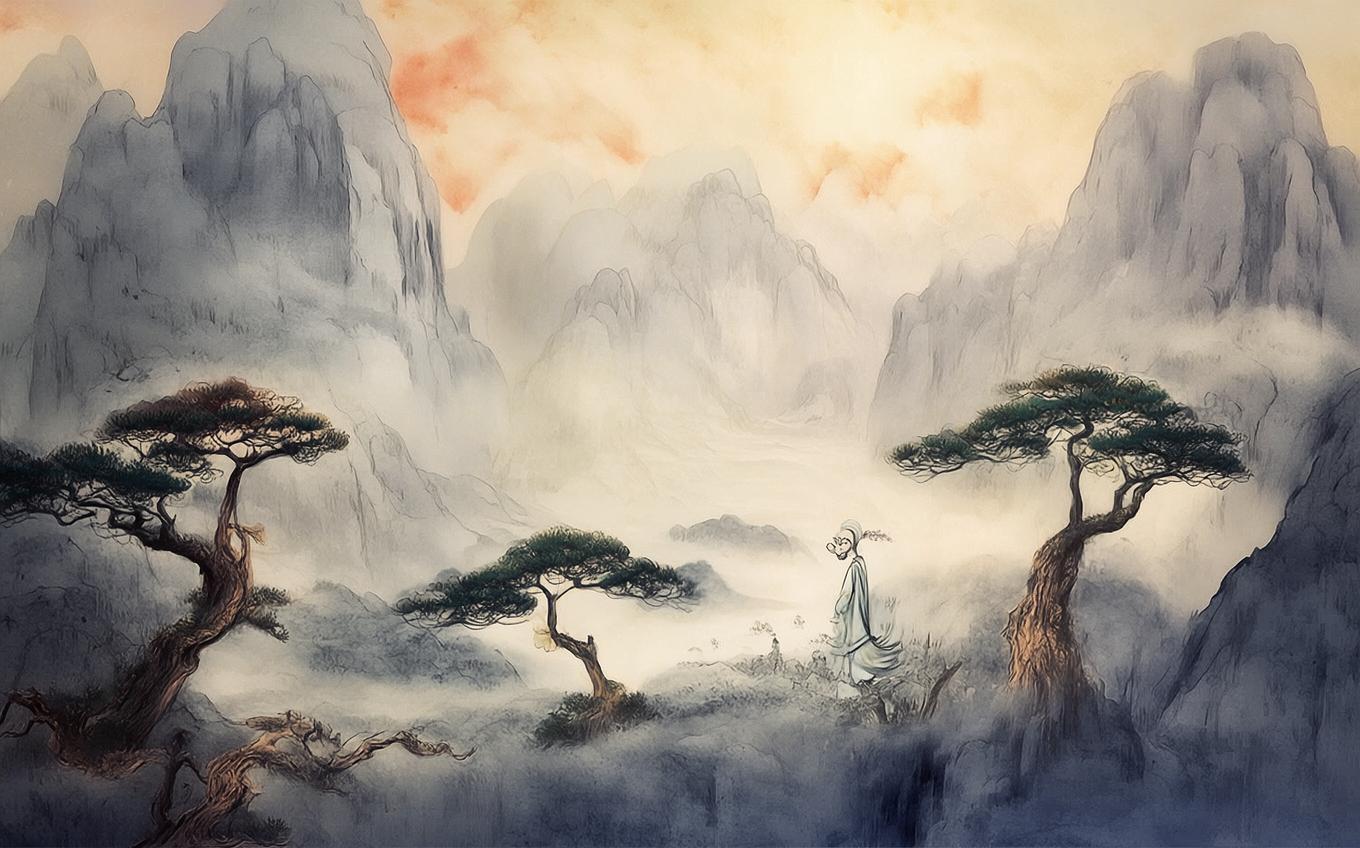
“探真士” (tàn zhēn shì) stands as the human ideal in this short poem. Deng Ziyang embodies the Taoist sage who has retreated into the mountains, yet whose wisdom is called upon at moments of national crisis. This archetype – the hidden master whose power forestalls disaster – permeates Chinese literature, from the strategist Zhuge Liang to later martial arts fiction. Xuanzong’s portrait is both personal and archetypal, stressing the value of contemplative knowledge in an age of action.
Ritual as Statecraft
The “three offerings” (三醮) are not private devotion but public liturgies conducted for the protection of the empire. The poem reveals a worldview in which diplomacy, warfare, and ritual formed an unbroken continuum. To “annihilate the remaining barbarians” required not only swords but the harmonization of cosmic forces – a concept foreign to most Western political thought, yet central to Tang high culture.
Cultural Context
Emperor Xuanzong composed this poem against a backdrop of both cultural zenith and creeping military threat. His early reign, known as the Kaiyuan era (713–741), saw the Tang Empire reach its territorial and artistic apogee. Xuanzong’s personal devotion to Taoism was legendary: he conferred posthumous titles on Laozi, commissioned the compilation of the Taoist canon, and sponsored grand rituals at the capital Chang’an. Deng Ziyang was one of several Taoist priests who gained imperial favor, renowned for his ability to summon spirits and produce talismans of protection. The poem’s reference to “remaining barbarians” likely points to ongoing conflicts with the Khitan, Tibetans, or the western Türgesh – preludes to the cataclysmic An Lushan Rebellion (755–763) that would shatter Xuanzong’s world. In this light, the poem is not mere flattery but a genuine attempt to harness the numinous in defense of a fragile peace.
The poem also reflects the Tang dynasty’s unique synthesis of the “Three Teachings” (Confucianism, Buddhism, Taoism). While Confucianism governed civil administration and Buddhism offered solace to the populace, Taoism – with its claims to immortality and cosmic manipulation – often served the state’s symbolic and military needs. An emperor writing poetry empowered the sacerdotal class, affirming that the Mandate of Heaven was not automatic but needed constant ritual renewal.
Conclusion
“赐道士邓紫阳” is far more than an imperial souvenir. In eight pentasyllabic lines, Emperor Xuanzong opens a door into the Tang dynasty’s soul – a place where the celestial bureaucracy and earthly court mirrored each other, and where a master of talismans could be asked to tip the scales of war. The poem’s beauty lies in its compressed dignity: every word carries theological weight, from the shimmering heavens of Jade Purity to the pragmatic plea for military aid. For English-speaking readers, it serves as a poignant reminder that poetry in classical China was a living instrument of power, devotion, and desperate hope. Today, when the borders between the sacred and the political often seem rigidly drawn, this ancient verse whispers of an empire that saw them as one seamless, glorious fabric, woven with golden tablets and sealed with the fire of the stars.
Comments (0)
No comments yet. Be the first to comment!