Introduction
褚亮 (Chǔ Liàng, 560–647 CE) was a distinguished scholar-official who lived during the transitional period between the Sui and Tang dynasties. Born into an aristocratic family in what is now Zhejiang Province, he served under several rulers before ultimately becoming a trusted advisor to Emperor Taizong of Tang, one of China's greatest emperors. Chu Liang was renowned for his literary talents, particularly in the composition of court poetry and official documents. He was also the father of the famous calligrapher and historian Chu Suiliang.
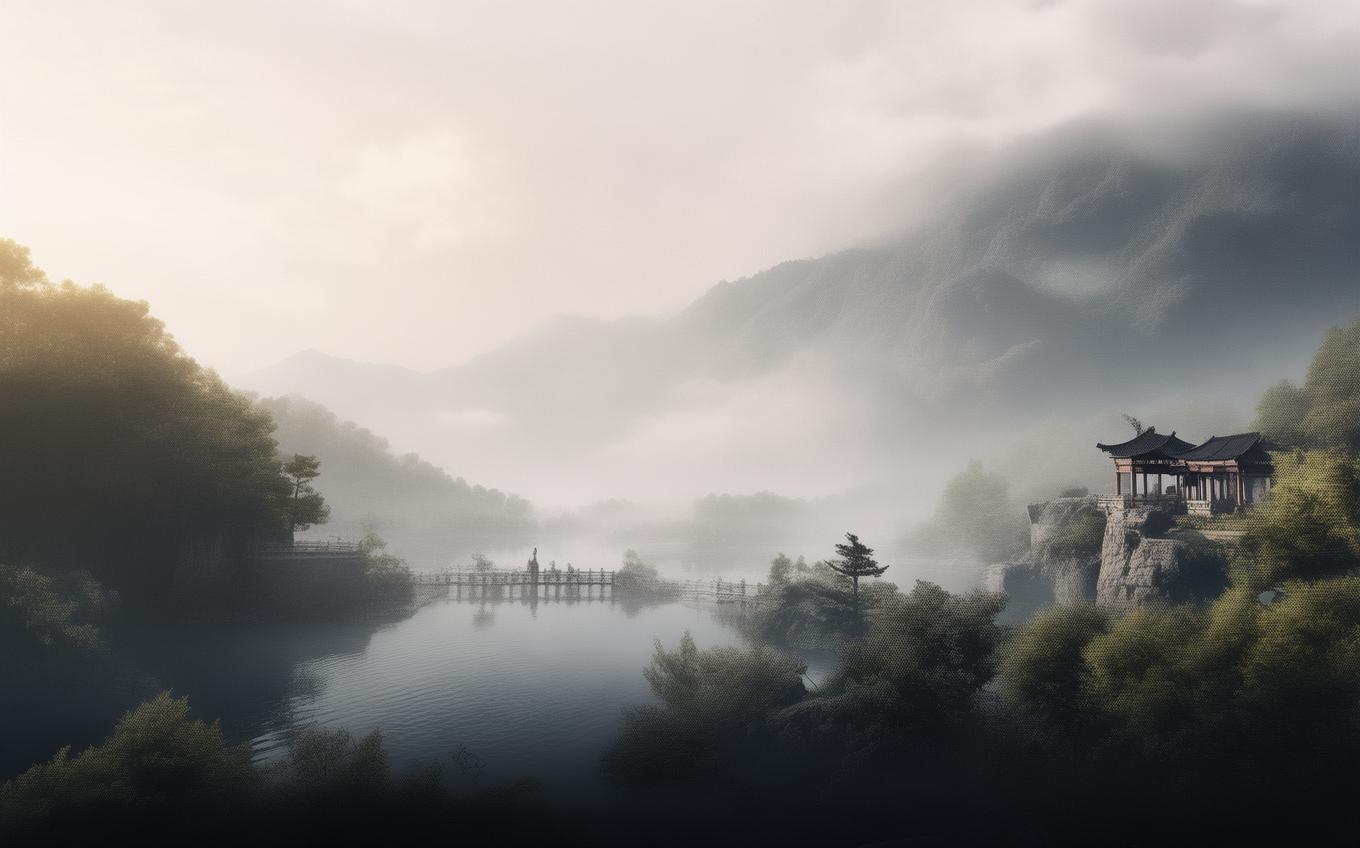
"临高台" ("Overlooking from a High Terrace") belongs to the rich tradition of denggao (登高, "ascending heights") poetry in Chinese literature — a genre that stretches back to the ancient Book of Songs and reached its zenith during the Tang Dynasty. This poem captures a moment of solitary contemplation as the speaker stands upon an elevated terrace, gazing out over the landscape below. It is a meditation on the relationship between human transience and the enduring natural world, a theme that resonates deeply throughout Chinese literary tradition.
The Poem: Full Text and Translation
高台暂俯临,飞翼耸轻音。
Gāo tái zàn fǔ lín, fēi yì sǒng qīng yīn.
From the high terrace I briefly look down; soaring wings rise with a light sound.
浮光随日度,漾影逐波深。
Fú guāng suí rì dù, yàng yǐng zhú bō shēn.
Floating light passes with the sun's course; rippling shadows pursue the deepening waves.
回瞰周平野,开怀畅远襟。
Huí kàn zhōu píng yě, kāi huái chàng yuǎn jīn.
Turning back, I gaze upon the surrounding flat plains; my heart opens wide, my distant thoughts flow freely.
独此三休上,还伤千岁心。
Dú cǐ sān xiū shàng, hái shāng qiān suì xīn.
Alone upon this thrice-resting height, I still grieve with a heart that spans a thousand years.
Line-by-Line Analysis
Line 1: 高台暂俯临,飞翼耸轻音
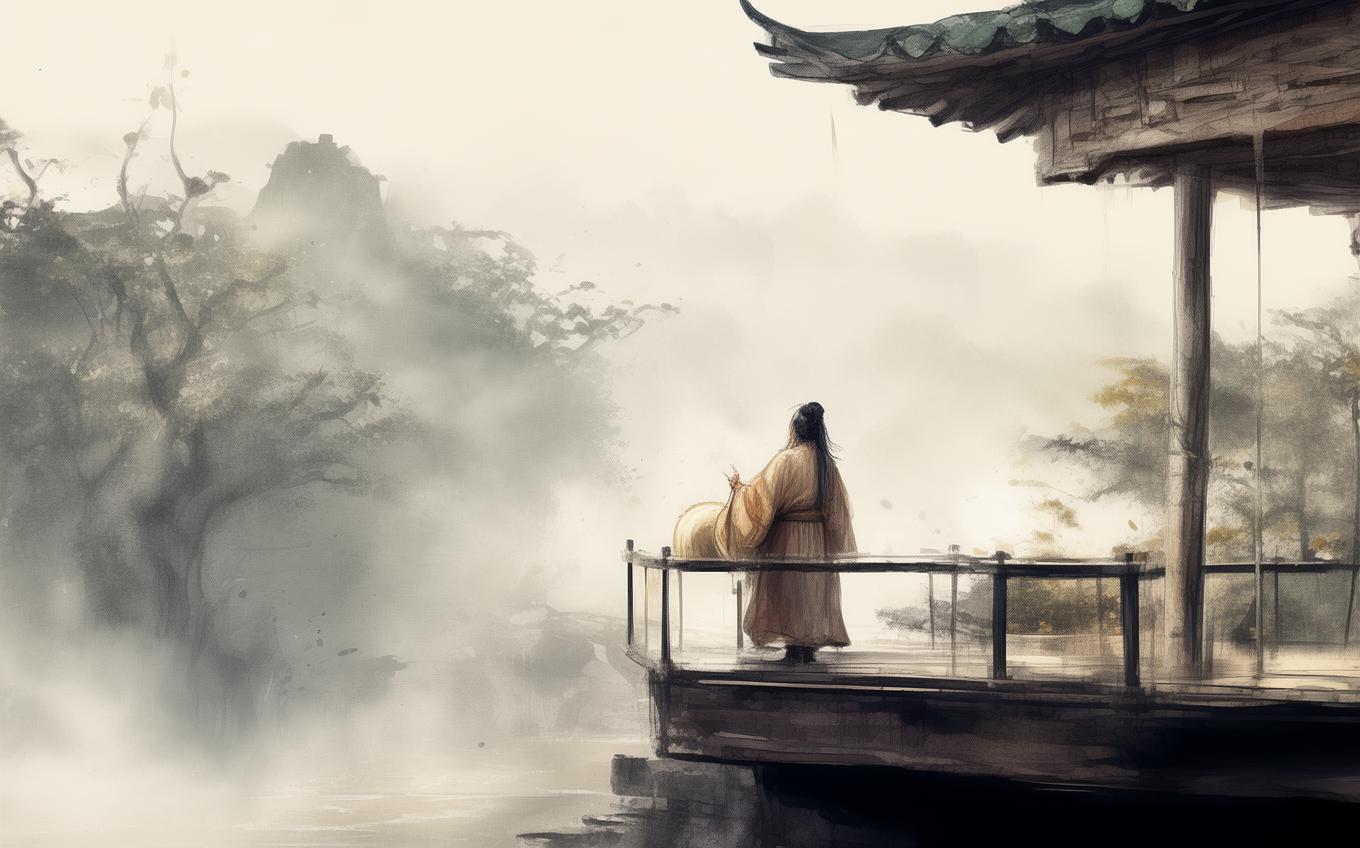
The poem opens with a striking immediacy. The speaker stands upon a "high terrace" (高台, gāo tái), a structure that in ancient China served both practical and symbolic purposes — watchtowers for defense, platforms for astronomical observation, and sites for ritual communion with the heavens. The word "暂" (zàn, "briefly" or "temporarily") is crucial here. It suggests that this moment of elevated perspective is fleeting, a temporary reprieve from the ordinary world below. The speaker does not claim permanent transcendence; he merely borrows this vantage point for a moment.
The second half of the line introduces "飞翼" (fēi yì), literally "flying wings." This could refer to birds taking flight from the terrace, startled by the speaker's presence, or it could be a more metaphorical reference to the sensation of spiritual elevation. The phrase "耸轻音" (sǒng qīng yīn, "rise with a light sound") is particularly evocative — the character "耸" suggests a sudden upward movement, while "轻音" conveys a delicate, almost ethereal quality. The sound is not heavy or jarring but light and graceful, as if the very act of rising produces a subtle music.
Line 2: 浮光随日度,漾影逐波深
This couplet shifts from the immediate surroundings to the broader landscape. "浮光" (fú guāng, "floating light") describes the play of sunlight upon water or the shimmering quality of light as it moves across the landscape. The verb "随" (suí, "to follow") establishes a relationship of dependency — the light does not move independently but follows the sun's trajectory across the sky. This is a subtle reminder of cosmic order, the way all things in nature follow their prescribed paths.
The parallel structure continues with "漾影" (yàng yǐng, "rippling shadows" or "swaying reflections"). Here, the shadows on the water's surface are not static but actively "pursue" (逐, zhú) the deepening waves. The word "深" (shēn, "deep") is significant — it suggests both physical depth and metaphorical profundity. The shadows chase the waves into ever-deeper waters, just as the speaker's thoughts descend into deeper contemplation. The parallelism between "浮光" and "漾影," between "随日度" and "逐波深," creates a rhythmic balance that mirrors the harmonious interplay of light and shadow, surface and depth.
Line 3: 回瞰周平野,开怀畅远襟
The third line marks a shift in perspective. The speaker "turns back" (回瞰, huí kàn) to survey the "surrounding flat plains" (周平野, zhōu píng yě). The character "周" implies completeness — the speaker takes in the entire panorama, not just a single direction. The flatness of the plains (平, píng) contrasts with the height of the terrace, emphasizing the speaker's elevated position and the vastness of the world spread out before him.
The emotional response to this panoramic view is immediate and powerful: "开怀畅远襟" (kāi huái chàng yuǎn jīn). "开怀" literally means "to open one's bosom" — a gesture of emotional release and receptivity. "畅远襟" extends this metaphor: "畅" suggests smoothness and freedom of flow, while "远襟" refers to the "distant lapels" or "far-reaching breast" — the innermost part of one's being reaching outward toward the horizon. The speaker's heart expands to encompass the vast landscape, his spirit flowing freely across the distant plains. This is the denggao experience at its most sublime: the physical elevation leads to emotional and spiritual elevation.
Line 4: 独此三休上,还伤千岁心
The final line introduces a sudden turn toward melancholy. "独此" (dú cǐ, "alone upon this") emphasizes the speaker's solitude. The phrase "三休上" (sān xiū shàng, "thrice-resting height") is a literary allusion that requires some unpacking. In ancient Chinese literature, "三休" refers to the need to rest three times while climbing a steep ascent — a phrase that appears in various classical texts to describe particularly arduous climbs. By invoking this image, Chu Liang suggests that reaching this height required significant effort, making the moment of contemplation all the more precious.
But the real emotional weight comes in the final phrase: "还伤千岁心" (hái shāng qiān suì xīn, "still grieve with a heart that spans a thousand years"). The word "伤" (shāng, "to grieve, to wound") introduces a note of sorrow that has been building beneath the surface of the poem's apparent serenity. The "thousand-year heart" (千岁心, qiān suì xīn) is a profound image — it suggests a consciousness that extends far beyond the individual lifespan, a heart that feels the weight of history, the sorrow of all who have stood in similar places and felt similar emotions. The speaker's grief is not merely personal but historical, even cosmic. He grieves for the impermanence of all human endeavor, for the countless generations who have come and gone while the landscape remains unchanged.
Themes and Symbolism
The Denggao Tradition
"临高台" participates in one of the most enduring traditions in Chinese poetry: the ascent to a high place for contemplation. From the ancient "登高而招" passages in classical philosophical texts to the great Tang Dynasty poems of Du Fu and Wang Wei, the act of climbing to an elevated vantage point has served as a powerful metaphor for spiritual transcendence, philosophical reflection, and emotional release. The high terrace in Chu Liang's poem is not merely a physical structure but a threshold between the mundane world and the realm of elevated thought.
Light and Shadow
The poem's central imagery revolves around the interplay of light and shadow. "浮光" (floating light) represents the visible, the transient, the surface of things. "漾影" (rippling shadows) suggests depth, mystery, and the hidden dimensions of reality. Together, they create a dynamic picture of the natural world in constant motion — light following the sun, shadows pursuing the waves. This imagery serves as a metaphor for the human condition: we are all, in some sense, floating lights and rippling shadows, briefly illuminated before fading into the depths.
The Terrace as Liminal Space
The high terrace occupies a liminal position between heaven and earth, between the human realm and the celestial. In ancient Chinese cosmology, elevated structures were believed to facilitate communication with the divine. By placing his speaker on such a structure, Chu Liang creates a space where ordinary boundaries dissolve — where past and present, self and cosmos, joy and sorrow can intermingle freely.
The "Thousand-Year Heart"
Perhaps the most striking image in the poem is the "千岁心" (qiān suì xīn, "thousand-year heart"). This concept reflects a distinctly Chinese understanding of consciousness and history. In the Confucian tradition, the cultivated individual is expected to feel a profound connection to the past — to the ancestors, to the sages, to the accumulated wisdom and sorrow of civilization. The "thousand-year heart" is a heart that carries this burden of historical consciousness, that feels the weight of time itself. It transforms the poem from a simple nature description into a meditation on mortality and the human condition.
Cultural Context
The Early Tang Period
Chu Liang lived during a pivotal moment in Chinese history. The Sui Dynasty (581–618) had reunified China after centuries of fragmentation, but it collapsed quickly due to overambitious projects and military failures. The Tang Dynasty (618–907) that followed would become one of the most glorious periods in Chinese civilization — an era of territorial expansion, cultural flourishing, and relative stability. Chu Liang served as an official during this transition, witnessing both the chaos of dynastic change and the promise of a new era.
This historical context is crucial for understanding the poem's emotional complexity. The "thousand-year heart" that grieves at the poem's conclusion may reflect the speaker's awareness of the countless dynasties that had risen and fallen, the endless cycle of human ambition and disappointment. The early Tang was a time of optimism, but it was also a time of reflection on the lessons of history — what had caused previous dynasties to fail, and how the new dynasty might avoid the same fate.
The Aesthetics of Restraint
Chinese classical poetry is renowned for its economy of expression — the ability to convey profound emotions through carefully chosen images and allusions. Chu Liang's poem exemplifies this aesthetic. In just forty characters, he creates a complete emotional arc: from the initial moment of elevated perspective, through the contemplation of natural beauty, to the final meditation on historical sorrow. There is no explicit statement of emotion until the final line; instead, the feelings emerge organically from the imagery itself. This restraint is a hallmark of the Chinese poetic tradition, reflecting a cultural preference for understatement and indirect expression.
The Philosophy of Wuqing and Youqing
The poem embodies a tension between two philosophical perspectives on the natural world. On one hand, nature is wuqing (无情, "without feeling") — it follows its own rhythms without regard for human concerns. The light follows the sun, the shadows pursue the waves, indifferent to the speaker's presence. On the other hand, the human observer brings youqing (有情, "having feeling") to the encounter — the capacity to be moved, to grieve, to feel the weight of history. This tension between the indifference of nature and the sensitivity of the human heart is a recurring theme in Chinese poetry, and Chu Liang handles it with particular subtlety.
Conclusion
"临高台" by 褚亮 is a masterful example of the denggao tradition in Chinese poetry. In just eight short lines, it takes the reader on a journey from physical elevation to spiritual contemplation, from the beauty of the natural world to the sorrow of historical consciousness. The poem's power lies in its restraint — its ability to suggest profound emotions through carefully chosen images rather than explicit statement.
For modern readers, the poem offers a timeless meditation on the human condition. We still climb to high places — whether physical terraces or metaphorical vantage points — seeking perspective on our lives. We still feel the tension between the beauty of the world and the brevity of our time within it. And we still carry, in our own ways, the "thousand-year heart" — the awareness that we are part of a story much larger than ourselves, connected to all who have come before and all who will follow.
Chu Liang's poem reminds us that this awareness, though it may bring sorrow, is also a source of depth and meaning. The ability to grieve for the passage of time is, paradoxically, what makes us fully human. The high terrace may be temporary, the moment of vision fleeting, but the heart that opens to embrace the vast landscape — and the vast sweep of history — achieves a kind of permanence that transcends the individual lifespan. In this way, "临高台" continues to speak to readers across the centuries, its quiet wisdom as relevant today as it was in the early Tang Dynasty.
Sources and Verification
- Verified text and attribution: 褚亮, “临高台” (Tang dynasty).
- Primary dataset: Chinese Poetry open corpus.
- Source record:
56ba6ccc-ed3b-41f5-8995-2d506fcad31f.
The Chinese source text and attribution are supplied from the verified record above. The English translation and commentary are educational explanations.
Comments (0)
No comments yet. Be the first to comment!