Introduction
褚亮 (Chǔ Liàng, 560–647) was a distinguished scholar-official and poet who lived during the transitional period between the Sui and Tang dynasties. Born into an aristocratic family in what is now Zhejiang Province, Chu Liang served in various official capacities and was particularly renowned for his literary talents. He was one of the prominent figures in the early Tang court, serving under Emperor Taizong and contributing to the compilation of important literary and historical works.
The poem "咏花烛" (Yǒng Huā Zhú), which translates to "Ode to the Flower Candle" or "In Praise of the Flowered Candle," belongs to the tradition of occasional poetry (应制诗) that flourished in the Tang court. The title refers to decorated candles used in wedding ceremonies—candles adorned with floral patterns or placed among flowers, symbolizing the union of marriage. This poem is significant in Chinese literature as it exemplifies the refined, courtly style of early Tang poetry, where elegant imagery and subtle allusions were prized over raw emotion. It demonstrates the sophisticated aesthetic sensibility of the period and offers insight into the cultural values surrounding marriage, beauty, and the passage of time in medieval China.
The Poem: Full Text and Translation
兰迳香风满,梅梁暖日斜。
lán jìng xiāng fēng mǎn, méi liáng nuǎn rì xié.
The orchid path is filled with fragrant breeze; the plum-carved beam catches the slanting warm sun.
言是东方骑,来寻南陌车。
yán shì dōng fāng qí, lái xún nán mò chē.
It is said to be the rider from the east, coming to seek the carriage on the southern path.
靥星临夜烛,眉月隐轻纱。
yè xīng lín yè zhú, méi yuè yǐn qīng shā.
A dimple like a star approaches the night candle; eyebrows like a crescent moon hide behind light gauze.
莫言春稍晚,自有镇开花。
mò yán chūn shāo wǎn, zì yǒu zhèn kāi huā.
Do not say that spring is somewhat late; there is naturally a flower that blooms perpetually.
Line-by-Line Analysis
Lines 1–2: Setting the Scene
兰迳香风满,梅梁暖日斜。
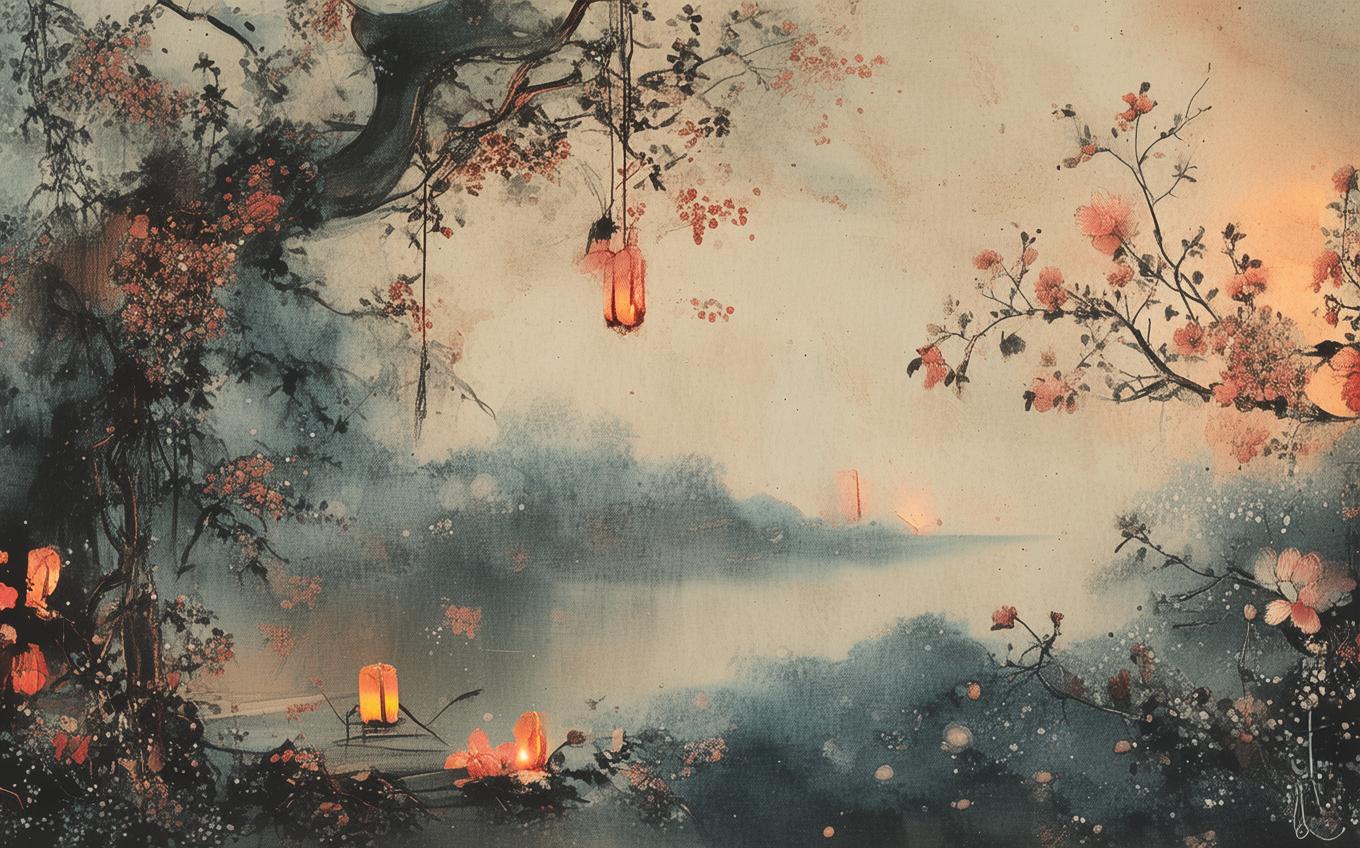
The poem opens with an exquisitely crafted scene. The "orchid path" (兰迳) immediately evokes the fragrance and elegance associated with the orchid, a flower that in Chinese culture symbolizes refinement, moral virtue, and noble character. The path filled with fragrant wind suggests a garden or courtyard prepared for a special occasion—likely the wedding celebration implied by the title. The "plum-carved beam" (梅梁) refers to architectural woodwork decorated with plum blossom motifs, another flower rich in symbolic meaning, representing resilience, purity, and the arrival of spring. The "slanting warm sun" (暖日斜) indicates the time of day—late afternoon or early evening—when the light is golden and soft, creating an atmosphere of warmth and intimacy. Together, these two lines establish a setting of aristocratic beauty and auspicious symbolism.
Lines 3–4: The Arrival
言是东方骑,来寻南陌车。
These lines introduce the human element of the poem. The "rider from the east" (东方骑) is a classical allusion that carries romantic connotations. In Chinese literary tradition, the east is associated with the rising sun, new beginnings, and the male principle (yang). The rider coming from the east to "seek the carriage on the southern path" (南陌车) represents the bridegroom arriving to claim his bride. The carriage on the southern path represents the bride—the south being associated with warmth, femininity (yin), and the direction of honor. The verb "寻" (xún, to seek) implies a quest or journey, suggesting that this union is the culmination of deliberate intention and destined meeting. The line "言是" (it is said) adds a slightly narrative, almost reportorial quality, as if the poet is describing a scene unfolding before the eyes of observers.
Lines 5–6: The Bride Revealed
靥星临夜烛,眉月隐轻纱。
These are perhaps the most striking lines of the poem, employing the technique of metaphorical doubling that is characteristic of Tang poetry. The "dimple like a star" (靥星) describes the bride's dimple—that charming indentation that appears when she smiles—likening it to a star. This star "approaches the night candle" (临夜烛), creating a beautiful juxtaposition: the artificial light of the candle and the natural "star" of the bride's face meeting in the darkness. The "eyebrows like a crescent moon" (眉月) is a classic Chinese aesthetic ideal—the curved, delicate eyebrows that resemble the new moon. These eyebrows "hide behind light gauze" (隐轻纱), suggesting the bride's veil or the sheer curtains of her chamber. The imagery here is intimate and tender, capturing the moment when the bride's beauty is partially revealed, partially concealed—a moment of exquisite anticipation.
Lines 7–8: The Consolation and Promise
莫言春稍晚,自有镇开花。
The final couplet shifts from description to reflection, offering a philosophical consolation. "Do not say that spring is somewhat late" (莫言春稍晚) addresses a potential concern—perhaps the wedding is taking place later in the season, or the bride is marrying at an age considered somewhat advanced, or there is some other sense of belatedness. The response is confident and reassuring: "there is naturally a flower that blooms perpetually" (自有镇开花). The "flower that blooms perpetually" (镇开花) is a powerful metaphor—it could refer to the bride herself, whose beauty is not subject to seasonal constraints; to the love between the couple, which will remain fresh and vibrant; or to the institution of marriage itself, which renews and perpetuates life. The word "镇" (zhèn) carries the meaning of "always," "permanently," or "steadily," emphasizing the enduring nature of this blooming.
Themes and Symbolism
The Theme of Marriage and Union
The poem's central theme is marriage—the coming together of two people in a sacred union. This is conveyed through the imagery of the rider seeking the carriage, the meeting of light sources (star and candle), and the overall atmosphere of celebration and beauty. The poem celebrates not just the event of marriage but its deeper significance as a union that transcends time and season.
The Symbolism of Flowers
Flowers permeate this poem. The orchid (兰) symbolizes nobility and virtue; the plum blossom (梅) represents resilience and the promise of spring; the "flower that blooms perpetually" (镇开花) symbolizes enduring love and beauty. In Chinese culture, flowers are not merely decorative—they carry profound moral and philosophical meanings. The use of flower imagery throughout the poem connects the wedding celebration to the natural world's cycles of renewal and beauty.
Light and Darkness
The poem is structured around a progression from daylight to darkness. It begins with the "slanting warm sun" and moves to the "night candle" and the star-like dimple. This movement from day to night mirrors the transition from the public celebration to the private intimacy of the wedding night. The interplay of light sources—sun, candle, star, moon—creates a luminous quality that suffuses the entire poem with warmth and radiance.
Concealment and Revelation
The image of the "eyebrows like a crescent moon hidden behind light gauze" (眉月隐轻纱) introduces the theme of concealment and revelation. This is a common motif in Chinese love poetry, where the beloved's beauty is often described as partially hidden, creating a sense of mystery and allure. The veil or gauze represents the boundary between public and private, between the seen and the unseen, between anticipation and fulfillment.
The Transcendence of Time
The final couplet addresses the theme of time and its transcendence. The concern about "spring being somewhat late" (春稍晚) represents the anxiety about timing, aging, and missed opportunities. The response—that there is a flower that blooms perpetually—suggests that true beauty and love are not subject to the constraints of time. This reflects a philosophical outlook that values the eternal over the temporal, the enduring over the fleeting.
Cultural Context
The Tang Dynasty Court and Occasional Poetry
The Tang Dynasty (618–907) is often considered the golden age of Chinese poetry. The early Tang period, during which Chu Liang lived and wrote, was characterized by the flourishing of court poetry (宫廷诗). Poets at the imperial court were expected to compose verses for various occasions—imperial banquets, seasonal festivals, and social gatherings. "咏花烛" belongs to this tradition of occasional poetry, likely composed for a wedding celebration at court or among the aristocracy.
The Aesthetics of the "Palace Style"
The poem exhibits characteristics of what literary historians call the "Palace Style" (宫体诗), which emerged during the late Six Dynasties period and continued into the early Tang. This style is characterized by its focus on elegant, refined imagery; its attention to beautiful objects and settings; and its treatment of romantic themes with subtlety and restraint. The Palace Style has sometimes been criticized for being overly ornate and lacking in emotional depth, but poems like "咏花烛" demonstrate that within this aesthetic framework, genuine beauty and meaningful expression were possible.
Marriage Customs in Tang China
The poem reflects the marriage customs of Tang Dynasty China. Weddings were elaborate affairs involving multiple rituals and ceremonies. The groom would travel to the bride's home to escort her to his residence—a journey reflected in the "rider from the east" coming to "seek the carriage on the southern path." The use of candles decorated with flowers was a common feature of wedding celebrations, symbolizing the brightness and beauty of the union. The poem captures the moment when these rituals culminate in the meeting of bride and groom.
Chinese Philosophical Values
The poem's conclusion—"Do not say that spring is somewhat late; there is naturally a flower that blooms perpetually"—reflects Chinese philosophical values, particularly the Daoist and Buddhist emphasis on transcending conventional categories of time and season. This outlook encourages acceptance of circumstances while maintaining faith in the enduring nature of beauty and goodness. It also reflects the Confucian value of optimism and faith in the natural order of things.
Conclusion
"咏花烛" by 褚亮 is a masterpiece of Tang Dynasty court poetry that continues to enchant readers more than a millennium after its composition. Its beauty lies not only in its exquisite imagery—the fragrant orchid path, the plum-carved beam, the star-like dimple, the crescent-moon eyebrows—but in its profound understanding of love, beauty, and time. The poem moves from the external world of the wedding celebration to the intimate moment of the bride's revelation, and finally to a philosophical reflection on the enduring nature of true beauty.
What makes this poem particularly appealing to modern readers is its delicate balance between the concrete and the abstract, the temporal and the eternal. The wedding celebration is a specific moment in time, yet the poem suggests that what it represents—love, union, beauty—transcends time itself. The "flower that blooms perpetually" is a promise that resonates across centuries, reminding us that the most beautiful things in life are not subject to the seasons.
For English-speaking readers encountering this poem, it offers a window into the sophisticated aesthetic sensibility of Tang Dynasty China—a world where poetry was an essential part of social life, where flowers carried profound symbolic meanings, and where the celebration of love was elevated to an art form. The poem's enduring appeal lies in its ability to capture a moment of beauty and transform it into a meditation on the eternal.
This analysis is based on the verified text of "咏花烛" by 褚亮, as preserved in classical Chinese literary sources.
Sources and Verification
- Verified text and attribution: 褚亮, “咏花烛” (Tang dynasty).
- Primary dataset: Chinese Poetry open corpus.
- Source record:
2907d5c7-28c9-457d-9b1d-eae0cabb5cc7.
The Chinese source text and attribution are supplied from the verified record above. The English translation and commentary are educational explanations.
Comments (0)
No comments yet. Be the first to comment!