Introduction
The Tang Dynasty (618–907 CE) is often regarded as the golden age of Chinese poetry, a period when verse was not merely a literary pursuit but an essential part of courtly life, diplomatic exchange, and social bonding. Among the many poets who contributed to this flourishing tradition was 褚亮 (Chǔ Liàng), a scholar-official who served in the early Tang court. Though not as widely known today as Li Bai or Du Fu, Chu Liang was a respected literary figure of his time, skilled in the formal, occasional poetry that was central to aristocratic gatherings.
The poem presented here, 《奉和望月应魏王教》 ("Respectfully Harmonizing with 'Gazing at the Moon,' Responding to the Prince of Wei's Instruction"), belongs to a specific genre of Chinese poetry: the 奉和 (fèng hè) or "respectful response" poem. In this tradition, a host—often a prince or high-ranking noble—would compose a poem, and guests or subordinates would write matching verses using the same rhyme scheme and thematic material. The phrase 应魏王教 ("responding to the Prince of Wei's instruction") indicates that this poem was written at the behest of the Prince of Wei, likely during a moon-viewing banquet.
This poem is significant not only for its elegant imagery but also for what it reveals about Tang court culture—the importance of literary skill as a form of social currency, the aesthetic appreciation of nature, and the complex web of deference and artistry that characterized aristocratic life.
The Poem: Full Text and Translation
层轩登皎月,流照满中天。
céng xuān dēng jiǎo yuè, liú zhào mǎn zhōng tiān.
From the tiered pavilion, one ascends to the bright moon; its flowing radiance fills the heavens.
色共梁珠远,光随赵璧圆。
sè gòng Liáng zhū yuǎn, guāng suí Zhào bì yuán.
Its color shares the far-reaching brilliance of the Liang pearls; its light follows the roundness of the Zhao jade disk.
落影临秋扇,虚轮入夜弦。
luò yǐng lín qiū shàn, xū lún rù yè xián.
Its falling shadow graces an autumn fan; its ethereal orb enters the strings of the night.
所欣东馆里,预奉西园篇。
suǒ xīn dōng guǎn lǐ, yù fèng xī yuán piān.
What I take delight in, within the Eastern Pavilion, is to receive in advance the poem composed at the Western Garden.
Line-by-Line Analysis
Line 1: 层轩登皎月,流照满中天
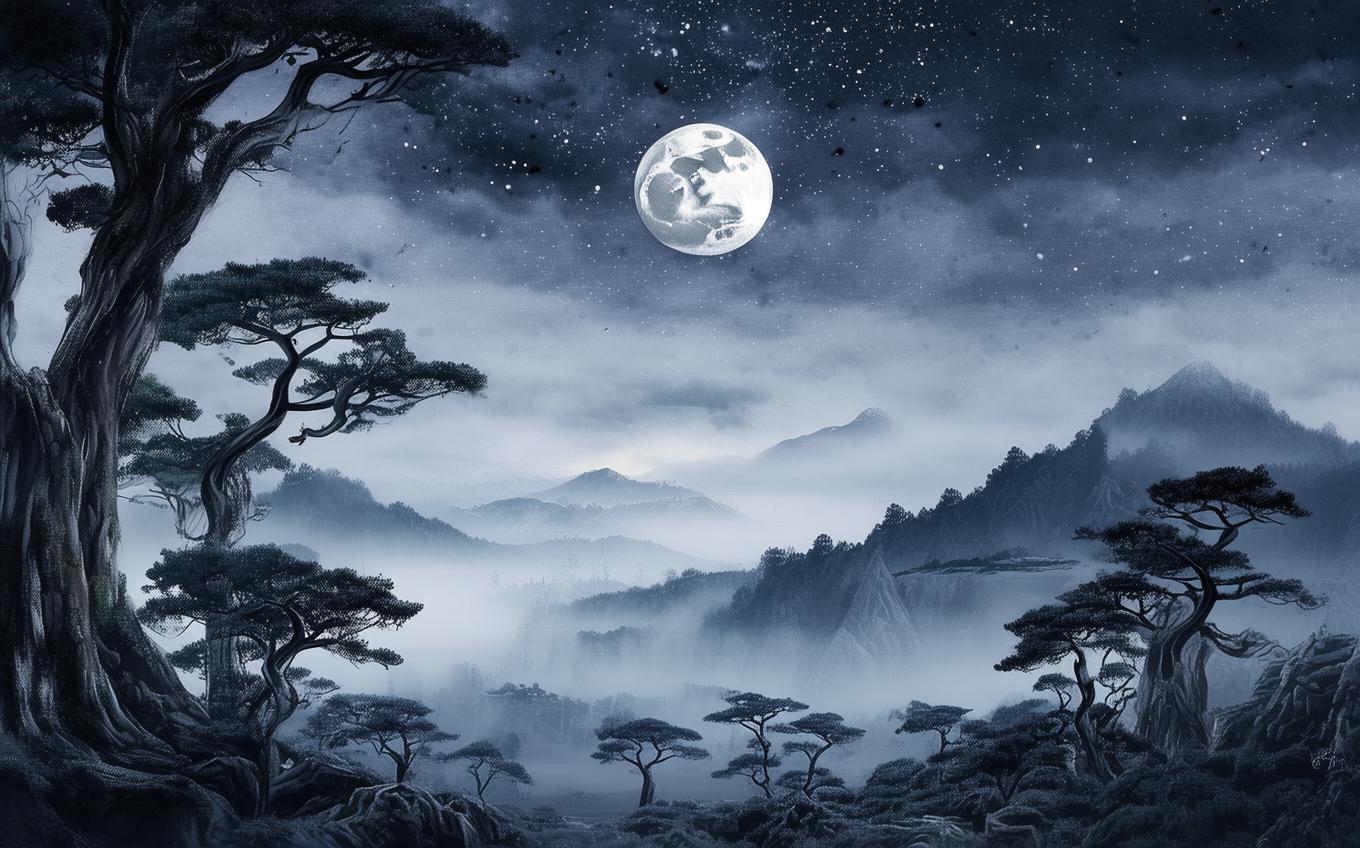
The poem opens with a grand, almost architectural image. 层轩 (céng xuān) refers to a multi-tiered pavilion or tower—a common feature in the gardens and palaces of Tang nobility. The verb 登 (dēng), meaning "to ascend" or "to climb," creates a sense of upward movement. But here, it is not the speaker who ascends; rather, the bright moon (皎月, jiǎo yuè) seems to climb the pavilion's tiers. This personification gives the moon an active, almost companionable quality.
The second half of the line, 流照满中天 ("flowing radiance fills the heavens"), uses the character 流 (liú)—"to flow"—to describe moonlight as if it were water or liquid silver pouring across the sky. This metaphor of light as a flowing substance is deeply rooted in Chinese poetic tradition, evoking both the visual effect of moonlight and its intangible, pervasive presence. The word 满 (mǎn), "full," emphasizes completeness and abundance, setting a tone of plenitude and harmony.
Line 2: 色共梁珠远,光随赵璧圆
This couplet introduces two classical allusions that would have been immediately recognizable to educated Tang readers. 梁珠 (Liáng zhū) refers to the legendary luminous pearls associated with the ancient state of Liang, said to shine with extraordinary brilliance. 赵璧 (Zhào bì) refers to the famous jade disk of the state of Zhao—the same precious artifact at the center of the well-known story of "returning the jade intact to Zhao" (完璧归赵). This jade disk, or 璧 (bì), was perfectly round, with a circular hole in the center, and was considered a national treasure.
By comparing the moon's color to the far-reaching brilliance of Liang pearls and its light to the perfect roundness of the Zhao jade, the poet elevates the moon from a mere natural phenomenon to an object of supreme aesthetic and cultural value. The moon becomes a jewel in the sky—precious, flawless, and radiant. This is not mere flattery of nature; it is a demonstration of the poet's cultural literacy and his ability to weave classical allusions into fresh imagery.
Line 3: 落影临秋扇,虚轮入夜弦
This line is the most intimate and evocative of the poem. 秋扇 (qiū shàn), or "autumn fan," is a loaded image in Chinese poetry. The fan, useful in summer but discarded in autumn, traditionally symbolizes a woman abandoned by her lover or a minister dismissed by his ruler. However, here the context is different: the moon's shadow falls upon an autumn fan, suggesting a gentle, melancholic beauty rather than abandonment. The fan becomes a canvas for moonlight, a surface upon which the moon inscribes its presence.
The second part, 虚轮入夜弦 ("the ethereal orb enters the strings of the night"), is more abstract. 虚轮 (xū lún)—"empty wheel" or "ethereal orb"—refers to the moon's disk, emphasizing its insubstantial, dreamlike quality. The 夜弦 (yè xián)—"night strings"—may evoke the strings of a musical instrument, suggesting that the moon's light is like music played upon the darkness. Alternatively, it may suggest the taut strings of a bow or the threads of fate. The image is deliberately ambiguous, inviting multiple interpretations and creating a sense of mystery.
Line 4: 所欣东馆里,预奉西园篇
The final couplet grounds the poem in its social context. 东馆 (dōng guǎn), the "Eastern Pavilion," and 西园 (xī yuán), the "Western Garden," are both references to specific locations associated with literary gatherings. The Western Garden, in particular, carries strong literary connotations: it was the site of the famous gathering of the Seven Sages of the Bamboo Grove and later became a symbol of refined literary fellowship.
The poet expresses his delight (所欣, suǒ xīn) at being in the Eastern Pavilion, where he has the honor of receiving (预奉, yù fèng) the poem composed at the Western Garden. The word 预 (yù) means "in advance" or "beforehand," suggesting that the poet is privileged to hear or read the Prince's poem before others. This is a gesture of deference and gratitude, appropriate for a poem written in response to a royal command.
Themes and Symbolism
The Moon as a Symbol of Perfection and Unity
The moon is the central symbol of this poem, and it operates on multiple levels. On the most immediate level, it is a beautiful natural phenomenon, admired for its brightness, roundness, and ethereal quality. But in Chinese culture, the full moon (满月, mǎn yuè) also symbolizes completeness, unity, and family reunion—associations that culminate in the Mid-Autumn Festival, when families gather to admire the full moon and eat mooncakes.
In this poem, the moon's roundness is explicitly compared to the Zhao jade disk, a symbol of perfection and priceless value. The moon thus becomes an emblem of aesthetic and moral excellence, a fitting subject for a poem composed at a royal gathering.
The Social Function of Poetry
The poem's title and final couplet make clear that this is not a spontaneous outpouring of personal emotion but a carefully crafted response to a social situation. The 奉和 (fèng hè) genre was a form of literary etiquette, a way of showing respect to one's host while demonstrating one's own poetic skill. The poet must match the rhyme scheme and theme of the original poem while also producing something fresh and beautiful—a challenging artistic feat.
This reflects a broader aspect of Chinese literary culture: poetry was not merely a private art form but a social practice, a means of building and maintaining relationships, expressing loyalty, and displaying cultural refinement.
Light as a Flowing, Connecting Force
The poem repeatedly uses imagery of flowing light (流照, liú zhào) and falling shadows (落影, luò yǐng), suggesting that moonlight is not static but dynamic, moving through space and connecting different elements—the pavilion, the fan, the strings, the heavens. This sense of connection mirrors the social bonds being celebrated in the poem: just as moonlight flows from the moon to the earth, so too does poetic inspiration flow from the Prince to his guests, and from one poet to another.
Cultural Context
The Tang Court and Literary Patronage
The Tang Dynasty was a period of extraordinary cultural flourishing, and the imperial court was at the center of this activity. Emperors and princes often acted as patrons of the arts, hosting gatherings where poetry was composed, recited, and evaluated. The 魏王 (Wèi Wáng), or Prince of Wei, mentioned in the title, was likely one such patron—a member of the imperial family who cultivated literary talent and expected those around him to participate in poetic exchanges.
This system of literary patronage had deep roots in Chinese history, stretching back to the Han Dynasty and beyond. It reached its apogee in the Tang, when poetry became a key qualification for government service and a marker of elite status.
The Allusion to the Western Garden
The reference to the 西园 (Xī Yuán) or "Western Garden" is particularly significant. In Chinese literary tradition, the Western Garden was associated with the famous gathering of the 建安七子 (Jiàn'ān Qī Zǐ)—the "Seven Masters of the Jian'an period"—who met at the court of Cao Cao in the late Han Dynasty. This gathering became a symbol of literary fellowship and creative collaboration, a model for later generations of poets and patrons.
By referencing the Western Garden, Chu Liang places himself and his patron within this prestigious lineage, suggesting that their gathering is a continuation of this noble tradition.
The Aesthetics of the Moon in Chinese Culture
The moon holds a special place in Chinese aesthetics. Unlike the sun, which is associated with masculine yang energy, the moon is linked to feminine yin energy—cool, receptive, and contemplative. Moon-viewing (望月, wàng yuè) was a popular pastime among the elite, often accompanied by wine, music, and poetry. The moon was seen as a companion to the solitary thinker, a source of inspiration, and a reminder of the cyclical nature of time.
In this poem, the moon is not merely observed but actively engaged with—it climbs the pavilion, flows across the sky, and casts its shadow on human objects. This active engagement reflects a broader Chinese aesthetic principle: the blurring of boundaries between subject and object, self and nature.
Conclusion
《奉和望月应魏王教》 is a small gem of Tang court poetry, a work that demonstrates both technical skill and cultural sophistication. Through its elegant imagery and carefully chosen allusions, it transforms a simple act of moon-viewing into a meditation on beauty, friendship, and the enduring power of art.
For modern readers, the poem offers a window into a world where poetry was not a solitary pursuit but a social bond, where the moon was not merely a celestial body but a symbol of perfection and unity, and where a well-crafted verse could serve as both a gesture of respect and a demonstration of genius.
In an age of constant distraction and fragmented attention, this poem reminds us of the value of slowing down, looking up at the sky, and allowing ourselves to be moved by the quiet beauty of the moon. It invites us to imagine a gathering of poets in a tiered pavilion, the moonlight flowing around them like liquid silver, each one composing verses that would echo through the centuries. And it reminds us that, in the words of the poet himself, there is profound joy in sharing such moments with others—in receiving, and in giving, the gift of poetry.
Sources and Verification
- Verified text and attribution: 褚亮, “奉和望月应魏王教” (Tang dynasty).
- Primary dataset: Chinese Poetry open corpus.
- Source record:
bdfbb09a-d41f-49bc-a7e7-4ed6c9335d71.
The Chinese source text and attribution are supplied from the verified record above. The English translation and commentary are educational explanations.
Comments (0)
No comments yet. Be the first to comment!