Introduction
Chu Liang (褚亮, 560–647) lived through the fall of the Sui and the founding of the Tang. A learned court scholar from the Hangzhou region, he later served among the celebrated literary attendants of Li Shimin, the future Emperor Taizong. His son, Chu Suiliang, would become one of the great calligraphers of the age. Chu Liang’s own verse belongs to the early Tang moment when older Southern court elegance met a new, more personal seriousness.
“晚别乐记室彦” (“Evening Farewell to Yue Yan, the Recorder”) is a parting poem addressed to a colleague: a man surnamed Yue (乐, pronounced Yuè), given name Yan (彦), who held the staff post of jishi (记室), a recorder or confidential secretary. The poem is not among the most famous Tang anthology pieces, yet it is a clear, moving example of how early Tang writers turned a formal farewell into a study of shared displacement. Its value lies in the restraint of its images—year’s end, river, mist, frost, sleeves, wine, geese, and a slow boat—and in the way those images make loneliness feel mutual rather than solitary.
The Poem: Full Text and Translation
穷途属岁晚,临水忽分悲。
Qióng tú shǔ suì wǎn, lín shuǐ hū fēn bēi.
At a road’s hard end, the year itself is late; beside the water, the grief of parting suddenly comes.
抱影同为客,伤情共此时。
Bào yǐng tóng wéi kè, shāng qíng gòng cǐ shí.
Each of us clasps his own shadow, and both of us are sojourners; wounded feeling belongs to us together, in this very hour.
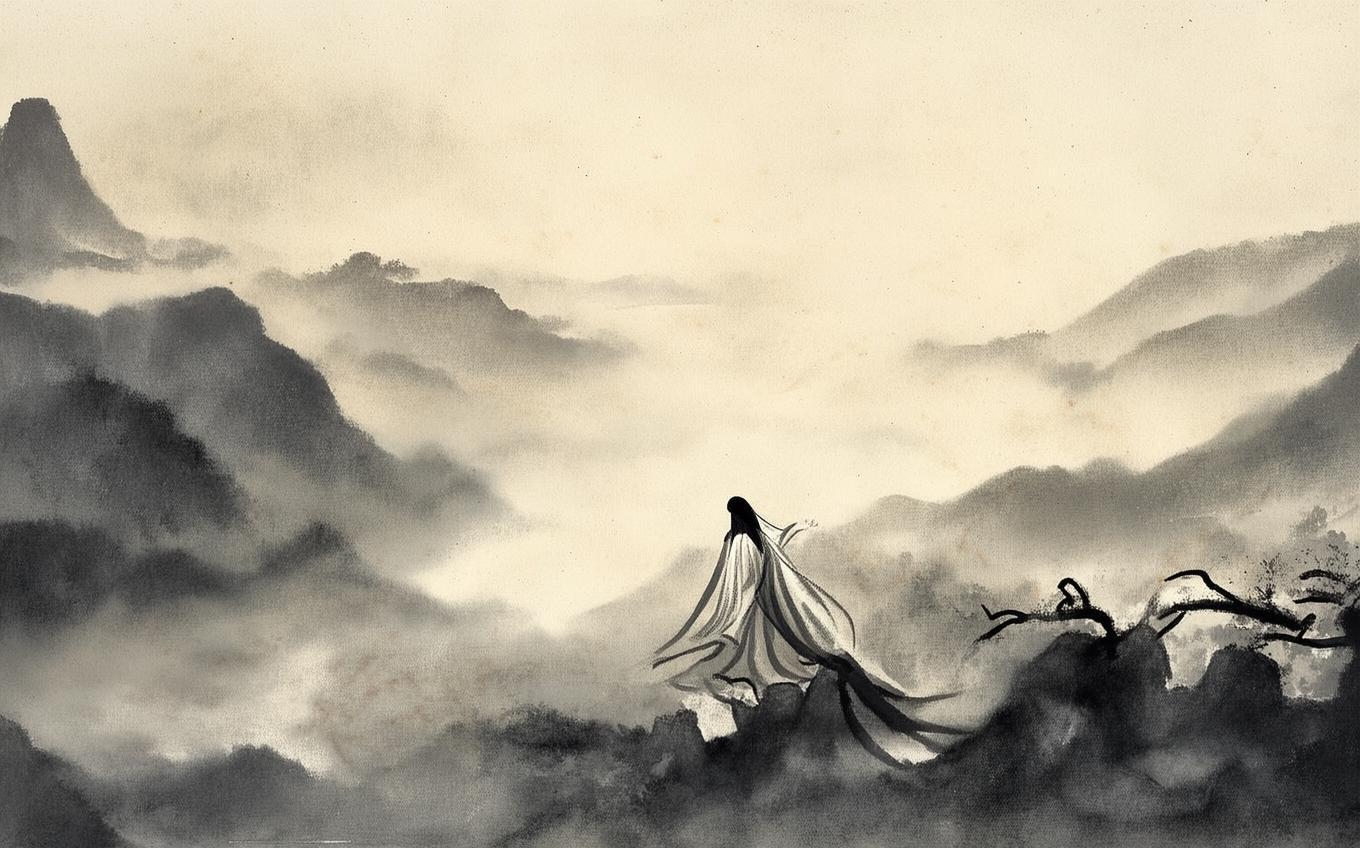
雾色侵虚牖,霜氛冷薄帷。
Wù sè qīn xū yǒu, shuāng fēn lěng bó wéi.
The color of mist invades the empty window; frosty air chills the thin curtain.
举袂惨将别,停杯怅不怡。
Jǔ mèi cǎn jiāng bié, tíng bēi chàng bù yí.
We raise our sleeves, wretched at the farewell about to happen; we set down the cups, melancholy and ill at ease.
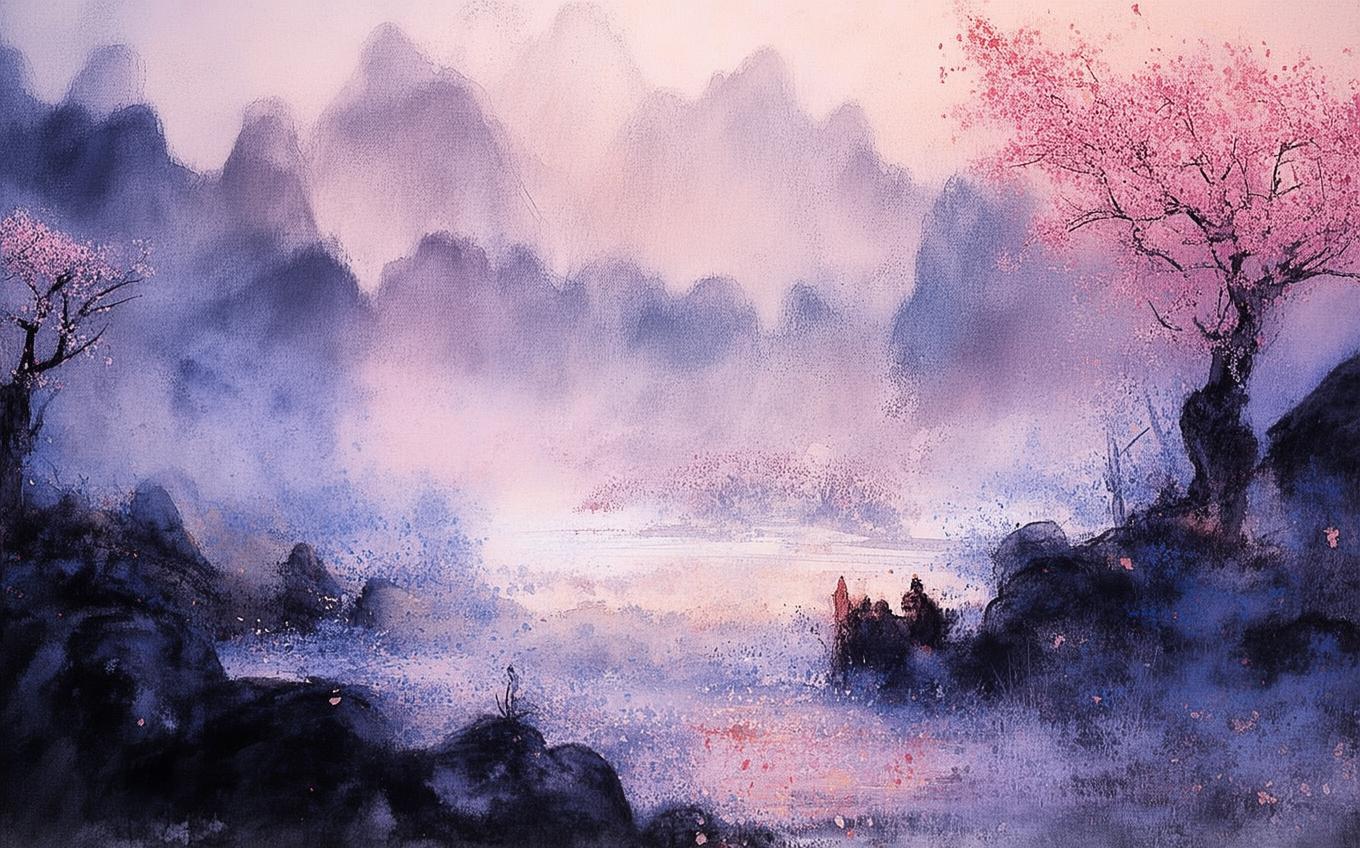
风严征雁远,雪暗去篷迟。
Fēng yán zhēng yàn yuǎn, xuě àn qù péng chí.
The wind is harsh, and the journeying geese are far; snow darkens the sky, and the departing boat’s awning is slow to go.
Line-by-Line Analysis
The opening couplet places the farewell at two edges at once. Qióng tú, “a road at its limit,” is an old phrase for a career or a journey that has reached difficulty, even exhaustion. Suì wǎn, “the year is late,” adds the calendar’s own ending: winter, when travel is hardest and homesickness sharpest. Then the scene narrows to water. In Chinese parting poetry, rivers and quays are the classic stage of goodbye, because one person stays on shore and the other is carried away. Fēn bēi—grief that “divides,” or the sorrow proper to separation—arrives hū, “suddenly.” The emotion is not argued; it breaks in.
The second couplet is the poem’s emotional center. Bào yǐng, “embracing one’s shadow,” is a traditional image of isolation: when no companion remains, only the shadow keeps a person company. Chu Liang immediately revises that solitude. Tóng wéi kè, “together we are guests,” means both men are away from home, serving or traveling in someone else’s place. Their loneliness is shared. Shāng qíng gòng cǐ shí, “wounded feeling is common to this moment,” binds them in time as well as in circumstance. The poem’s tenderness comes from this recognition: neither friend is merely sending the other off from a settled life. Both are unsettled.
The third couplet turns outward to the room where the farewell banquet seems to be taking place. Mist does not simply hang outside; its sè, its dim color, qīn, “invades,” the xū yǒu, the empty lattice window. Frosty vapor makes the bó wéi, the thin bed-curtain or hanging, cold. “Empty” and “thin” do quiet work. The window is unoccupied by any warmer scene, and the curtain is too slight to keep the season out. Nature is not a backdrop here. It enters the private space and confirms what the friends already feel.
The fourth couplet gives the human gestures. Jǔ mèi, raising the sleeve, can suggest a formal wave of parting and also the wiping away of tears; sleeves in classical verse often carry emotion that the face does not fully show. Cǎn jiāng bié stresses that the separation is imminent rather than complete: the grief is in the about-to-be. Tíng bēi, stopping the cup, interrupts the usual comfort of a farewell drink. Wine should ease the moment. Instead the cups are set down, and chàng bù yí—restless sadness, a failure to feel at ease—remains. Courtesy and ritual cannot finish the feeling.
The last couplet lifts the view to sky and distance. Zhēng yàn, migrating wild geese, are both a sign of deep winter and a traditional figure for messages traveling far from home. They are already yuǎn, far off, under a yán, severe, wind. Below or beyond them, snow darkens the scene—xuě àn is not a bright snowfall but a dimming one—and the qù péng, the mat awning of the boat that must leave, is chí, slow. The delay may be weather, but in the poem it reads as reluctance. Even the boat seems unwilling to complete what the friends have already begun to suffer.
Themes and Symbolism
The dominant theme is parting intensified by shared exile. This is not a poem of one settled friend pitying a traveler. The word kè, “guest” or “sojourner,” places both men in a life of temporary lodging, official service, and uncertain roads. Loneliness is therefore not only the absence of the other after goodbye; it is the condition they already inhabit, briefly made bearable by being in the same room.
Time and season reinforce that condition. Year’s end, frost, harsh wind, and snow are not decorative winter scenery. In Chinese poetry they mark closure, exposure, and the difficulty of movement. The late year echoes the “road at its limit”: public life and private feeling both seem to be running out of ease.
Several symbols carry the emotion without naming it outright. The shadow is the companion left when human company fails, yet here each man has a shadow and, for a moment, a friend. The empty window and thin curtain show a dwelling that cannot shelter them from the season or from departure. Raised sleeves and paused cups are the social ritual of farewell breaking down into genuine distress. Wild geese suggest distance, migration, and the old hope that news might still travel. The boat’s awning, slow under a darkened sky, is the future itself: separation is certain, but the poem lingers on the delay, as if feeling could hold the boat a little longer.
Cultural Context
Early Tang official culture was built on movement. Scholars and secretaries followed princes, regional headquarters, and the shifting needs of a new dynasty. A jishi was not a remote bureaucrat on paper alone; he drafted documents, managed correspondence, and lived in the household or headquarters he served. Friendships formed in that world were real, but they were also subject to orders, transfers, and the roads between posts. A poem of evening farewell was both a personal gift and a socially recognizable form.
The poem also reflects a long-standing Chinese value: feeling should be deep, but its expression should remain measured. Chu Liang does not protest the journey or blame anyone for the separation. He records the place, the weather, the shared status of guest, and a few restrained gestures. That balance—strong emotion held inside parallel, carefully made lines—is itself a cultural ideal. It resembles the broader Confucian tension between private attachment and public duty. One may grieve, but one still boards the boat.
Philosophically, the poem is closer to the melancholy clarity of classical verse than to explicit Daoist or Buddhist reflection. Still, its images imply a view of life as provisional. Houses are thin against frost, roads reach dead ends, years close, and people remain guests. What can be fully possessed is not permanence but a shared hour: gòng cǐ shí, “together, this time.”
Conclusion
“晚别乐记室彦” is beautiful because it refuses to exaggerate. Chu Liang builds a farewell from a hard road, a winter river, two shadows, an invaded window, a sleeve, a cup set down, distant geese, and a boat that leaves too slowly. Each image is familiar in Chinese poetry; together they make a particular friendship feel precise and unsentimental.
The poem’s message remains easy to recognize. Separation hurts most when both people are already far from home, and when the season itself seems to be ending. Its relevance is not limited to Tang official travel. Anyone who has said goodbye in a temporary place—at the end of a year, with bad weather outside and the departure not quite willing to happen—can still hear the quiet claim at its center: for this hour, at least, the sorrow is shared.
Sources and Verification
- Verified text and attribution: 褚亮, “晚别乐记室彦” (Tang dynasty).
- Primary dataset: Chinese Poetry open corpus.
- Source record:
2d657619-0d58-46c1-9e1f-3af22bf57230.
The Chinese source text and attribution are supplied from the verified record above. The English translation and commentary are educational explanations.

Comments (0)
No comments yet. Be the first to comment!