Introduction
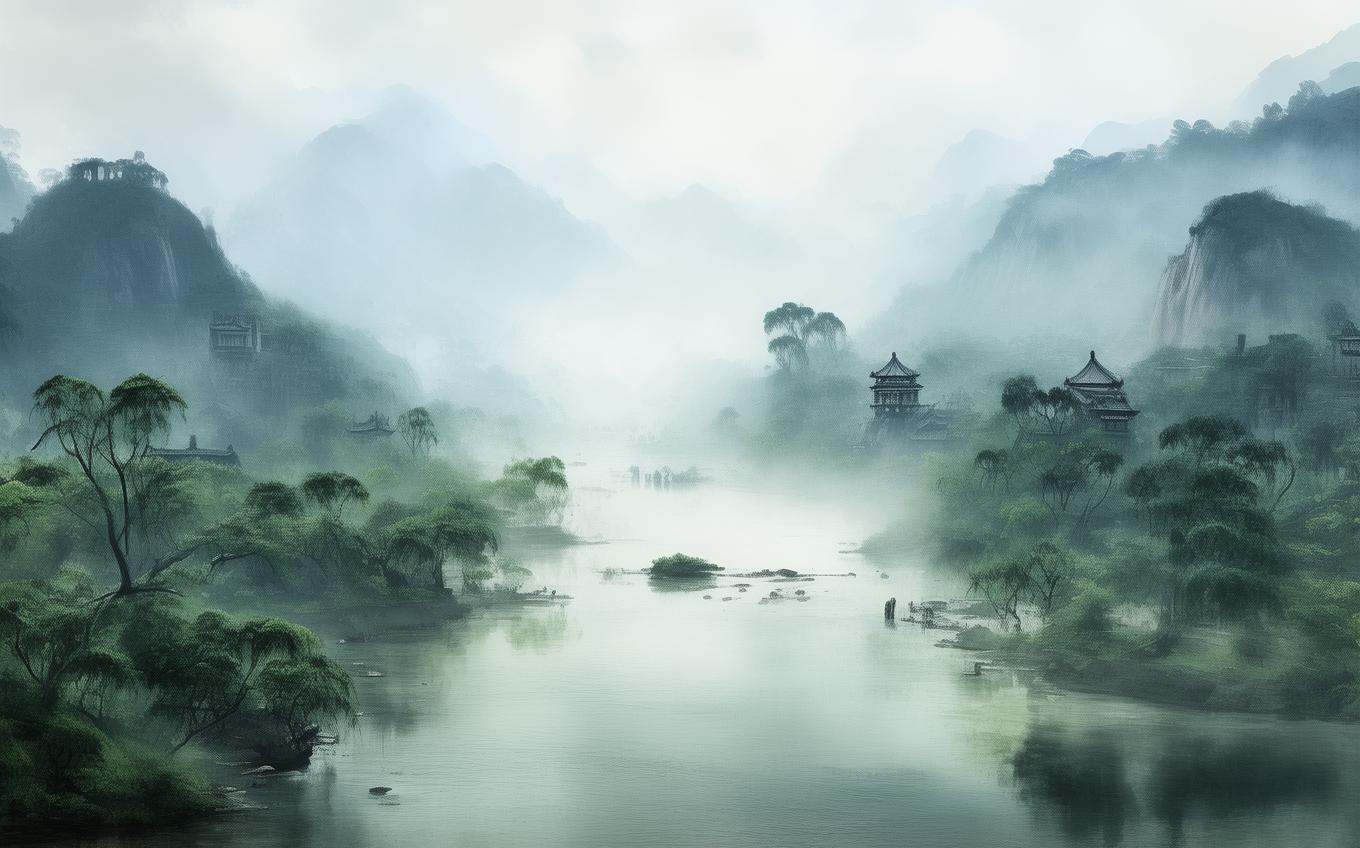
"早发成皐望河" (Departing from Chenggao at Dawn, Gazing at the Yellow River) is a landscape poem by 刘孝孙 (Liu Xiaosun), a poet of the early Tang Dynasty. The poem captures a moment of profound reflection as the speaker departs from the fortified region of Chenggao and looks out upon the vast waters of the Yellow River — a river that has long served as both a physical lifeline and a spiritual symbol in Chinese civilization.
Liu Xiaosun is not among the most famous names in Tang poetry, yet this work exemplifies the early Tang aesthetic: a fusion of vivid natural description, historical allusion, and deep emotional resonance. The poem stands as a meditation on time, mortality, and the enduring presence of the past, all framed by the awe-inspiring landscape of one of China's greatest rivers.
The Yellow River (黄河, Huáng Hé) is often called the "Mother River" of Chinese civilization. Its turbulent waters, unpredictable floods, and immense scale have inspired poets for millennia. In this poem, the river becomes more than a geographical feature — it becomes a mirror for the poet's own unsettled spirit and a gateway to the legends of ancient China.
The Poem: Full Text and Translation
清晨发岩邑,车马走轘辕。
Qīngchén fā yán yì, chēmǎ zǒu Huányuán.
At dawn I depart from the rocky town, horses and carriage pass through Huanyuan.
回瞰黄河上,惝怳屡飞魂。
Huí kàn Huánghé shàng, chǎnghuǎng lǚ fēi hún.
Turning back to gaze upon the Yellow River, my spirit repeatedly flies away in dazed confusion.
鸿流遵积石,惊浪下龙门。
Hóng liú zūn jīshí, jīng làng xià Lóngmén.
The mighty current follows the Jishi Mountains, the startling waves descend through Dragon Gate.
仙槎不辨处,沈璧想犹存。
Xiān chá bù biàn chù, chén bì xiǎng yóu cún.
The immortal's raft can no longer be located, yet I imagine the sunken jade disc still remains.
远近洲渚出,飒沓凫鴈喧。
Yuǎnjìn zhōuzhǔ chū, sàtà fú yàn xuān.
Near and far, islets and sandbanks emerge; in swift clamor, wild ducks and geese cry out.
怀古空延伫,叹逝将何言。
Huái gǔ kōng yánzhù, tàn shì jiāng hé yán.
Longing for antiquity, I stand lingering in vain; sighing over what has passed, what words can I offer?
Line-by-Line Analysis
清晨发岩邑,车马走轘辕。
The poem opens with a scene of departure. "岩邑" (yán yì) literally means "rocky town" or "fortified city among rocks," referring to Chenggao (成皐), a strategically important area in ancient China known for its rugged terrain and defensive fortifications. The word "清晨" (qīngchén, "clear morning") establishes both a temporal setting and a mood of freshness tinged with solemnity. The mention of "轘辕" (Huányuán) — a famous mountain pass in present-day Henan Province — grounds the poem in real geography while also evoking the arduous journeys of ancient travelers. The movement of "车马" (chēmǎ, "carriage and horses") suggests official travel, perhaps a military or administrative mission, lending the opening a sense of duty and restlessness.
回瞰黄河上,惝怳屡飞魂。
The second couplet introduces the central action: the speaker turns back to look at the Yellow River. The verb "回瞰" (huí kàn, "turn back and gaze") is emotionally loaded — it implies reluctance to leave, a lingering attachment to what is being left behind. The phrase "惝怳" (chǎnghuǎng) is a disyllabic compound meaning "dazed," "bewildered," or "in a trance-like state." It appears in earlier Chinese poetry, notably in the "Chuci" (楚辞, Songs of Chu), where it describes a state of spiritual disorientation. The image of the soul "flying" (飞魂, fēi hún) suggests that the speaker's spirit is so moved by the sight of the river that it leaves his body — a powerful expression of awe and emotional overwhelm.
鸿流遵积石,惊浪下龙门。
Here the poet describes the river's course with two geographical references. "积石" (Jīshí) refers to the Jishi Mountains, traditionally considered the source area of the Yellow River in ancient Chinese geography. "龙门" (Lóngmén, "Dragon Gate") is a famous narrow gorge along the Yellow River where the waters rush with tremendous force. According to legend, the sage-king Yu the Great (大禹, Dà Yǔ) carved the Dragon Gate to control flooding. The verb "遵" (zūn, "to follow") personifies the river as a traveler obeying the contours of the land, while "惊浪" (jīng làng, "startling waves") captures the violent energy of the water as it crashes through the gorge. This couplet celebrates the river's mythic power while also acknowledging its destructive potential.
仙槎不辨处,沈璧想犹存。
This couplet introduces two allusions rich in cultural significance. The "仙槎" (xiān chá, "immortal's raft") refers to a legend recorded in the "博物志" (Bówù Zhì, Record of Marvels): a man once floated on a raft up the Milky Way and encountered the Weaving Maid (织女, Zhīnǚ) and the Cowherd (牛郎, Niúláng). The story symbolizes the human desire to transcend earthly limitations and reach the divine. The poet says the place of the immortal's raft can no longer be identified — suggesting that the path to transcendence has been lost or obscured.
The "沈璧" (chén bì, "sunken jade disc") alludes to another ancient legend: when Yu the Great successfully controlled the floodwaters, he cast a jade disc (璧, bì) into the river as an offering to the river gods. The jade disc was a sacred object used in rituals and symbolized purity, value, and communication with the divine. By imagining that the jade disc still lies beneath the waters, the poet suggests that the river preserves the traces of ancient heroism and piety, even if they are no longer visible to the human eye.
远近洲渚出,飒沓凫鴈喧。
After the weight of historical allusion, the poet returns to the present moment with keen sensory observation. "洲渚" (zhōuzhǔ) refers to small islets and sandbanks that emerge from the river's surface — a reminder of the river's ever-changing topography as sediment shifts and water levels fluctuate. The phrase "远近" (yuǎnjìn, "near and far") creates a sense of spatial depth, inviting the reader to scan the vast river landscape. The onomatopoeic compound "飒沓" (sàtà) evokes the rapid, fluttering movement of birds taking flight, while "凫鴈" (fú yàn, "wild ducks and geese") brings the scene to life with sound and motion. The contrast between the silent, ancient river and the noisy, present-day birds heightens the poem's meditation on time.
怀古空延伫,叹逝将何言。
The final couplet crystallizes the poem's emotional core. "怀古" (huái gǔ, "longing for antiquity") is a central concept in Chinese poetry — a nostalgic yearning for the golden ages of the past, for the heroes and sages whose deeds still echo through the landscape. The word "空" (kōng, "in vain," "emptily") is devastating in its simplicity: the poet stands there, lingering, but his longing cannot bring the past back. "叹逝" (tàn shì, "sighing over what has passed") echoes a famous line from the "Analects" (论语, Lúnyǔ): "The Master stood by a river and said: 'What passes is like this, never ceasing day or night'" (子在川上曰:逝者如斯夫,不舍昼夜). The final question — "将何言" (jiāng hé yán, "what words can I offer") — is rhetorical, expressing the inadequacy of language in the face of time's relentless flow.
Themes and Symbolism
The River as Time
The Yellow River is the poem's central symbol, representing the inexorable passage of time. Just as the river flows ceaselessly toward the sea, so too do human lives, dynasties, and civilizations move irrevocably toward their end. The poet's gaze upon the river becomes a meditation on mortality — his own and that of all who came before him.
Nostalgia and Historical Memory
The poem is steeped in "怀古" (huái gǔ), the longing for antiquity that pervades much of Chinese literature. The allusions to Yu the Great, the immortal's raft, and the sunken jade disc all point to a golden age when humans could communicate with the divine and heroes could tame the forces of nature. The poet's inability to locate these traces in the present reflects a sense of loss and disconnection from the past.
The Sublime in Nature
The description of the river — its "鸿流" (mighty current), "惊浪" (startling waves), and the dramatic landscape through which it flows — exemplifies the aesthetic of the sublime. The river is beautiful but also terrifying, life-giving but also destructive. This duality mirrors the Chinese philosophical concept of yin and yang: opposing forces that are ultimately complementary and interdependent.
The Limits of Language
The poem ends with a question about the inadequacy of words. After all the vivid description and rich allusion, the poet confesses that he cannot fully express what he feels. This humility before the ineffable is a hallmark of classical Chinese aesthetics, which often values suggestion and understatement over explicit statement.
Cultural Context
The Yellow River in Chinese Civilization
The Yellow River has been central to Chinese identity for over three thousand years. It was along its banks that the earliest Chinese dynasties — the Xia, Shang, and Zhou — established their capitals. The river provided water for agriculture, a route for transportation, and a natural defense against invaders. However, its frequent flooding also brought devastation, earning it the nickname "China's Sorrow" (中国的忧患, Zhōngguó de yōuhuàn). The legend of Yu the Great, who tamed the floods through dredging rather than damming, embodies the Chinese ideal of harmonious coexistence with nature rather than domination over it.
Chenggao and Huanyuan Pass
Chenggao (成皐) was a strategically vital location in ancient China, particularly during the Warring States period and the Chu-Han Contention (206–202 BCE). It was the site of numerous battles due to its position controlling access to the Yellow River and the fertile plains beyond. Huanyuan Pass (轘辕关) was one of the "Eight Passes of Luoyang," a series of mountain fortifications protecting the ancient capital. By setting his poem in this historically charged landscape, Liu Xiaosun invites readers to feel the weight of centuries of conflict and ambition.
Early Tang Poetry
The early Tang Dynasty (7th century) was a period of consolidation and cultural flowering after centuries of division and warfare. Poets of this era sought to revive the grandeur of Han Dynasty literature while also incorporating the lyrical intensity of the Southern Dynasties. Liu Xiaosun's poem reflects this synthesis: it combines the rugged, masculine imagery of the northern landscape with the refined emotional sensitivity of southern poetry.
The Confucian and Daoist Dimensions
The poem's meditation on time and mortality resonates with both Confucian and Daoist thought. The Confucian tradition emphasizes the importance of historical memory and the moral lessons to be learned from the past. The Daoist tradition, by contrast, encourages acceptance of the natural flow of existence and recognition of the limits of human effort. The poem holds these two perspectives in tension: the poet longs for the past (Confucian) but ultimately accepts the futility of that longing (Daoist).
Conclusion
"早发成皐望河" is a poem of remarkable depth and beauty. In just twelve lines, Liu Xiaosun transports us to the banks of the Yellow River at dawn, where the sight of the great waterway triggers a cascade of emotions — awe, nostalgia, melancholy, and ultimately a quiet acceptance of human limitation. The poem's power lies in its ability to connect the personal with the universal, the momentary with the eternal.
What makes this poem endure is its honesty. The poet does not offer easy answers or comforting platitudes. Instead, he stands before the river — that ancient symbol of time itself — and admits that words are insufficient. In doing so, he speaks for all of us who have ever been struck speechless by the beauty and terror of existence.
For modern readers, the poem offers a reminder of the value of stillness and reflection. In a world that often demands constant motion and productivity, Liu Xiaosun's lingering gaze upon the river invites us to pause, to look back, and to honor the past even as we continue our journey forward. The river still flows, the birds still cry, and the ancient jade disc still lies somewhere beneath the waters — waiting, perhaps, for someone to remember.
Sources and Verification
- Verified text and attribution: 刘孝孙, “早发成皐望河” (Tang dynasty).
- Primary dataset: Chinese Poetry open corpus.
- Source record:
055bba81-4c1a-46a0-bb05-67739d1cc395.
The Chinese source text and attribution are supplied from the verified record above. The English translation and commentary are educational explanations.
Comments (0)
No comments yet. Be the first to comment!