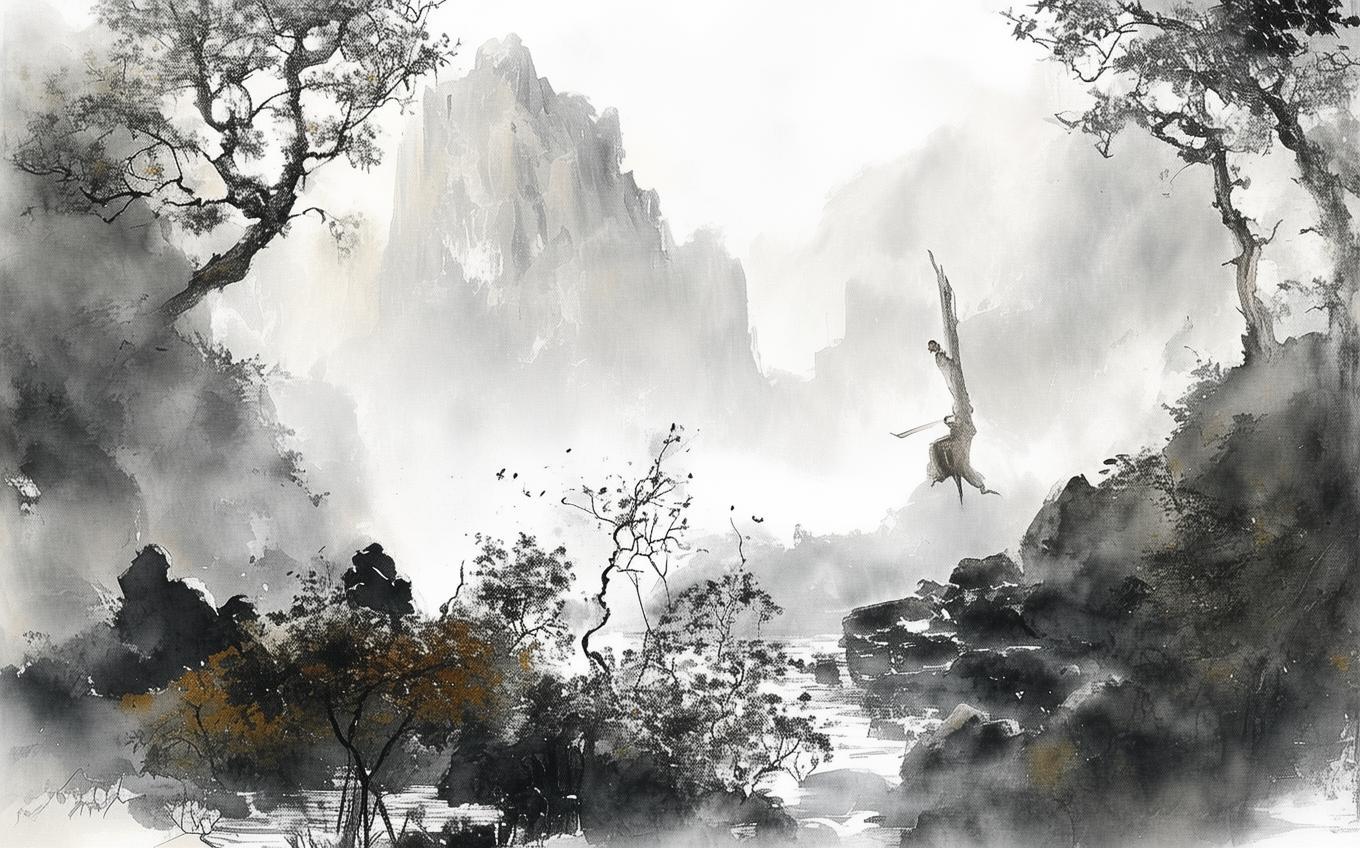
Analysis of “江城子·密州出獵” (Hunting at Mizhou) – Classical Chinese Poetry
Introduction
Su Shi (蘇軾, 1037–1101), also known as Su Dongpo, is one of the most celebrated figures in Chinese literary history. A statesman, essayist, gastronome, and peerless poet of the Song Dynasty, his works are admired for their emotional depth, philosophical insight, and bold romanticism. Among his many famous poems, “江城子·密州出獵” (Jiāngchéngzǐ · Mìzhōu chūliè, “Hunting at Mizhou”) stands out as a stirring anthem of patriotic vigor and resilient old age. Composed in 1075 when Su Shi was serving as prefect of Mizhou (in modern Shandong), the poem transforms a simple hunt into a declaration of his unwavering loyalty to the empire, despite political exile and advancing years. It remains one of the most frequently recited poems celebrating martial spirit and the refusal to surrender to time.
The Poem: Full Text and Translation
First stanza
老夫聊发少年狂,
Lǎo fū liáo fā shào nián kuáng,
An old man I may be, but for once I unleash a youthful frenzy;左牵黄,右擎苍,
Zuǒ qiān huáng, yòu qíng cāng,
Left hand leading a yellow hound, right hand holding a gray goshawk;锦帽貂裘,千骑卷平冈。
Jǐn mào diāo qiú, qiān jì juǎn píng gāng.
In brocade hat and sable coat, a thousand horsemen sweep across the flat hills.为报倾城随太守,亲射虎,看孙郎。
Wèi bào qīng chéng suí tài shǒu, qīn shè hǔ, kàn sūn láng.
To repay the whole city that has followed their prefect, I’ll shoot a tiger myself—watch me play the part of Sun Lang!
Second stanza
酒酣胸胆尚开张,
Jiǔ hān xiōng dǎn shàng kāi zhāng,
Heartened by wine, my chest and courage still swell open;鬓微霜,又何妨?
Bìn wēi shuāng, yòu hé fáng?
My temples are lightly dusted with frost—so what?持节云中,何日遣冯唐?
Chí jié yún zhōng, hé rì qiǎn Féng Táng?
When will the court send a Feng Tang with a tally to recall me from this frontier town?会挽雕弓如满月,西北望,射天狼。
Huì wǎn diāo gōng rú mǎn yuè, xī běi wàng, shè tiān láng.
I will draw the carved bow like a full moon, gaze northwest, and shoot the Celestial Wolf.
Line-by-Line Analysis
The poem opens with a delightful paradox: Lǎo fū liáo fā shào nián kuáng — the speaker calls himself an old man yet claims to channel a “youthful frenzy.” This sets the tone for the entire piece, where age is acknowledged only to be defiantly brushed aside. The word kuáng (狂) implies an untamed, almost eccentric energy, suggesting that hunting is not a duty but a release of suppressed passion.
The second line paints a vivid tableau of the hunt. In traditional Chinese poetry, specific animals carry symbolic weight. The “yellow” hound suggests loyalty and earthiness; the “gray” goshawk (cāng) is a bird of prey associated with ferocity and a soaring spirit. By placing one on his left and the other on his right, Su Shi presents himself as the commanding center of wild, controlled power. The image is immediately magnified by qiān jì juǎn píng gāng — a thousand horsemen rolling across the hills like a tide. The verb juǎn (to roll up, to sweep) turns the cavalcade into a natural force, a storm of silk and leather.
The first stanza culminates in a personal boast that is also a show for his people. The phrase qīng chéng (literally “empty the city”) hyperbolically claims that everybody in Mizhou has poured out to watch their prefect. To honor their enthusiasm, he vows to qīn shè hǔ (personally shoot a tiger). Then he dares them to watch him become Sūn Láng — Sun Lang, a nickname for Sun Quan (182–252), the heroic ruler of Eastern Wu during the Three Kingdoms period, who famously killed a tiger with his own hands when his horse was attacked. This allusion instantly elevates a local grandee’s hunting trip to the level of classical legend, fusing self-deprecating theater with genuine valor.
The second stanza shifts inward. Jiǔ hān (flushed with wine) is more than intoxication; it is a state of emotional openness. His chest and courage (xiōng dǎn) shàng kāi zhāng — still expand, still swell, as if physically pushing back against the constraints of middle age. The wine strips away pretense and reveals the true ambition simmering beneath the jovial hunt.
Then the poet looks at himself: bìn wēi shuāng — a faint frost on his temples. The metaphor is delicate, almost tender, yet immediately challenged by yòu hé fáng? (what does it matter?). The tiny frost cannot chill his inner fire. This refusal to lament graying hair is a hallmark of Su Shi’s optimistic resilience.
The next two lines contain the poem’s political and emotional core. Su Shi alludes to the story of Wei Shang, a capable Han Dynasty general who, in old age, was unjustly demoted. When the emperor came to his senses, he sent an envoy named Feng Tang with the official tally (jié) to restore Wei Shang to command at the remote fortress of Yunzhong. Here Su Shi is no longer a prefect on a joyride; he is a warrior-statesman exiled to a frontier post, dreaming of the day the court will recognize his worth and summon him back to defend the realm. The question hé rì (what day?) drips with longing and restrained bitterness.
The poem surges to its climax with one of the most iconic images in Chinese martial poetry: huì wǎn diāo gōng rú mǎn yuè — “I will draw the carved bow like a full moon.” The full moon is a symbol of wholeness, perfection, and reunion, but here it is weaponized. The bow, pulled into a perfect circle, becomes a promise of power fully realized. Then he looks xī běi wàng — gazes northwest — toward the direction of the Western Xia kingdom, the Song Empire’s perennial enemy on the steppe. And what does he shoot? Tiān láng, the Celestial Wolf, a baleful star in ancient Chinese astrology that governed invasion and war. To shoot the Celestial Wolf was to annihilate the barbarian threat. One old man, one bow, and a cosmic target: the poem transforms personal frustration into a mythic act of national salvation.
Themes and Symbolism
Resilience against time. The poem’s most immediate theme is the refusal to be defined by age. “Frosted temples” are a conventional image of aging in Chinese poetry, but Su Shi treats them as inconsequential, a mere dusting on an otherwise undiminished spirit. The “youthful frenzy” is not nostalgia for the past but a living force that can be summoned on command.
Patriotism and frustrated ambition. Throughout the piece, the hunt is a metaphor for military readiness. The hawk and hound, the thousand horsemen, the tiger-slaying swagger — all point toward the martial skill the speaker longs to put to genuine use. The Feng Tang allusion reveals his deep sorrow: he is a talent sidelined, while enemies gnaw at the empire’s borders. The final image of shooting the Celestial Wolf crystallizes his desire to protect the realm, even if he must do it symbolically.
Heroic ideal and self-fashioning. By invoking Sun Lang (Sun Quan) and the ancient general Wei Shang, Su Shi places himself in a lineage of active, heroic figures. He is not merely mimicking them; he is claiming their legacy, asserting that he, too, can step from the page of history into the present. This self-mythologizing is characteristic of Su Shi, who often used poetry to construct a persona of unbreakable optimism.
The bow and the wolf. The “carved bow” (diāo gōng) is a symbol of the cultivated warrior — art and violence combined. Drawn into the full moon, it becomes a circle of completeness, uniting the human, the cosmic, and the martial. The Celestial Wolf (tiān láng) is drawn from the star lore of the Tiān Guān Shū (天官書) where it signified invasion and chaos. To aim at this star is to aim at the root of all turmoil.
Cultural Context
The Song Dynasty (960–1279) was a period of extraordinary cultural achievement and persistent military anxiety. Unlike the expansionist Tang before it, the Song often found itself on the defensive against the Khitan Liao dynasty in the north and the Tangut Western Xia in the northwest. The year 1075, when Su Shi wrote this poem, was part of a turbulent era of reform under Emperor Shenzong. Su Shi had been demoted from the capital for opposing the radical policies of Wang Anshi, and his posting to Mizhou was a form of political exile. He was only thirty-eight — hardly an old man — but his self-designation as lǎo fū (old fellow) was both a poetic convention and a rueful acknowledgment of his thwarted career.
Hunting in ancient China was never merely sport. For the ruling class, it was a ritualized demonstration of martial prowess and a reminder of the warrior origins of the nobility. By staging an elaborate hunt and writing about it, Su Shi was signaling that he had not forgotten the duties of a scholar-official to protect the state. The allusions to historical figures were not mere ornament: they functioned as coded political messages. Readers would immediately recognize the parallels between Su Shi and Wei Shang — a loyal servant wrongly sidelined — and the call for a “Feng Tang” was a thinly veiled plea to the emperor. The poem thus operates on two levels: a vibrant hunting scene and a delicate political petition wrapped in heroic imagery.
Conclusion
“江城子·密州出獵” endures because it is a masterpiece of swagger turned into art. In just a few lines, Su Shi conjures the pounding hooves of a thousand horses, the chill of frosted temples, and the vast arc of the northwest sky. He transforms a local hunt into a stage for personal and national aspirations, and he does it all with a grin that never fades into bitterness. The poem reminds us that the human spirit can remain “youthfully frenzied” regardless of circumstance, that one can draw a bow against the void and still hope to strike a star. For readers today, whether facing personal setbacks or larger anxieties, Su Shi’s voice from the eleventh century offers an enduring lesson: meet the world with courage, a little wine, and the unwavering belief that it is never too late to draw the bow.
Comments (0)
No comments yet. Be the first to comment!