Analysis of "饮马长城窟行" - Classical Chinese Poetry
Introduction
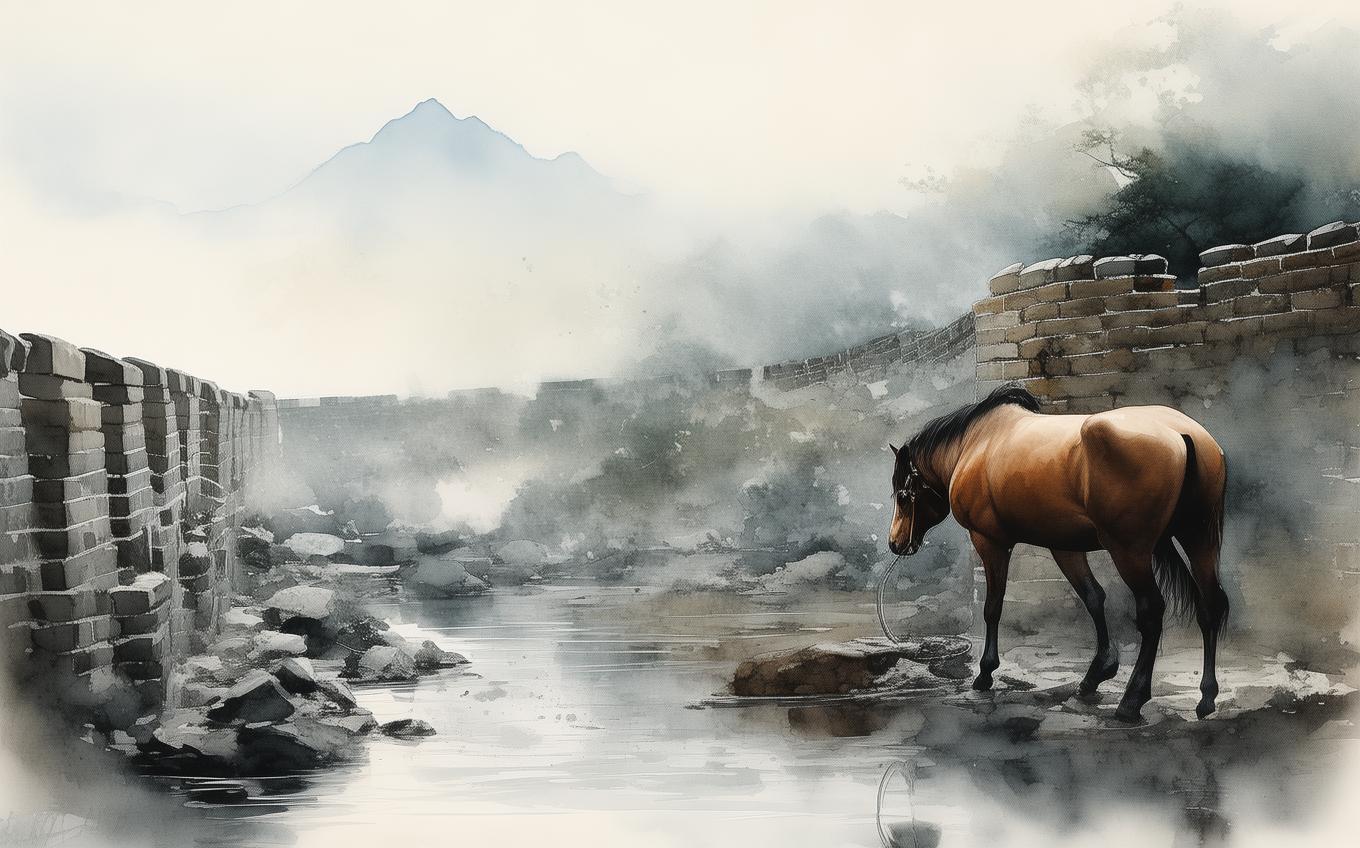
"饮马长城窟行" (Yǐn Mǎ Cháng Chéng Kū Xíng), often translated as "Drinking Horses at the Long Wall Spring," is a hauntingly beautiful poem from the Han dynasty (206 BC–220 AD). It belongs to the yuefu (乐府) tradition — folk songs or ballad-style poems collected by the imperial music bureau. The poem’s author is unknown, as is the case with many early yuefu, but its voice is unmistakably that of a woman longing for a husband who has been conscripted to labor or fight on the northern frontier, near the Great Wall. The title itself refers to a desolate spot where soldiers watered their horses at a spring by the Wall — an image that instantly conjures distance, hardship, and separation.
For centuries, this poem has been cherished for its exquisite layering of natural imagery, dream psychology, and a dramatic twist ending. It is not merely a lament; it is a delicate exploration of love, absence, and the fragile thread of human connection maintained across vast distances. This analysis will guide English-speaking readers through the poem line by line, unpacking its rich symbolism and cultural context.
The Poem: Full Text and Translation
Below is the complete poem in the original Chinese, followed by Pinyin romanization and a faithful English translation.
青青河畔草,
Qīng qīng hé pàn cǎo,
Green, green grows the grass by the river;绵绵思远道。
Mián mián sī yuǎn dào.
Unbroken, my thoughts reach to the distant road.远道不可思,
Yuǎn dào bù kě sī,
That distant road is beyond my thinking,夙昔梦见之。
Sù xī mèng jiàn zhī.
Yet last night I dreamed of him.梦见在我傍,
Mèng jiàn zài wǒ bàng,
In the dream he was right beside me,忽觉在他乡。
Hū jué zài tā xiāng.
Suddenly I woke, and he was in another land.他乡各异县,
Tā xiāng gè yì xiàn,
In another land, in a different county —展转不相见。
Zhǎn zhuǎn bù xiāng jiàn.
Tossing and turning, we cannot see each other.枯桑知天风,
Kū sāng zhī tiān fēng,
The withered mulberry knows the sky’s wind;海水知天寒。
Hǎi shuǐ zhī tiān hán.
The sea water knows the sky’s cold.入门各自媚,
Rù mén gè zì mèi,
Each one entering the door pleases only themselves;谁肯相为言?
Shuí kěn xiāng wèi yán?
Who is willing to speak a word for me?客从远方来,
Kè cóng yuǎn fāng lái,
A traveler came from a far-off place,遗我双鲤鱼。
Wèi wǒ shuāng lǐ yú.
And gave me a pair of carp.呼儿烹鲤鱼,
Hū ér pēng lǐ yú,
I called my son to cook the carp;中有尺素书。
Zhōng yǒu chǐ sù shū.
Inside was a foot-long letter on white silk.长跪读素书,
Cháng guì dú sù shū,
Kneeling straight, I read the silk letter;书中竟何如?
Shū zhōng jìng hé rú?
What did the letter finally say?上言加餐食,
Shàng yán jiā cān shí,
First it said, “Eat more,”下言长相忆。
Xià yán cháng xiāng yì.
And then it said, “I will remember you forever.”
Line-by-Line Analysis
Opening with Nature and Longing
The poem opens with two images that fuse landscape and emotion: “青青河畔草” (green, green grass by the river) and “绵绵思远道” (unbroken thoughts of the distant road). In classical Chinese poetry, lush grass by water often evokes the cycle of life and the ache of separation — grass stretches endlessly, just like longing. The alliterative repetition qīng qīng (green, green) and mián mián (unbroken, continuous) creates a musical, incantatory rhythm. The “distant road” is the path her husband has taken to the frontier; it is both a physical route and a metaphor for the emotional chasm between them.
The Dream Escape and Its Collapse
The next four lines capture the bittersweet logic of a dream. She admits that the “distant road” is bù kě sī — beyond thinking, too painful to dwell on. Yet the subconscious betrays her: she dreams of him (“梦见之”). In the dream he is so close (“在我傍”, right beside me) that the boundary between reality and illusion dissolves — until she wakes. The abrupt shift “忽觉在他乡” (suddenly I woke, and he was in another land) is devastating. The repetition of “他乡” (another land) in the following line emphasizes the finality of separation. “展转不相见” — tossing and turning, never seeing each other — describes both sleeplessness and the helpless rotation of their lives apart.
Nature as Witness to Sorrow
Then come two of the most enigmatic lines in the poem: “枯桑知天风,海水知天寒.” Literally, the withered mulberry knows the sky’s wind; the sea water knows the sky’s cold. These are not just landscapes; they are metaphors for shared knowledge of suffering. Even a dead, leafless tree feels the gale; even the vast sea senses the chill in the air. By implication, husband and wife, though far apart, share the same harshness of existence — he in his frontier garrison, she in her lonely home. But the following couplet reveals a cruel irony: “入门各自媚,谁肯相为言?” (Each one entering the door pleases only themselves; who is willing to speak a word for me?) Here the speaker shifts to the human world: people return to their own homes, absorbed in their own happiness, and no one spares a thought or carries a message for her. The natural world understands her pain better than her neighbors do.
The Miraculous Letter and the Carp Symbol
A sudden narrative turn: “客从远方来,遗我双鲤鱼.” A traveler from afar brings her a pair of carp. In ancient China, a pair of carp was a symbol of marital fidelity and, more practically, a traditional vessel for delivering letters — letters were often hidden inside wooden fish-shaped containers, or the fish itself might serve as a metaphor. Calling her son to cook the fish (“呼儿烹鲤鱼”), she discovers inside “尺素书” — a letter written on a foot-long piece of white silk. The act of “cooking” is both literal (preparing a gift) and symbolic (unsealing a message). The recipient’s reaction is deeply ceremonial: “长跪读素书” — she kneels upright, a posture of respect and intense emotion, to read the letter.
The Heartbreakingly Simple Message
The poem’s climax is masterfully understated. The letter contains only two instructions: “上言加餐食,下言长相忆” — first, “eat more,” and then, “I will remember you forever.” There are no grand declarations, no promises of return, no details of his suffering. “加餐食” (jiā cān shí) is a stock phrase in Han-dynasty letters, meaning “take care of your health.” Its appearance here is profoundly tender: in a time of scarcity, wishing someone to eat well is an act of love. “长相忆” (cháng xiāng yì) — “long will I remember you” — is a vow of enduring devotion that the distance cannot break. The woman’s question “书中竟何如?” (what did the letter finally say?) is answered by these modest lines, yet they contain infinities of sorrow and hope.
Themes and Symbolism
The Pain of Separation and the Frontier
The poem is rooted in the historical reality of the Han empire’s military conscription. Men were taken from their homes to build and guard the Great Wall, often never to return. The title’s “Long Wall Spring” is a metonym for this world of male hardship and female loneliness. The wife’s voice embodies the domestic cost of empire.
Dream and Reality
The dream sequence captures the psychological truth of longing: the beloved is vividly present only in sleep, and waking is a second loss. The blurred line between dream vision and waking emptiness is a technique that influenced later Chinese poetry profoundly.
Nature as a Mirror
From the riverside grass to the wind-swept mulberry, nature reflects and validates human emotion. The mulberry and sea do not simply observe; they know. This empathetic cosmos contrasts with the indifference of other people (“谁肯相为言”).
The Letter as Lifeline
The carp and silk letter are among the most famous objects in Chinese literary history. They symbolize communication across impossibility. The letter’s content — so simple that it seems almost trivial — actually carries the weight of existence. In a world without instant connection, the very act of receiving a message is a miracle.
Cultural Context
“饮马长城窟行” belongs to the yuefu tradition, which collected songs from across the Han empire and often preserved the voices of common people — soldiers, farmers, abandoned wives. The anonymous poet likely drew on folk motifs and actual letter formulas of the time. The phrase “尺素书” refers to the standard size of a silk letter in the Han dynasty. The “double carp” (双鲤鱼) is a well-documented conceit: a wooden fish-shaped case that could be opened to reveal a hidden letter, merging the utilitarian with the symbolic. This poem also echoes the language of the “Nineteen Old Poems” (古诗十九首), a group of anonymous Han works that similarly lament separation and the brevity of life.
Confucian values of loyalty and family devotion underpin the poem, but it is the Daoist-like sympathy between humans and nature that gives it cosmic resonance. The frontier — the Great Wall — was both a real place of exile and a literary archetype for the edge of civilization, where love is tested and memory becomes a form of resistance.
Conclusion
“饮马长城窟行” endures because it distills the universal experience of missing someone into a sequence of unforgettable images: green grass by a river, a dream that shatters at dawn, a dried tree that feels the wind, a fish that conceals a message, and a message that simply says “eat more” and “I remember you.” The poem’s power lies in its restraint — it never raises its voice, yet it echoes across two millennia. For the English-speaking reader, it opens a window into an ancient Chinese sensibility where love is measured not by passion but by quiet constancy, and where the most profound communication is often hidden in the most ordinary words. In our age of instant messaging, the poem reminds us what it truly means to wait for a letter, and what it means to be remembered.

Comments (0)
No comments yet. Be the first to comment!