Introduction
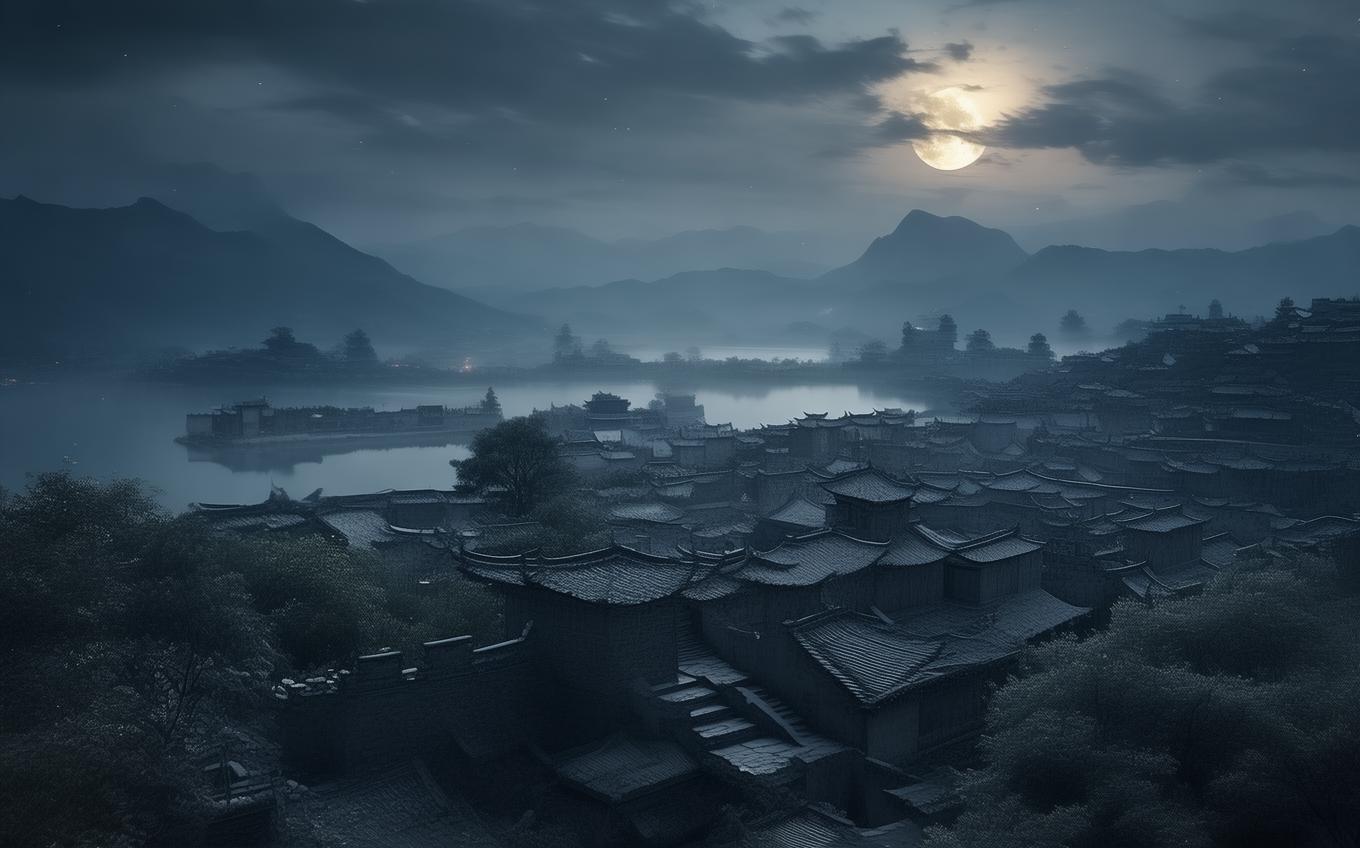
Looking at the Moon from Liao City (辽城望月, Liáo Chéng Wàng Yuè) is a remarkable poem by Emperor Taizong of the Tang Dynasty (唐太宗, Táng Tàizōng), born Li Shimin (李世民). Composed in 645 AD during a military campaign against the Korean kingdom of Goguryeo, the poem stands at a unique crossroads of personal reflection, martial ambition, and cosmic contemplation. Rather than retreating into pure lyricism, Taizong uses the moonlit landscape to mirror both the splendor of nature and the weight of imperial duty. The result is a work that fuses the aesthetic delicacy of Tang poetry with the grand narrative of state-building, offering modern readers a rare glimpse into the mind of an emperor-poet.
The Poem: Full Text and Translation
玄兔月初明
Xuán tù yuè chū míng
The dark rabbit moon begins to brighten,
澄辉照辽碣
Chéng huī zhào Liáo jié
Clear radiance shines on the rocky shores of Liao.
映云光暂隐
Yìng yún guāng zàn yǐn
Reflected on clouds, the light briefly hides;
隔树花如缀
Gé shù huā rú zhuì
Through the trees, blossoms seem threaded like ornaments.
魄满桂枝圆
Pò mǎn guì zhī yuán
When the moon’s soul is full, the cassia branch rounds;
轮亏镜彩缺
Lún kuī jìng cǎi quē
When its wheel wanes, the mirror’s colors break.
临城却影散
Lín chéng què yǐng sàn
Approaching the city, its shadow then disperses;
带晕重围结
Dài yùn chóng wéi jié
With a halo, layered encirclements knot.
驻跸俯丸都
Zhù bì fǔ Wán dū
The imperial carriage halts, overlooking Wandu;
伫观妖氛灭
Zhù guān yāo fēn miè
I stand and watch the evil miasma extinguished.
Line-by-Line Analysis
The poem opens with an astute celestial observation: “The dark rabbit moon begins to brighten.” In Chinese mythology, the moon is inhabited by a jade rabbit, and here “dark rabbit” (玄兔, xuán tù) poetically names the moon itself. Taizong chooses the moment when lunar light first asserts itself—a threshold between obscurity and clarity, a fitting opening for a poem about order overcoming chaos.
The second line—“Clear radiance shines on the rocky shores of Liao”—anchors the universal in the local. 辽碣 (Liáo jié) denotes the stone landmarks of the Liao region where the imperial army is encamped. Radiance (澄辉, chéng huī) suggests not just physical light but moral and political purity, as if the emperor’s virtue illuminates the frontier.
Lines three and four introduce a delicate visual play. The moon’s light is “briefly hidden” by clouds, a moment of hesitation. Yet the poet’s gaze finds beauty in this interruption: flowers seen through tree branches appear “threaded like ornaments” (花如缀, huā rú zhuì). The shift from grand landscape to intricate detail reveals Taizong’s sensitivity. Even in a military camp, he pauses to admire nature’s embroidery.
The central couplet, lines five and six, juxtaposes the moon’s fullness and decline. “When the moon’s soul is full, the cassia branch rounds” evokes the myth of the cassia tree that grows on the moon, forever being cut yet whole again—a symbol of renewal. The “soul” (魄, pò) connects the lunar body to a spiritual essence. Conversely, “when its wheel wanes, the mirror’s colors break” employs the common metaphor of the moon as a mirror. The breaking of colors (镜彩缺, jìng cǎi quē) is a quiet lament, acknowledging that glory is impermanent. These lines do more than describe phases; they meditate on the rhythm of rise and fall that governs all things, including empires.
Lines seven and eight bring the moon close to the human world. “Approaching the city, its shadow then disperses” suggests a shifting, elusive presence—perhaps the moonlight vanishing over the fortress. The following image, “with a halo, layered encirclements knot” (带晕重围结, dài yùn chóng wéi jié), functions on multiple levels. A lunar halo is a meteorological phenomenon, but “encirclements” (重围, chóng wéi) simultaneously suggest the army surrounding the enemy city. The halo becomes a cosmic echo of the siege, entwining heaven’s patterns with the emperor’s strategy.
The poem’s conclusion pivots decisively to the martial present: “The imperial carriage halts, overlooking Wandu.” Wandu (丸都) was a capital of Goguryeo, the campaign’s ultimate target. Taizong places himself physically above the contested landscape. The final line—“I stand and watch the evil miasma extinguished” (妖氛灭, yāo fēn miè)—turns the moon’s clarifying light into a metaphor for moral purification. “Evil miasma” refers to the disorderly forces of the enemy, which will be dissipated like fog under the morning sun. The emperor, aligned with the moon’s radiance, is the agent of cosmic order.
Themes and Symbolism
The poem’s central theme is the correspondence between cosmic order and righteous rule. From the first brightening of the moon to the final quelling of “evil miasma,” Taizong constructs a world where celestial light validates imperial action. The moon is never merely decorative; it is a mirror of Heaven’s mandate.
Symbolism runs deep. The dark rabbit and the cassia tree root the poem in shared myth, reminding the reader that the emperor partakes of timeless patterns. The lunar phases symbolize the natural cycle of waxing and waning that even the most powerful ruler must respect. The halo and the encirclements knit nature and warfare into a single fabric. And “evil miasma” (妖氛) is a powerful allegorical weapon: it delegitimizes the enemy not as a political adversary but as a kind of stain on the world that light must dissolve.
Another subtle theme is the duality of presence and absence. The moon’s light hides, scatters, breaks, and knots—it is never static. This flux mirrors the uncertainty of the battlefield and the emperor’s own awareness that his power, however great, partakes of the same impermanence.
Cultural Context
Emperor Taizong’s campaign against Goguryeo was one of the defining military endeavors of his reign. In 645, he personally led a massive force into the Korean peninsula, seeking to subdue a kingdom that had long resisted Tang suzerainty. The siege of Wandu was a strategic high point. Writing a moon-gazing poem in such a context was not a retreat from reality; it was an assertion of the Confucian ideal that the ruler must align his mind with the principles of the cosmos. The very act of composing poetry while on campaign demonstrated that the emperor was a cultivated sage as much as a warrior.
In Chinese literary tradition, moon poems typically evoke longing, separation, or refined solitude. Taizong subverts this convention: his moon illuminates a battlefield rather than a garden. Yet he retains the lyrical precision, the mythic allusions, and the philosophical weight. The poem thus occupies a unique space—stately, purpose-driven, yet undeniably tender toward the natural world. It exemplifies the Tang dynasty’s confidence that art and governance could, and should, proceed hand in hand.
Conclusion
Looking at the Moon from Liao City endures because it refuses easy categorization. It is a poem of conquest that pauses to admire flowers through leaves; a meditation on celestial cycles that ends with the promise of military victory; an imperial decree rendered in the language of myth and meteorology. For English-speaking readers, it offers a vivid entry into the Chinese worldview where the boundary between landscape and politics dissolves. The moon that rose over the Liao River fourteen centuries ago still shines—a reminder that even in the midst of ambition, there is time to stand still, observe, and find in nature the pattern of one’s own duty.
Comments (0)
No comments yet. Be the first to comment!