Analysis of "春日玄武门宴群臣" - Classical Chinese Poetry
Introduction
Emperor Taizong of the Tang dynasty (598–649 CE), personal name Li Shimin, is widely regarded as one of the greatest emperors in Chinese history. His reign ushered in the golden age of the Tang, marked by military expansion, economic prosperity, and a remarkable flourishing of the arts. Yet, Taizong was not only a brilliant strategist and statesman; he was also an accomplished poet. His poem “春日玄武门宴群臣” (Chūnrì Xuánwǔ Mén Yàn Qúnchén – “Spring Day Banquet at Xuanwu Gate for Ministers”) offers a rare glimpse into the mind of the ruler himself—a solemn and joyous state banquet held at a site heavy with history. Written in elegant regulated verse, the poem blends imperial grandeur with Confucian humility, capturing the spirit of an empire at its confident, cosmopolitan zenith.
The Poem: Full Text and Translation
韶光开令序,淑气动芳年。
Sháo guāng kāi lìng xù, shū qì dòng fāng nián.
Auspicious light unfolds the season’s order; gentle air stirs the fragrant year.
驻辇华林侧,高宴柏梁前。
Zhù niǎn huá lín cè, gāo yàn Bǎi Liáng qián.
The imperial carriage halts beside the splendid grove; a lofty banquet is set before the Cypress Beam Hall.
紫庭文珮满,丹墀衮绂连。
Zǐ tíng wén pèi mǎn, dān chí gǔn fú lián.
The purple court brims with jade-pendant officials; on the vermilion steps, dragon robes and ceremonial sashes link together.
九夷簉瑶席,五狄列琼筵。
Jiǔ yí zào yáo xí, wǔ dí liè qióng yán.
The Nine Yi tribes gather at the jade mats; the Five Di peoples array themselves beside the gem-like feast.
娱宾歌湛露,广乐奏钧天。
Yú bīn gē zhàn lù, guǎng yuè zòu jūn tiān.
Guests are entertained with the song “Heavy Dew”; grand music resounds like the harmonies of Heaven.
清尊浮绿醑,雅曲韵朱弦。
Qīng zūn fú lǜ xǔ, yǎ qǔ yùn zhū xián.
Clear goblets float with green fermented wine; elegant airs rhyme upon vermilion strings.
粤余君万国,还惭抚八埏。
Yuè yú jūn wàn guó, huán cán fǔ bā shān.
Though I rule over ten thousand states, I still feel ashamed when governing the eight extremities of the earth.
庶几保贞固,虚己厉求贤。
Shù jī bǎo zhēn gù, xū jǐ lì qiú xián.
May I preserve steadfast integrity, empty myself, and earnestly seek out the worthy.
Line-by-Line Analysis
The poem opens with a classic spring couplet. “韶光” (sháo guāng, “auspicious light”) is not ordinary sunlight but a radiance that carries cosmic blessing; it “opens” the proper sequence of the season. The “淑气” (shū qì, “gentle air”) actively stirs the year into fragrance. These lines set a tone of natural harmony and imperial renewal, implying that the banquet aligns with Heaven’s will. Spring is not just a backdrop—it is a moral force that the sagely ruler channels.
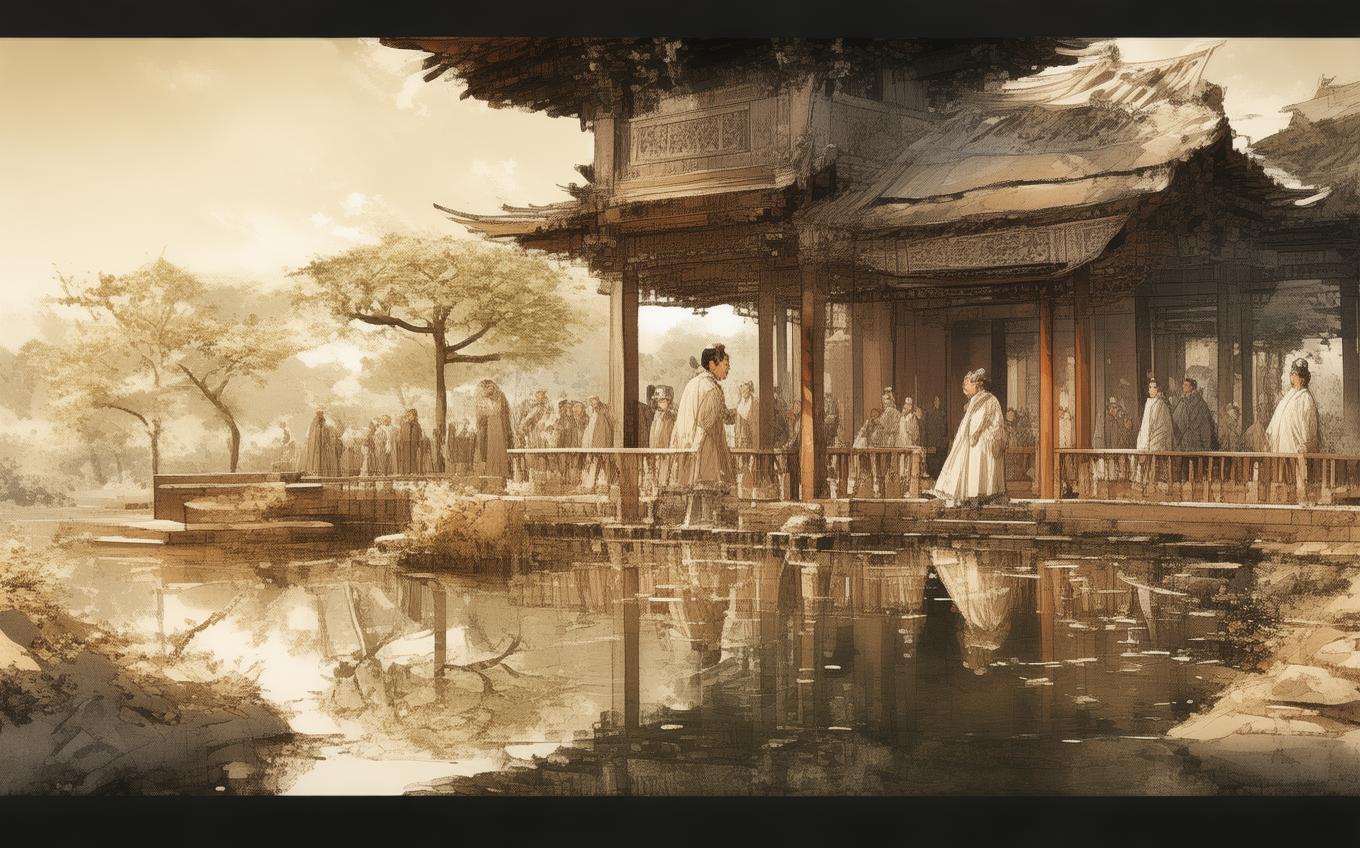
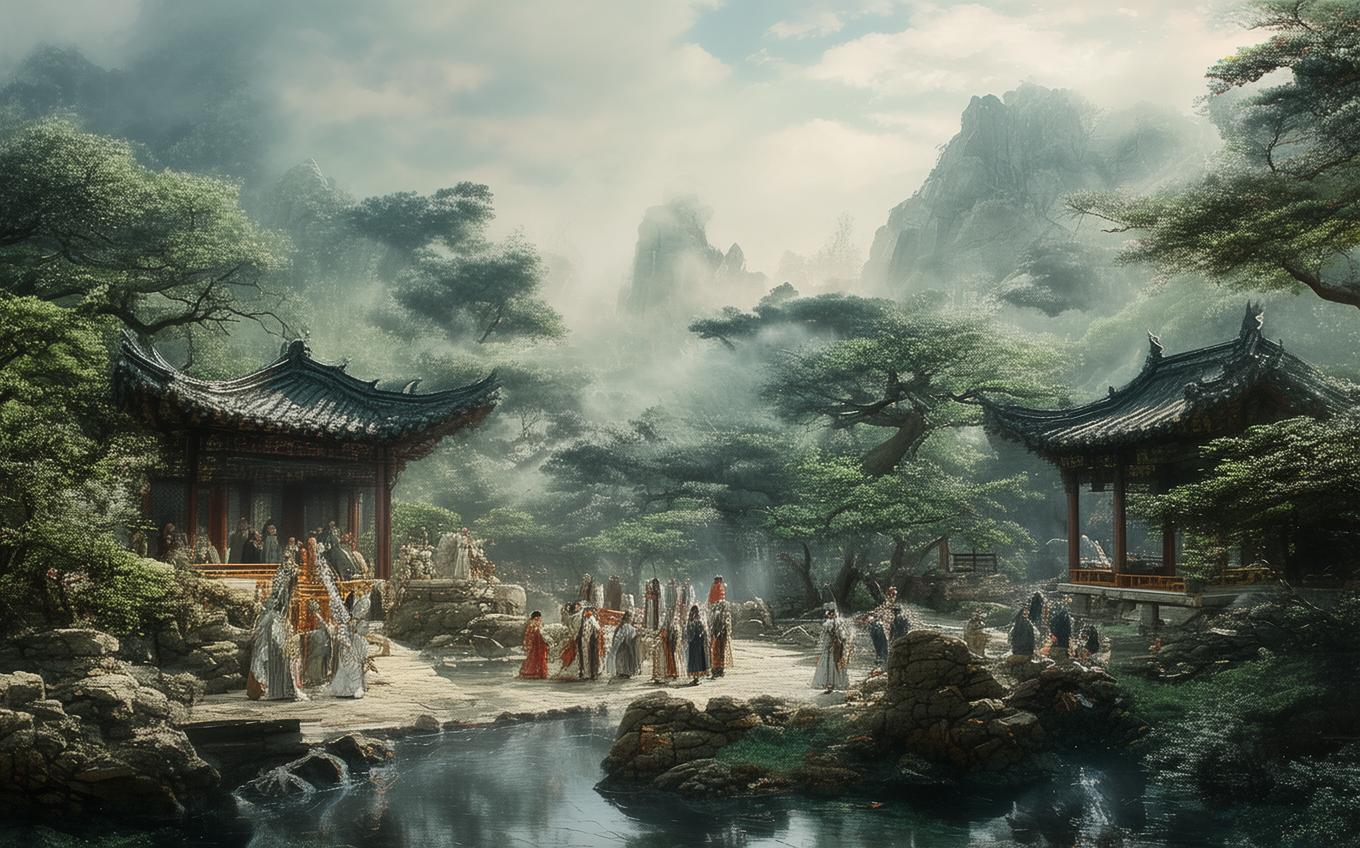
The second couplet anchors the scene at a specific location: the Xuanwu Gate and its Cypress Beam Hall (Bǎi Liáng). The emperor’s carriage pauses by a beautiful grove, transforming a military gate into a space of refined leisure. The phrase “高宴” (gāo yàn, “lofty banquet”) conveys both the physical elevation of the hall and the elevated status of the gathering. Historically, Xuanwu Gate was the site of the bloody coup that brought Taizong to power, but here it is rewritten as a stage for cultural brilliance and political unity—a deliberate act of symbolic reclamation.
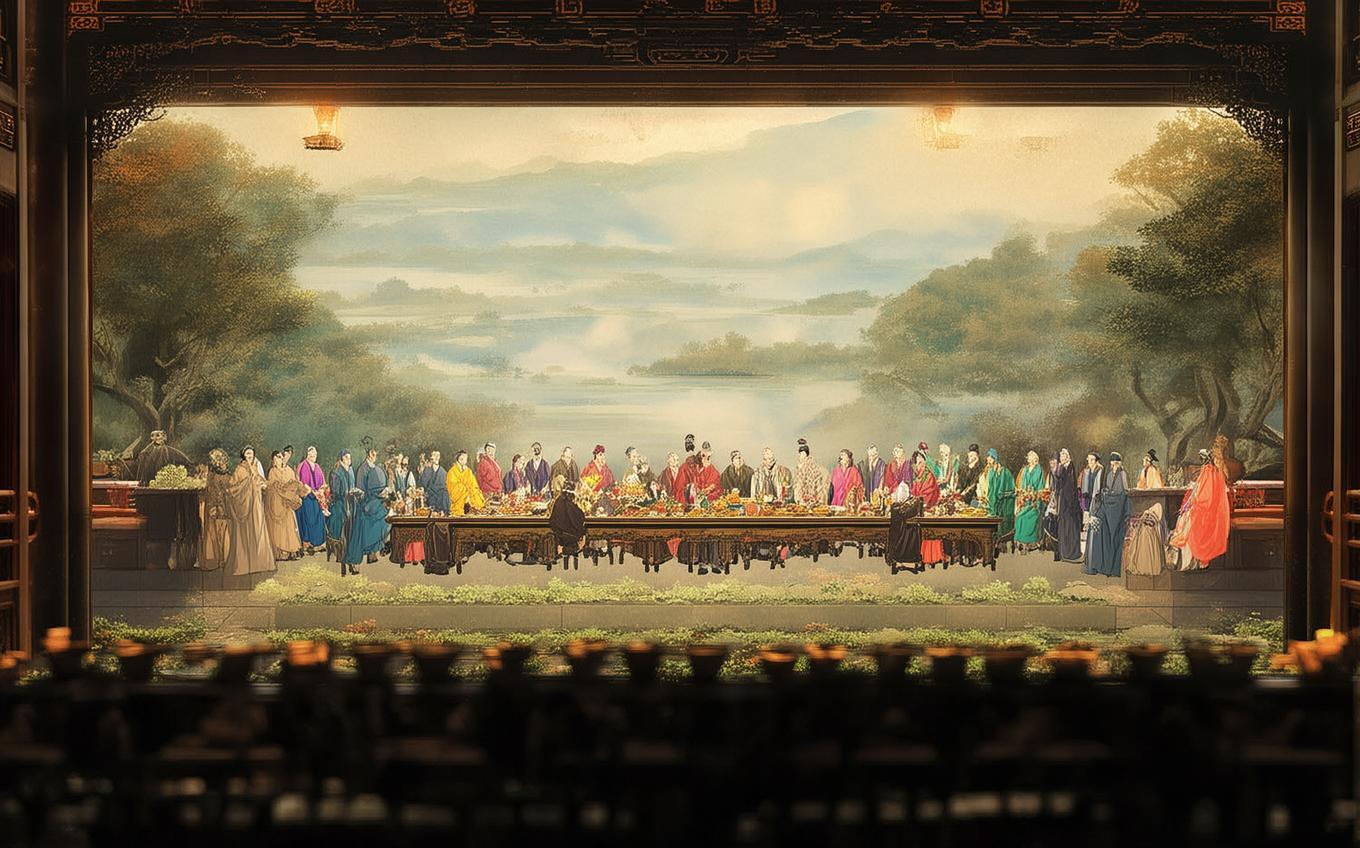
The next two couplets paint the assembly with vivid, hierarchical detail. “紫庭” (zǐ tíng, “purple court”) and “丹墀” (dān chí, “vermilion steps”) are metonyms for the imperial palace, suffused with royal colors. The officials’ jade pendants and embroidered dragon robes signify rank, while the verbs “满” (mǎn, “full”) and “连” (lián, “linked”) suggest a seamless, overflowing community of talent. Then the gaze widens dramatically: “九夷” and “五狄” are ancient terms for non-Chinese peoples from the east, south, north, and west. Their presence at the “瑶席” and “琼筵” (bejeweled feasting mats) expresses the Tang ideal of tianxia—the world drawn harmoniously under a single virtuous ruler. The language is deliberately ornate, using mineral imagery (jade, gem) to elevate the foreign guests to equal splendor.
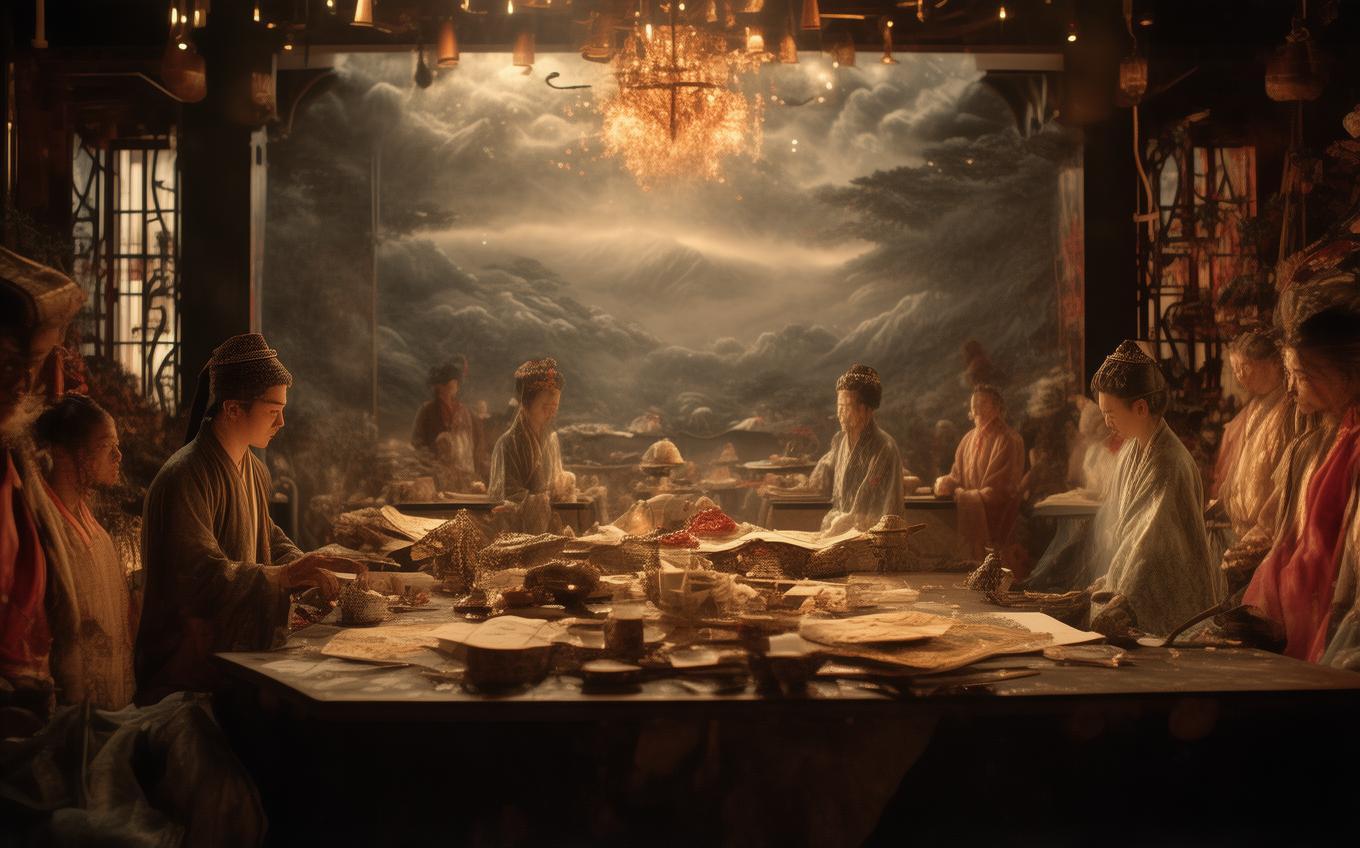
The banquet’s entertainment is both lyrical and cosmic. “湛露” (Zhàn Lù, “Heavy Dew”) is a song from the Book of Songs that celebrates royal feasting and the bond between lord and vassals. Quoting it reinforces the theme of benevolent rule. “钧天” (jūn tiān, “the balanced heavens”) refers to the music of the gods, suggesting that the earthly feast mirrors celestial harmony. Wine (“绿醑” – green-strained liquor) and string music (“朱弦” – vermilion silk strings) blend sensory pleasure with Confucian propriety, creating an atmosphere where art becomes a conduit of moral order.
Then, in a striking shift, the emperor turns inward. The line “粤余君万国” (Yuè yú jūn wàn guó) literally means “As for me, the ruler of ten thousand states.” The archaic particle “粤” lends gravity. Yet immediately he confesses “还惭抚八埏” — “I still feel ashamed when governing the eight extremities of the earth.” This is not false modesty but a profound Confucian gesture. The ideal ruler never feels self-satisfied; the broader his domain, the heavier his responsibility. The phrase “八埏” (bā shān, “eight extremities”) recalls the furthest reaches of the world, places the emperor cannot fully control, and thus a perpetual source of humility.
The final couplet crystallizes the poem’s political philosophy. “贞固” (zhēn gù) means steadfastness and integrity, the virtues needed to “preserve” the state. “虚己” (xū jǐ, “empty oneself”) is a Daoist-inflected concept adopted by Confucian statecraft: the ruler must rid himself of arrogance and personal desire in order to receive wise counsel. “厉求贤” (lì qiú xián, “earnestly seek the worthy”) is the active conclusion—a call to constant, vigorous recruitment of talent. The banquet, then, is not merely a celebration but a ritual of mutual commitment between sovereign and ministers.
Themes and Symbolism
The Ruler’s Virtue as Cosmic Order – Spring’s “auspicious light” and “gentle air” mirror the emperor’s moral radiance. The banquet mirrors Heaven’s harmony; the music is “music of the spheres.” The entire poem functions as a political allegory: when the ruler is virtuous, the seasons proceed correctly, the court is full of worthies, and foreign peoples submit willingly.
Unity of the Realm (Tianxia) – The presence of the “Nine Yi” and “Five Di” is highly symbolic. In Tang ideology, the emperor was not just the sovereign of China but the pivot of the civilized world. This poem transforms ethnic diversity into a banquet table discourse—enemies become honored guests through the magnetic power of culture and virtue.
Humility in Power – The poem’s most memorable lines are the emperor’s self-reproach. Despite the glittering display, the speaker remains “ashamed” and vows to empty his ego. This theme echoes Confucian classics and also Taizong’s own historical image: he was famous for listening to blunt remonstrance and seeking talent tirelessly.
The Banquet as Ritual Bond – Wine, music, and feasting forge a social covenant. The allusion to “Heavy Dew” reminds guests that the lord’s graciousness is a life-giving force, while the refined musical instruments symbolize the cultivation required of all participants. The ceremony elevates political obligation into an aesthetic and moral experience.
Cultural Context
The Tang dynasty (618–907) is often regarded as China’s most cosmopolitan age. The capital, Chang’an, was the world’s largest city, and embassies from Persia, Japan, Korea, India, and the Turkic steppes thronged the court. Emperor Taizong’s military campaigns had pacified the northern frontiers, earning him the title “Heavenly Khan” among the Turks. This poem reflects that reality: the “Nine Yi” and “Five Di” were not imaginary but actual envoys attending state banquets.
The Xuanwu Gate itself carries a darker resonance. In 626, at this very gate, Li Shimin ambushed and killed his two brothers and forced his father, Emperor Gaozu, to abdicate. The event was an indelible stain on his accession. By hosting such a luminous, inclusive banquet here, the emperor engages in a complex act of political narrative-making—transforming a place of fratricide into a stage for Confucian benevolence and world harmony. The poem erases personal guilt and replaces it with public virtue.
Poetically, the regulated verse (lüshi) form, with its parallel couplets and tonal patterns, was reaching full maturity in the early Tang. This poem’s careful symmetry—palace vs. foreign tribes, visual splendor vs. inner humility—demonstrates the elegance of the genre. It also shows that even emperors submitted their expression to the formal discipline of poetry, an art that was considered a marker of true civilization.
Conclusion
“春日玄武门宴群臣” is far more than a spring banquet snapshot. It is a deftly woven tapestry of statecraft, nature, music, and personal ethics. Emperor Taizong uses the poem to project an image of sage kingship: the cosmos rejoices, the world gathers, and yet the ruler remains humbly devoted to self-improvement and meritocracy. For modern readers, the poem offers a window into the ideals that animated one of history’s most brilliant courts—a vision where power finds its highest expression not in arrogance, but in the constant, anxious search for wisdom. As spring light stirs the air and wine fills the goblets, the emperor reminds us that the vastest empire still rests on the fragile, virtuous heart of one person.
Comments (0)
No comments yet. Be the first to comment!