Introduction
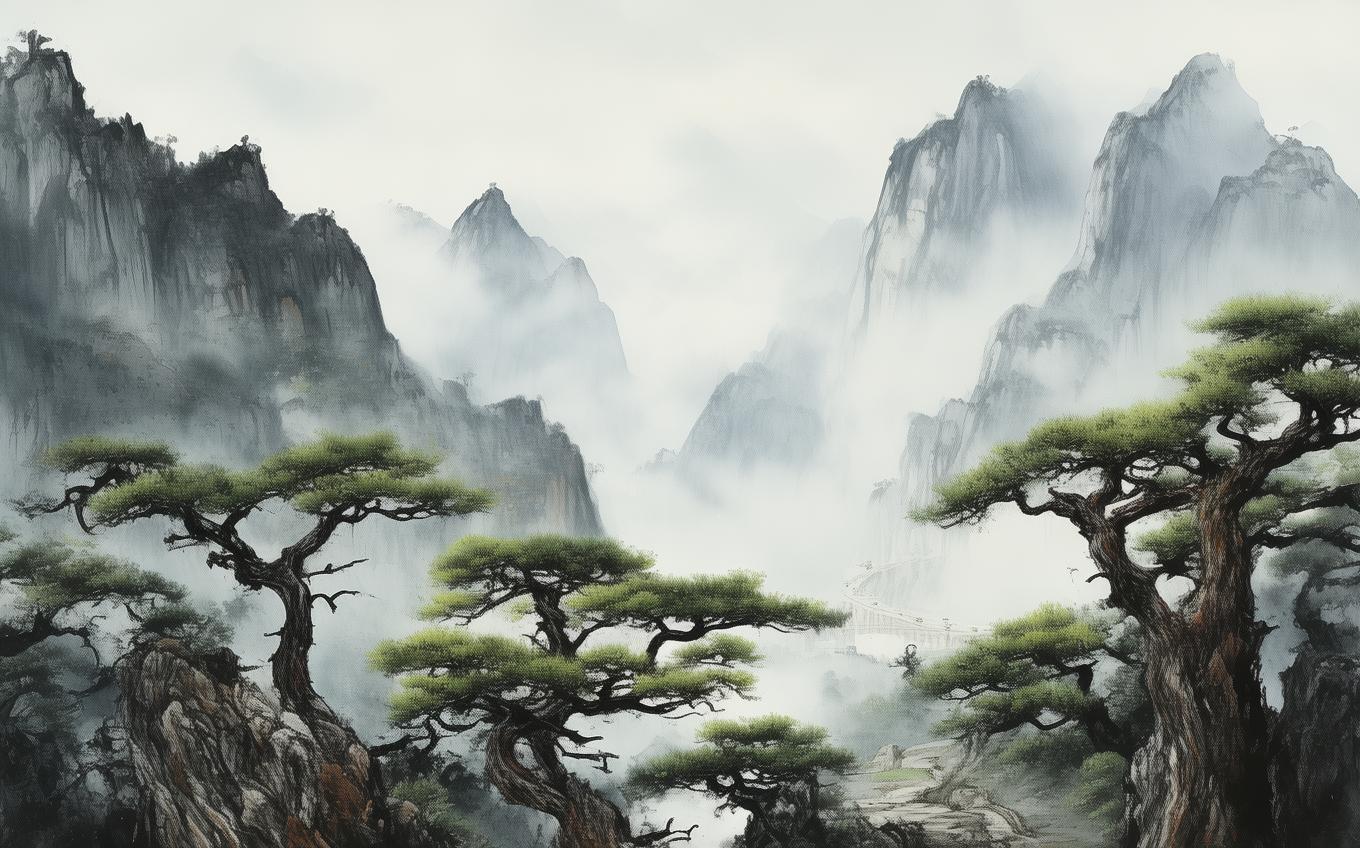
Li Bai (701–762 CE), one of the most celebrated poets of China’s Tang dynasty, is known for his romantic spirit, love of nature, and Daoist-infused yearning for freedom. The poem commonly referred to as “望终南山” (Gazing at Mount Zhongnan) is formally titled “望终南山寄紫阁隐者” – Gazing at Mount Zhongnan, Sent to the Hermit of Purple Pavilion Peak. Written during an era when reclusion and retreat to the mountains were honored ideals, the poem captures a moment of profound connection between the poet’s inner world and the timeless landscape. More than a simple description of scenery, it transforms the act of looking at a mountain into a spiritual longing for a life unspoiled by worldly affairs, making it a cherished piece in the canon of Chinese nature poetry.
The Poem: Full Text and Translation
出门见南山,引领意无限。
chū mén jiàn nán shān, yǐn lǐng yì wú xiàn.
Stepping out the door, I gaze at Mount Zhongnan; craning my neck, my thoughts are boundless.
秀色难为名,苍翠日在眼。
xiù sè nán wéi míng, cāng cuì rì zài yǎn.
Its exquisite beauty is hard to name; the deep green color is present before my eyes all day.
有时白云起,天际自舒卷。
yǒu shí bái yún qǐ, tiān jì zì shū juǎn.
Sometimes white clouds arise, freely unfurling and curling at the edge of the sky.
心中与之然,托兴每不浅。
xīn zhōng yǔ zhī rán, tuō xìng měi bù qiǎn.
My mind blends with it, and the poetic inspiration stirred is never shallow.
何当造幽人,灭迹栖绝巘。
hé dāng zào yōu rén, miè jì qī jué yǎn.
When can I visit the recluse there, and vanish from the world, perching on the precipitous peak?
Line-by-Line Analysis
The opening couplet places us immediately in the poet’s world. “出门见南山” (Stepping out the door, I gaze at Mount Zhongnan) is deceptively simple – the mountain is not a distant tourist attraction but an ever-present companion, visible the moment one leaves the house. The gesture “引领” (craning one’s neck) conveys an eagerness that goes beyond physical sight; his thoughts (“意”) stretch without limit, suggesting that the mountain awakens something vast and uncontainable within him. The poet is not just seeing a landscape, he is being drawn into its spiritual dimension.
The second couplet wrestles with the inadequacy of language. “秀色难为名” (Its exquisite beauty is hard to name) echoes the Daoist notion that the deepest truths lie beyond words. The mountain’s beauty resists labeling, yet its “苍翠” (deep green, lush blue-green) is a constant, tangible presence “日在眼” – it fills his eyes every day. The paradox highlights how nature can be both intimately near and mysteriously elusive. The poet doesn’t attempt to catalogue specific features; instead, he rests in the sheer, unanalyzed fullness of color that sustains his spirit day after day.
The third couplet introduces the kinetic imagery of clouds, a signature motif in Li Bai’s poetry. “白云起” (white clouds arise) signals spontaneous movement, and “自舒卷” (freely unfurling and curling) emphasizes the natural, uncontrived way they spread and coil at the horizon. There is no human hand guiding them, no purpose other than their own unfolding. For Li Bai, this self-so motion mirrors the ideal state of the Daoist sage – acting without coercion, in harmony with the rhythms of the universe.
The fourth couplet reveals the internal effect: “心中与之然” (My mind blends with it). The poet’s consciousness merges with the mountain and its clouds, a state of empathetic union that generates “托兴” – poetic inspiration rooted in genuine feeling. The phrase “每不浅” (never shallow) insists that this is no fleeting amusement; every encounter with the mountain yields deep, lasting creative energy. The outer landscape has become the inner landscape of the poet’s soul.
The final couplet pivots from passive gazing to active longing. “何当造幽人” (When can I visit the recluse?) addressing the hermit of Purple Pavilion Peak, turns the poem into an epistle of yearning. The mountain is not empty – it holds a “幽人,” a hidden person who embodies the reclusive ideal. Li Bai imagines himself “灭迹” (vanishing from the world, erasing all traces) and “栖绝巘” (perching on the precipitous peak). The steep, inaccessible pinnacle symbolizes the ultimate detachment from society, a life so fused with nature that one becomes as invisible and free as a cloud. The question “何当” (when will it happen?) leaves the poem suspended in a space of hope and unresolved longing, inviting the reader to share this dream of transcendence.
Themes and Symbolism
The central theme is the transformation of gazing into a spiritual practice. Li Bai’s poem is an ode to the power of nature to awaken a desire for simplicity, authenticity, and liberation from the “dusty net” of official life. The mountain functions not as a mere backdrop but as a living presence that calls the poet toward a higher existence.
Symbols abound. Mount Zhongnan itself, long revered as a dwelling place of Daoist immortals and hermits, represents the sacred space where heaven and earth meet. White clouds symbolize spontaneity, purity, and the unfettered mind – a visual metaphor for the ideal Daoist sage who “drifts like a cloud.” The hermit on Purple Pavilion Peak stands for the realized self that Li Bai aspires to become: silent, hidden, completely at home in the wild. The “precipitous peak” is the ultimate destination of the soul’s ascent, a place where worldly identity dissolves. Even the act of “craning one’s neck” hints at a physical stretching toward transcendence, the body mirroring the spirit’s reach.
Cultural Context
Tang dynasty China inherited a rich tradition of reclusion rooted in both Daoist and Confucian thinking. Mount Zhongnan, just south of the capital Chang’an (modern Xi’an), was a famous retreat for scholars, poets, and aspiring officials who sought purity away from political intrigues. Retreating to the mountains was not only a personal choice but a culturally celebrated act that could enhance one’s moral stature. Li Bai himself spent much of his life wandering China’s great landscapes, often expressing a longing to abandon his career ambitions and live as a free spirit.
This poem reflects the Daoist belief in ziran (自然) – naturalness, spontaneous self-so-ness – and the ideal of merging with the Dao through immersion in the wild. It also touches on the literati notion of yinyi (隐逸), reclusion, as a way to preserve inner integrity. By sending the poem to a hermit, Li Bai participates in a tradition of poetic correspondence that bridges the gap between community and solitude. The mountain becomes a shared symbol of spiritual aspiration, and the poem itself a vessel for passing that aspiration to a friend – and to all readers across time.
Conclusion
Li Bai’s “望终南山” endures because it captures a universal moment of stillness and longing that transcends its era. Through spare, luminous language, the poet transforms a familiar view into a meditation on the limits of language, the beauty of the spontaneous, and the human desire to shed unnecessary burdens. As modern readers, we may not gaze at Mount Zhongnan from our doorsteps, but we recognize the impulse to look at a mountain, a sea, or a sky and feel the faint pull of a simpler, more authentic life. Li Bai’s poem assures us that such yearning is not shallow – it is, in fact, the very seed of poetry, inviting us to crane our necks a little higher and, for a moment, blend with the clouds.
Comments (0)
No comments yet. Be the first to comment!