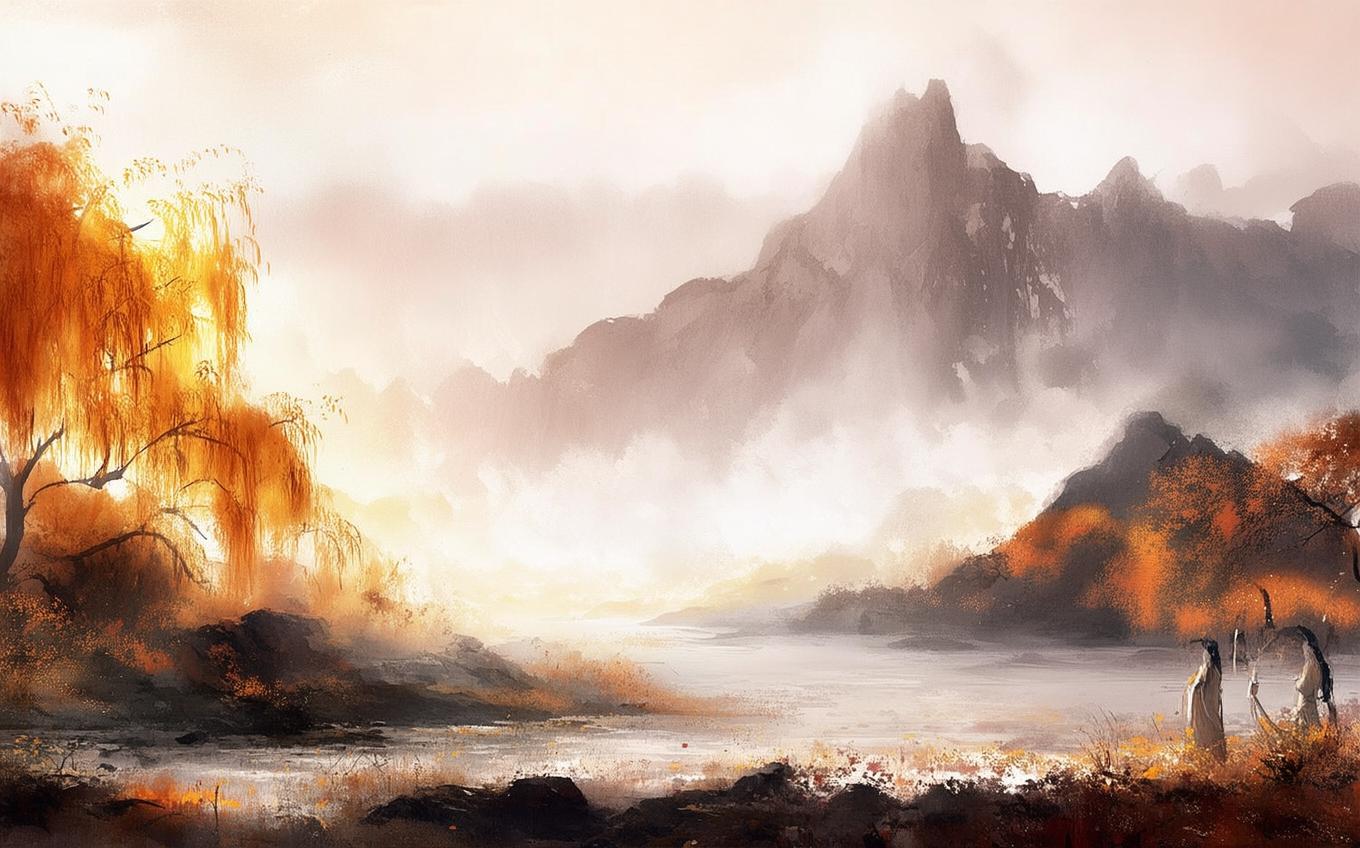
Analysis of "度秋" – Classical Chinese Poetry
Introduction
Emperor Taizong of Tang (唐太宗, 598–649), personal name Li Shimin (李世民), is celebrated not only as one of China’s greatest rulers but also as a sensitive poet who helped shape early Tang literature. His poem “度秋” (Dù Qiū, “Passing Autumn”) captures a moment of seasonal transition with courtly elegance and philosophical depth. Written in the imperial palace or perhaps during a brief retreat, this short regulated verse (律诗) uses finely observed natural details to ponder the relentless flow of time. For readers interested in Chinese culture, “度秋” opens a window onto how an emperor viewed the rhythms of nature and the human place within them.
The Poem: Full Text and Translation
夏律昨留灰,
Xià lǜ zuó liú huī,
The summer pitch-pipes left their ash yesterday;
秋箭今移晷。
Qiū jiàn jīn yí guǐ.
The autumn arrow now shifts the sundial’s shadow.
峨眉岫初出,
Éméi xiù chū chū,
Mount Emei’s peaks begin to emerge,
洞庭波渐起。
Dòngtíng bō jiàn qǐ.
Waves on Lake Dongting gradually rise.
桂白发幽岩,
Guì bái fā yōu yán,
White cassia blossoms appear on the secluded cliff,
菊黄开灞涘。
Jú huáng kāi Bà sì.
Yellow chrysanthemums bloom along the banks of the Ba River.
运流方可叹,
Yùn liú fāng kě tàn,
The flowing course of nature truly deserves a sigh;
含毫属微理。
Hán háo zhǔ wēi lǐ.
Holding my brush, I entrust these subtle principles to words.
Line-by-Line Analysis
“夏律昨留灰,秋箭今移晷。”
The opening couplet announces the shift from summer to autumn through two ancient technical images. “夏律” (summer pitch-pipes) refers to the lü (律) tuning pipes used in Chinese cosmology, where burning reed ash was placed in twelve pipes to mark the months; when the correct pipe’s ash was blown away, the corresponding season was affirmed. “Yesterday’s ash” suggests summer’s final note has just sounded. In the second line, the “秋箭” (autumn arrow) is the gnomon of a sundial whose shadow now lengthens, marking the season’s advance. By pairing these instruments, Taizong frames time not just as a subjective feeling but as a cosmic rhythm measured by astronomy and music. There is a quiet, courtly melancholy in acknowledging that summer has irrevocably passed.
“峨眉岫初出,洞庭波渐起。”
The poet’s gaze turns outward to famous landscapes: Mount Emei (峨眉) in Sichuan and Lake Dongting (洞庭) in Hunan. “岫初出” means the mountain’s hidden peaks seem to emerge now that summer mists and heat have lifted—autumn clears the air. “洞庭波渐起” sees the lake’s waters stirring as the autumn wind begins to blow, an echo of the classic “洞庭波兮木叶下” (“Waves on Dongting and falling leaves”) from the Chuci (Songs of Chu). These two lines use geography to paint a panoramic seasonal change: clarity and movement replace summer’s torpor. The emperor-poet imagines the entire realm shifting into a new phase.
“桂白发幽岩,菊黄开灞涘。”
Here the imagery becomes more intimate and courtly. The white osmanthus (桂) flowering on a hidden cliff is a symbol of autumn’s arrival and its purity, while the yellow chrysanthemum (菊) blooming by the Ba River (灞涘, near the Tang capital Chang’an) is an emblem of endurance and the gentleman’s virtue. The pairing of mountain (幽岩) and riverbank (涘) unites the untamed and the civilized, suggesting that the season’s beauty touches both the remote and the familiar. The colors white and yellow further enrich the autumnal palette, evoking a world turning crisp and luminous.
“运流方可叹,含毫属微理。”
The final couplet is a philosophical reflection. “运流” (the flowing course) refers to the natural motion of seasons and, by extension, of all things. “方” (truly, indeed) and “叹” (sigh) convey an emotion that is not despairing but deeply appreciative: the ceaseless transformation of the world is awesome and poignant. In the last line, the poet holds his brush (“毫”, the fine tip of a writing brush) and commits his thoughts to paper, hoping to capture the “微理”—the subtle, underlying pattern of the Dao. The act of writing becomes a way to align the human mind with nature’s quiet logic. Taizong thus transforms the passage of autumn into a moment of Confucian and Daoist introspection.
Themes and Symbolism
The poem’s central theme is the passage of time (shi guang 时光), viewed through the lens of seasonal shift. Taizong does not lament autumn as a season of decay; instead, he presents it as the cosmic order manifesting itself. Each natural detail—ash, shadow, mountain, wave, flower—is a symbol of this orderly flow.
Key symbols:
- Pitch-pipes and sundial: human attempts to measure and harmonize with cosmic time.
- Mount Emei and Lake Dongting: the vastness of the empire touched by the same seasonal rhythm.
- Cassia and chrysanthemum: moral integrity and the beauty of autumn’s arrival, often associated with reclusion and scholarly virtue.
- The brush (毫): the poet’s instrument for capturing fleeting truth, a symbol of literary immortality.
The poem embodies the classical Chinese notion of “gan wu” (感物)—being moved by external things—and the belief that poetry should accord with nature’s patterns (自然之理).
Cultural Context
Emperor Taizong reigned during the early Tang (618–649), a period of consolidation, expansion, and cultural brilliance. A patron of arts and letters, he himself composed over a hundred poems, often using landscape and seasons to express the ruler’s attunement to Heaven’s way. Poetry at court was a refined practice, blending political philosophy with personal sentiment.
“度秋” reflects the concept of “tian ren gan ying” (天人感应), the resonance between heaven and humanity: a good ruler must be sensitive to natural rhythms and cosmic signs. The reference to the pitch-pipes and sundial also shows how deeply Chinese cosmology intertwined music, astronomy, and government. For the Tang elite, autumn was a season of both harvest and reflection, a time to examine one’s conduct and align with the Dao.
The mention of specific sites (Emei, Dongting, Ba River) also maps the emperor’s imaginative reach across his empire, turning a personal moment into a unifying vision.
Conclusion
“度秋” is a gem of early Tang poetry, blending technical precision, scenic evocation, and quiet wisdom. Emperor Taizong’s lines move from the mechanical measurement of time to the organic blooming of cassia and chrysanthemum, finally arriving at a point where the poet’s brush becomes an instrument of cosmic harmony. The poem’s enduring appeal lies in its serene acceptance of change and its call to find subtle meaning in the everyday flow of the seasons. For the modern reader, it is an invitation to pause, observe how autumn unfolds, and perhaps take up a pen to capture a moment’s fleeting truth.
Comments (0)
No comments yet. Be the first to comment!