Introduction
The poem “秋日即目” (Autumn Day, Immediate View) was written by Emperor Taizong of the Tang Dynasty, Li Shimin (李世民, 598–649 CE). Li Shimin is revered as one of China’s greatest emperors, a brilliant military strategist and a ruler who valued culture, learning, and the arts. Under his reign, the Tang Dynasty flourished, and poetry—especially the “modern style” regulated verse—became a hallmark of high civilization. Though he is better known as a statesman, Li Shimin was also a sensitive poet, and his works often blend imperial majesty with personal reflection. This poem offers a vivid, momentary glimpse of an autumn landscape as seen from the imperial garden or palace, capturing both the beauty of nature and the subtle melancholy of passing time. It stands as a fine example of early Tang court poetry, where the outer world mirrors the inner state of the ruler.
The Poem: Full Text and Translation
爽气澄兰沼,
shuǎng qì chéng lán zhǎo,
The crisp air clarifies the orchid-covered marsh,
秋风动桂岑。
qiū fēng dòng guì cén.
The autumn wind stirs the osmanthus-dotted hill.
露凝千片玉,
lù níng qiān piàn yù,
Dew condenses into a thousand flakes of jade,
菊散一丛金。
jú sàn yī cōng jīn.
Chrysanthemums scatter a cluster of gold.
日敛高山影,
rì liǎn gāo shān yǐng,
The sun draws in the shadows of the high mountains,
云披远岫阴。
yún pī yuǎn xiù yīn.
Clouds drape over the shade of distant peaks.
寒蝉噪晚叶,
hán chán zào wǎn yè,
Cold cicadas buzz among the evening leaves,
秋雁带遥林。
qiū yàn dài yáo lín.
Autumn wild geese trail across the far-off woods.
已觉商飙变,
yǐ jué shāng biāo biàn,
Already I sense the shifting of the bleak west wind,
空惊岁月侵。
kōng jīng suì yuè qīn.
In vain I startle at the encroachment of the years.
何如随建武,
hé rú suí Jiàn Wǔ,
How could I compare to following the example of Jianwu,
长策定山岑。
cháng cè dìng shān cén.
With a long-term strategy to bring peace to the mountain ranges?
Line-by-Line Analysis
爽气澄兰沼,秋风动桂岑。
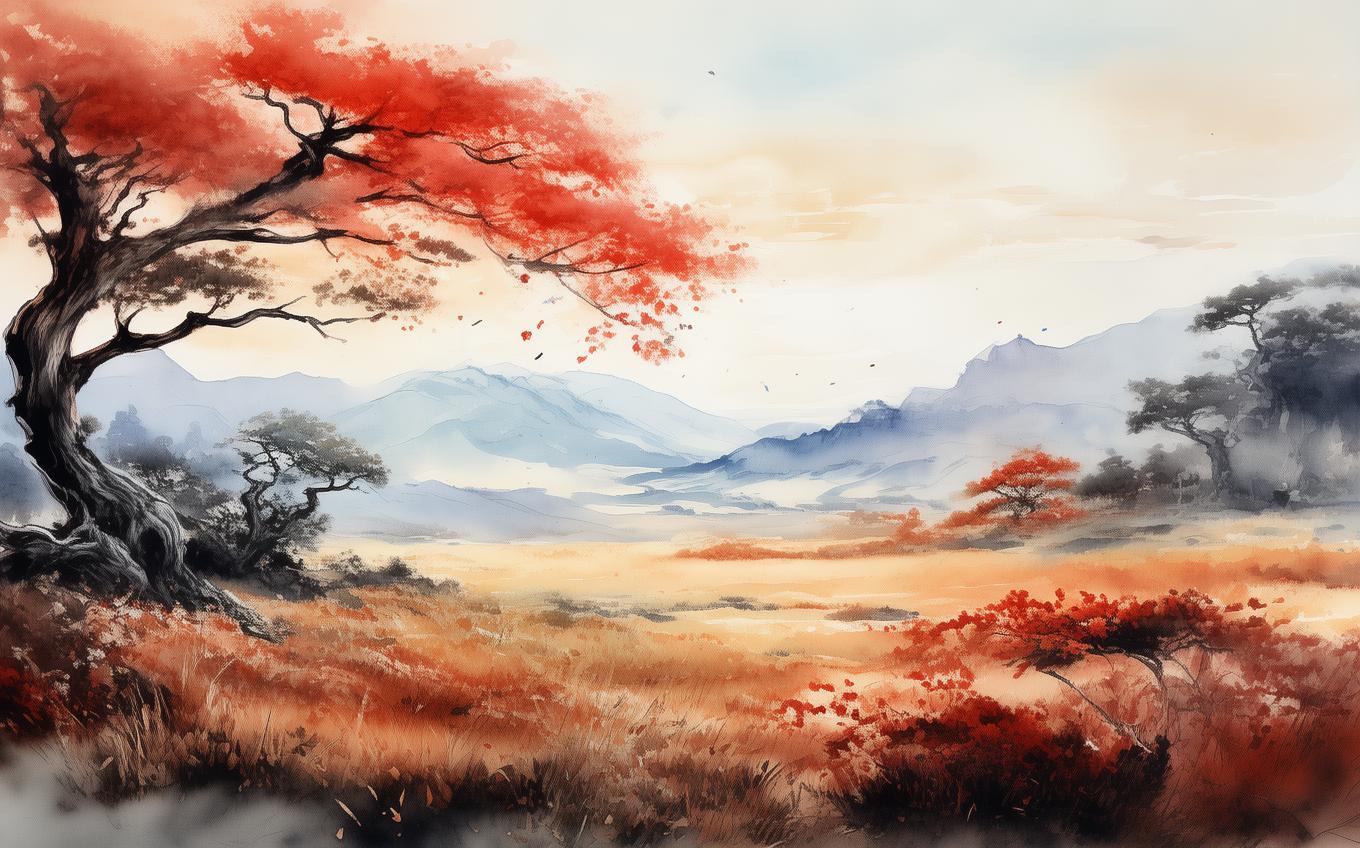
The poem opens with a sudden clarification of the atmosphere. “Crisp air” (shuǎng qì) is a classic autumnal cliché in Chinese poetry, yet the poet makes it vivid by pairing it with the image of an orchid pond made lucid by the weather. Orchids symbolize refinement and virtue, fitting for an imperial garden. The autumn wind stirs the osmanthus hill—osmanthus carries a fragrance and is associated with the moon and nobility. The verb “动” (dòng, stirs) suggests gentle motion, linking the emperor’s immediate surroundings to the larger cycle of seasons. The effect is one of delicate, visual freshness.
露凝千片玉,菊散一丛金。
Dew and frost are transformed into metaphors for precious substances: jade and gold. “A thousand flakes of jade” elevates moisture to something rare and pure, while “a cluster of gold” describes chrysanthemums—the quintessential autumn flower in Chinese culture. The words 凝 (condense) and 散 (scatter) form a subtle antithesis: dew gathers, blossoms release. The emperor as poet observes nature’s alchemy, where ordinary garden sights become treasures.
日敛高山影,云披远岫阴。
Here the focus shifts to the distance. The sun “draws in” the mountain shadows, as if retracting the landscape into a softer, more subdued form. The verb 敛 (draw in, restrain) imparts a sense of quiet withdrawal, a slowing of the day. 披 (drape, spread open) personifies clouds gently covering the shadowy distant ridges. The pairing conveys a world where light and shade are balanced, but the oncoming twilight brings a sense of impermanence.
寒蝉噪晚叶,秋雁带遥林。
The aural image of “cold cicadas” buzzing among evening leaves injects a faint, melancholy energy. Cicadas in Chinese poetry often signal the end of summer and the approach of decay—their sound is piercing yet brief. Meanwhile, wild geese flying in formation “trail across” the far woods. Geese are migratory birds, and their passage underscores departure, distance, and time’s passage. The emperor, though surrounded by beauty, hears and sees the evidence of change.
已觉商飙变,空惊岁月侵。
商飙 (shāng biāo) literally “the shāng wind,” refers to the west wind of autumn. In the ancient Chinese five-element cosmology, autumn corresponds to the west and to the note shāng, which carries a sorrowful, martial tone. To “sense the shifting of the shāng wind” means to perceive the deep, cosmic turn of the seasons. The poet admits that this awareness makes him “in vain startle at the encroachment of the years” (岁月侵). The seasonal change mirrors the emperor’s own aging and the relentless advance of time, which even imperial power cannot halt. The word 空 (empty, in vain) reveals a sense of helplessness.
何如随建武,长策定山岑。
The closing couplet introduces an historical allusion. “Jianwu” refers to Emperor Guangwu (Liu Xiu), the founder of the Eastern Han Dynasty, whose reign title was Jianwu. He restored order after chaos through military prowess and wise governance. Li Shimin, himself a unifier who seized the throne by force, asks a rhetorical question: how can he equal that example? To “have a long-term strategy to bring peace to the mountain ranges” expresses his wish for lasting stability. The mountains (shān cén) symbolize the far frontiers and perhaps the heights of achievement. The poem thus moves from aesthetic observation to political aspiration, ending on a note of responsibility and unfulfilled striving.
Themes and Symbolism
Nature as Mirror of the Inner Self
The poem is a classic example of the Chinese lyrical tradition in which landscape description is never purely objective. Autumn’s clarity, the jewel-like dew, the departing geese—all become reflections of the emperor’s reflective, slightly anxious state. The beauty is real, but it intensifies an awareness of impermanence.
Time and Transience
The central theme is the unstoppable passage of time. Autumn indicates decline, and even the mightiest ruler feels the “encroachment of the years.” The cicada’s cry and the geese’s flight are time’s audible and visible signs. The “empty startle” suggests that wisdom lies in recognizing this inevitability, yet still trying to act meaningfully.
Imperial Duty vs. Personal Melancholy
Li Shimin blends the role of emperor with that of the poet. The final couplet moves away from private emotion toward public responsibility. By invoking Jianwu, he implicitly measures himself against a historical ideal of righteous rule. The poem thus transforms autumn melancholy into a spur for constructive governance.
Key Symbols
- Orchid and Osmanthus: refinement, moral purity, courtly elegance.
- Jade and Gold: durability and preciousness, but here they describe transient things (dew, flowers), hinting at the fragility of beauty.
- Cicadas and Geese: traditional emblems of autumn, change, and the passing seasons.
- Shāng Wind: the west wind that brings cold and mortality; a cosmic sign of autumn’s power.
- Jianwu (Emperor Guangwu): a model of restored dynastic vigor; a historical mirror for Li Shimin’s own ambitions.
Cultural Context
The Tang Dynasty marked a golden age of Chinese poetry, and emperors often led by example, composing verses that were read at court gatherings. Li Shimin’s poem reflects the gongti (palace-style) tradition, which valued ornate description of gardens and weather, but it also leans toward the more personal, philosophical tone that later great poets like Du Fu would perfect.
The reference to the “shāng” wind comes from the pentatonic musical scale and the Yue Ling (Monthly Ordinances), an ancient text linking seasons, directions, and tones. This shows how deeply cosmology infused everyday perception. Moreover, the allusion to Emperor Guangwu would have resonated with Tang courtiers: Li Shimin himself came to power after a period of upheaval (the Sui collapse), much like Guangwu, and both faced the challenge of reunifying China. The poem thus layers the immediate autumn scene with historical and political meaning.
The concept of “immediate view” (即目, jímù) is important in Chinese poetics. It suggests a spontaneous capture of what the eye sees, yet the poem’s artful structure reveals careful crafting. This apparent spontaneity—a core value in Chinese aesthetics—allows the reader to feel the living breath of the moment, even across centuries.
Conclusion
“秋日即目” combines an emperor’s keen gaze with a poet’s vulnerable heart. In twelve lines, Li Shimin takes us from glistening dew to haunting bird calls, from personal aging to dynastic aspiration. The poem’s enduring appeal lies in its seamless fusion of the outer landscape

Comments (0)
No comments yet. Be the first to comment!