Introduction
The poem “山阁晚秋” (Mountain Pavilion in Late Autumn) was composed by Emperor Taizong of the Tang Dynasty, Li Shimin (598–649 CE), one of China’s most revered rulers. Though remembered primarily as a brilliant military strategist and the architect of the golden age of the Tang, Li Shimin was also a cultivated poet and calligrapher. His poems often reflect the Confucian ideal of a ruler who finds moral clarity in nature. This particular piece, likely written during a moment of quiet retreat, stands out for its refined landscape imagery and the introspective mood it captures. For readers interested in classical Chinese poetry, “山阁晚秋” offers an elegant window into the interplay between imperial sensibility, aesthetic restraint, and the timeless theme of autumn melancholy.
The Poem: Full Text and Translation
山阁晚秋
Shān gé wǎn qiū
Mountain Pavilion in Late Autumn山亭秋色满,
Shān tíng qiū sè mǎn,
The mountain pavilion brims with autumn hues,岩牖凉风度。
Yán yǒu liáng fēng dù.
A cool breeze passes through the rocky window.疏兰尚染烟,
Shū lán shàng rǎn yān,
Sparse orchids still tinted with mist,残菊犹承露。
Cán jú yóu chéng lù.
Fading chrysanthemums yet bear the dew.古石衣青苔,
Gǔ shí yī qīng tái,
Ancient stones wear a coat of green moss,危桥带瀑布。
Wēi qiáo dài pù bù.
A precipitous bridge girdles a waterfall.从来多古意,
Cóng lái duō gǔ yì,
From of old there has been much ancient sentiment,临眺独踌躇。
Lín tiào dú chóu chú.
Gazing out, alone, I linger undecided.
Line-by-Line Analysis
山亭秋色满,岩牖凉风度。
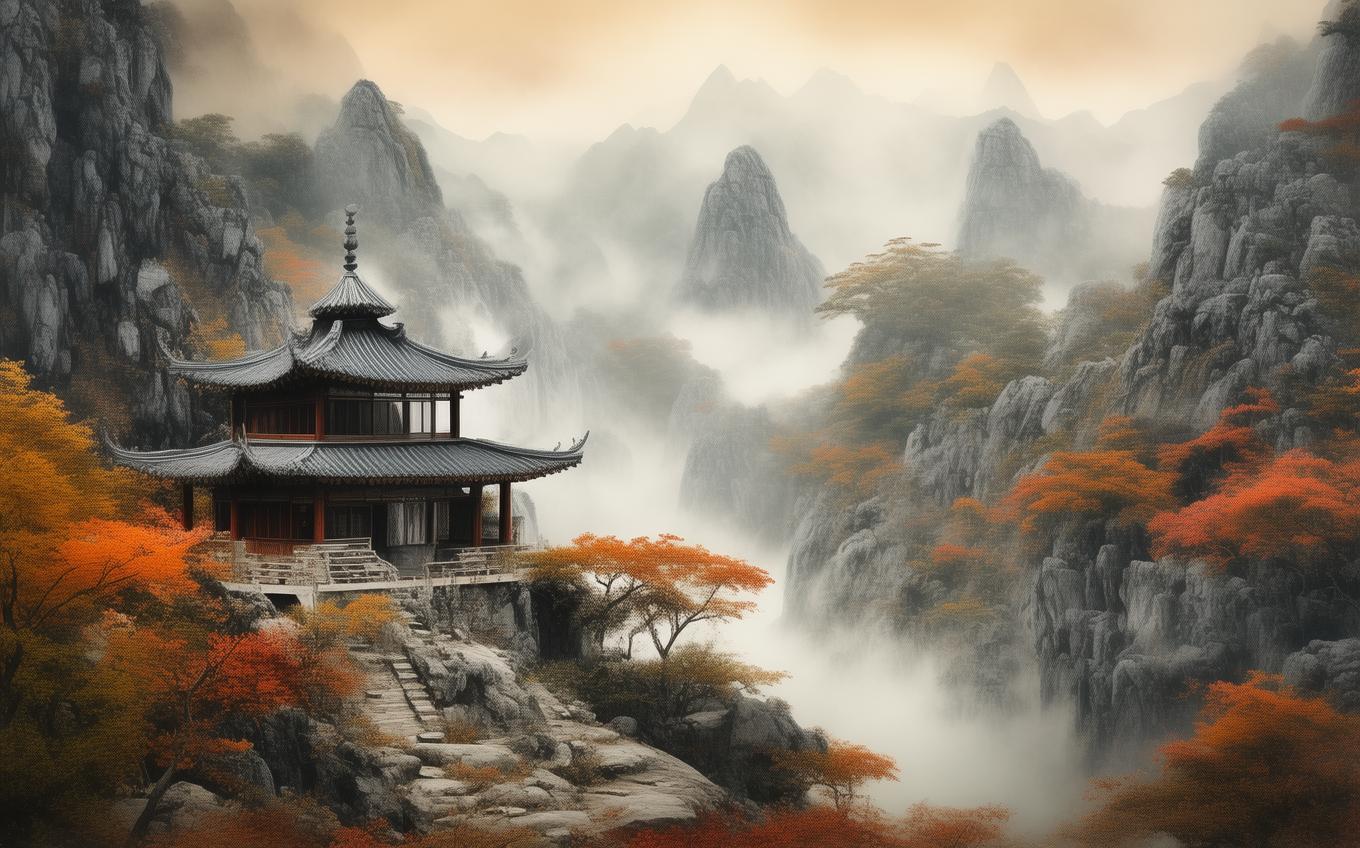
The opening couplet sets the scene immediately: a mountain pavilion (shān tíng) immersed in the fullness of autumn. “满” (full) suggests that autumn color saturates the entire view—a visual feast of red and gold leaves. The second line introduces a sensory shift from sight to touch: a cool breeze enters through a “rocky window” (yán yǒu), implying the pavilion is built against or within a natural rock face. This rocky window is both literal architecture and a metaphor for openness to the wild, cooling spirit of the season. The breeze brings with it a crispness that defines late autumn.
疏兰尚染烟,残菊犹承露。
Here the poet’s gaze turns to the delicate flora. Orchids, once abundant, are now sparse (shū lán), yet they remain touched by drifting mist—a suggestion of lingering beauty. The chrysanthemums, symbolic of autumn’s perseverance, are described as “残” (fading or damaged) but still capable of holding drops of dew. Together, these images of resilience in decline encapsulate the bittersweet essence of late autumn: grace persists even as the world prepares for winter. The mist and dew also evoke the passage of time, a fleeting quality that deepens the poem’s quiet melancholy.
古石衣青苔,危桥带瀑布。
The focus now expands to the rugged surroundings. Ancient stones are cloaked in a garment (衣) of green moss—an image that conveys both age and damp stillness. The metaphor of clothing suggests nature’s slow, patient transformation of inert rock into something living. The “precarious bridge” (wēi qiáo) that “carries” or “girdles” a waterfall introduces movement and a hint of danger. The character “危” simultaneously means high and perilous, embodying the sublime tension of mountain landscapes: exquisitely beautiful yet precarious. The waterfall provides a counterpoint of sound and motion to the otherwise serene scene.
从来多古意,临眺独踌躇。
In the closing couplet, the emperor pivots from external description to personal reflection. “多古意” (abundant ancient sentiment) reveals that this landscape stirs in the poet a connection to something timeless and bygone—perhaps the moral wisdom of the sage-rulers of antiquity, or simply a universal sorrow at autumn’s decay. Standing alone (独) and staring into the distance, he finds himself “踌躇” (hesitant, tarrying). This final word is laden with ambiguity: it can mean indecision, lingering affection, or a reluctance to leave. In the context of a ruler, it may subtly allude to the weight of state affairs—a moment in which the tranquility of nature invites him to pause, but duty calls him back. The poem ends on a suspended note, leaving the reader with the image of a solitary figure on the bridge between the personal and the political, nature and civilization.
Themes and Symbolism
Autumn as a Mirror of the Soul
In Chinese poetry, autumn consistently represents the autumn of life—a time of maturity, harvest, and inevitable decline. “山阁晚秋” uses this seasonal backdrop to explore transience without despair. The full autumn colors, the chill breeze, and the fading flowers all underscore beauty mixed with loss. The poet does not lament; rather, he records with a nearly painterly precision, aligning his own reflective state with the quiet dignity of the landscape.
Nature as a Teacher of Ancient Virtue
The phrase “古意” (ancient sentiment) is the poem’s emotional keystone. It links the physical scenery to a moral and spiritual inheritance. Moss-covered stones and time-worn rocks are not merely geological features—they are vessels of history. In the Confucian and Daoist traditions, mountains symbolize stability and retreat; water symbolizes adaptability. Here, the rocky pavilion, persisting orchids, and resilient chrysanthemums collectively evoke the ideal of the noble person (junzi), who remains upright and untainted even in harsh seasons.
The Solitary Gaze
The word “独” (alone) in the last line is significant. Despite being an emperor surrounded by courtiers, Li Shimin presents himself in a solitary, reflective pose—a traveler in his own realm. Solitude in classical Chinese poetry often represents an essential condition for deep perception. The poet’s hesitation (“踌躇”) might be read as a moment of philosophical suspension: between staying and returning, between nature’s timelessness and human impermanence.
Cultural Context
Emperor Taizong reigned from 626 to 649 CE, a period known as the Zhenguan era, celebrated for political stability, economic prosperity, and cultural flowering. He was a noted patron of literature and personally composed many poems, often using the regulated verse style that was becoming fashionable. “山阁晚秋” exhibits the balance and parallelism characteristic of Tang poetry: the couplets pair images—orchids and chrysanthemums, stones and bridges—creating a harmonious structure that mirrors the Confucian ideal of order.
The mountain pavilion itself was a common setting for the Tang elite, who built retreats where they could escape the bureaucracy and commune with nature. For an emperor, the choice to write about such a retreat implies a cultivated modesty and a desire to be seen as a sage-king in touch with the fundamental rhythms of the universe. The poem’s quietude also reflects the Daoist principle of wu wei (non-action), suggesting that even the busiest ruler must sometimes step back and simply observe.
This poem also participates in the broader Chinese tradition of “climbing high and gazing far” (deng gao), an act charged with emotional and philosophical meaning. From Wang Wei to Du Fu, poets used the elevated viewpoint to express both the vastness of the world and the smallness—and sorrow—of the individual. The emperor’s “踌躇” may thus be read as part of a long literary lineage: the moment when one sees clearly all that is beautiful and all that must be left behind.
Conclusion
“山阁晚秋” is far more than a monarch’s casual sketch of a seasonal scene. With disciplined elegance, Emperor Taizong transforms a mountain pavilion into a space of profound meditation. The poem’s careful arrangement of images—autumn colors, cool wind, misty orchids, dew-soaked chrysanthemums, ancient moss, a trembling bridge—guides the reader from outward splendor to inward quiet. In its closing hesitation, we sense the universal human predicament: we are always poised between the world we must inhabit and the timeless beauty that calls us to stay. For modern readers, this 1,400-year-old poem remains a gentle reminder to pause, to look closely, and to let nature’s ancient sentiment speak.
Comments (0)
No comments yet. Be the first to comment!