Introduction
Li Shangyin (李商隐, c. 813–858) remains one of the most admired poets of the late Tang dynasty, renowned for his richly allusive, often melancholic verse. In striking contrast to his famously obscure love poems, “喜雪” (Joy in Snow) is a radiant celebration of a snowfall over the imperial capital, Chang’an. Written in the strict form of a five‑character regulated verse (五言律诗), the poem embodies the Chinese tradition of treating auspicious weather as a sign of cosmic harmony. By weaving together vivid natural imagery and subtle courtly undertones, Li Shangyin transforms an ordinary meteorological event into a shared moment of heightened joy and optimism, offering English readers a luminous window into Tang culture.
The Poem: Full Text and Translation
朔雪自龙沙,
Shuò xuě zì lóng shā
Snow from the northern frontier drifts from the Dragon Sands,呈祥势可嘉。
Chéng xiáng shì kě jiā
presenting an auspicious omen—its display is truly praiseworthy.有田皆种玉,
Yǒu tián jiē zhòng yù
Every field seems planted with flawless jade,无树不开花。
Wú shù bù kāi huā
no tree is left without blossoms.粉垛收残粉,
Fěn duò shōu cán fěn
White ridges gather leftover powder,朱阑凸绛纱。
Zhū lán tū jiàng shā
vermilion railings protrude through crimson gauze.此时倾贺酒,
Cǐ shí qīng hè jiǔ
At this moment we pour celebratory wine,相望在京华。
Xiāng wàng zài jīng huá
gazing at one another here in the flowering capital.
Line‑by‑Line Analysis
朔雪自龙沙,呈祥势可嘉。
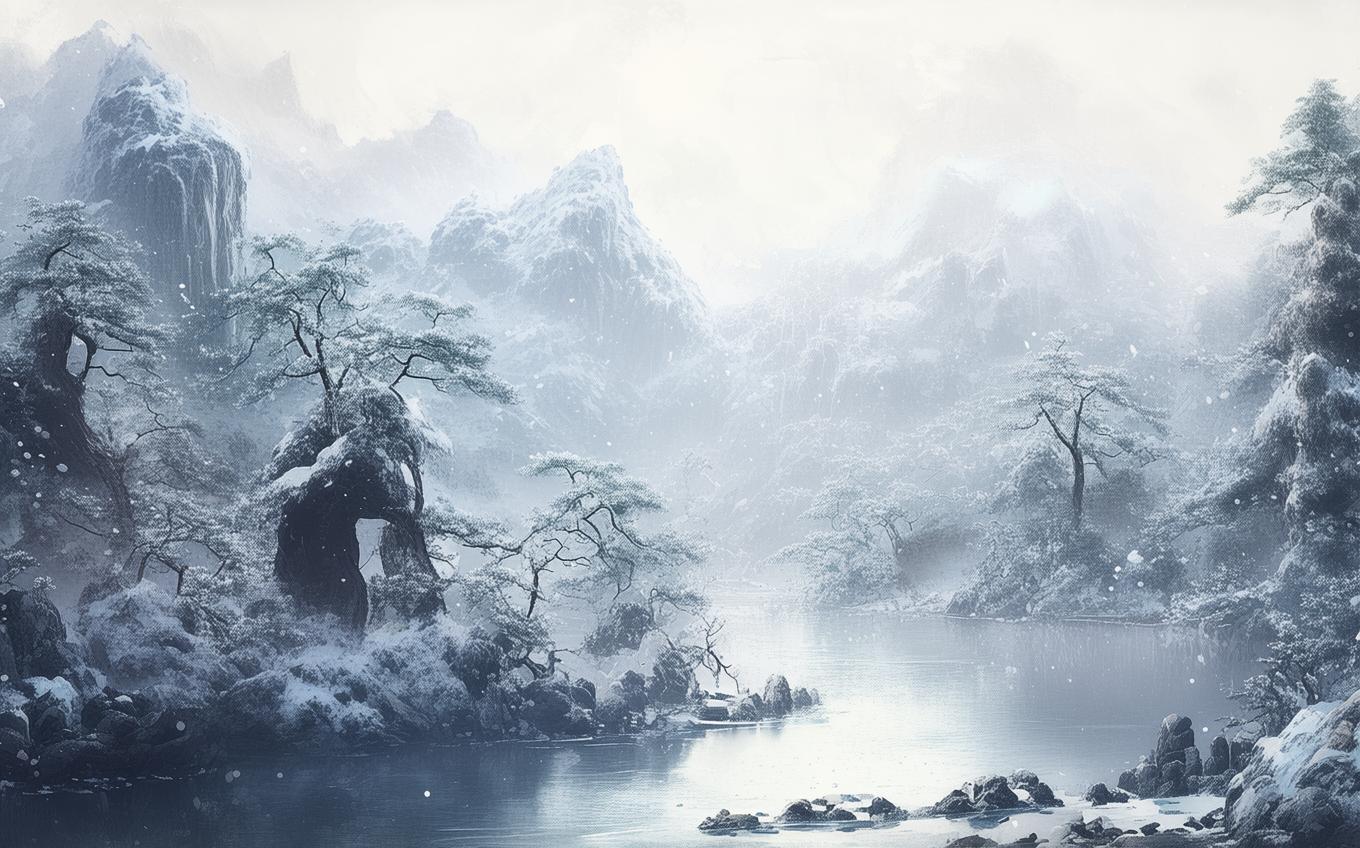
The poem opens by tracing the snow’s origin to the northern desert known as the Dragon Sands (龙沙), a desolate frontier region. In Chinese cosmology, snow arriving from this distant, wild place onto the cultivated heartland was considered a blessed anomaly—nature bringing the margin into the center. The word “呈祥” (presenting auspiciousness) immediately establishes the snowfall not as a hardship but as a benevolent sign from heaven. The phrase “势可嘉” (its momentum is praiseworthy) praises the grandeur of the drifting flakes, suggesting that the sheer scale of the storm is itself a visual hymn.
有田皆种玉,无树不开花。
This perfectly parallel couplet is the poem’s most famous image. “有田皆种玉” (all fields are planted with jade) transmutes the snow‑covered farmland into a field of precious stone, stressing the whiteness, purity, and value of the snow. Jade in Chinese culture represents nobility, eternity, and moral integrity. The second half, “无树不开花”, completes the metaphor: every bare branch has suddenly burst into bloom, as if winter had become a spring of white petals. Together, the lines suggest that the snow has given the entire landscape a magical, momentary rebirth, erasing all barrenness and replacing it with luminous beauty.
粉垛收残粉,朱阑凸绛纱。
This couplet shifts from the grand panorama to an intimate, architectural detail. “粉垛” refers to ridges—perhaps rooftops or ornamental mounds—that collect residual snow, described here as leftover white powder. The image of “收残粉” (gathering leftover powder) evokes a scene where not all the snow has settled evenly; some clings in delicate traces, like cosmetic powder on a woman’s face. By contrast, “朱阑” (vermilion railings) stands out vividly. The snow draped over the red balustrade is likened to a layer of translucent crimson gauze (绛纱) that “protrudes” (凸). The interplay of vivid red and pristine white is exquisitely sensory, turning the capital’s architecture into a piece of textile art. Li Shangyin’s use of a textile metaphor—gauze—subtly introduces a sense of luxury and courtly refinement.
此时倾贺酒,相望在京华。
The final couplet moves from the silent spectacle to human celebration. “倾贺酒” (pouring congratulatory wine) signals a toast; the snow is an occasion for communal festivity. The phrase “相望在京华” (gazing at one another in the capital) suggests a city united in shared joy, with citizens and perhaps officials raising their cups and catching each other’s eyes, all under the same blessing of snow. “京华” (flowering capital) is a poetic name for Chang’an, itself a metaphor of cultural splendor. The poem closes on a note of civic harmony, turning private delight into a public affirmation of good fortune.
Themes and Symbolism
Auspicious Snow as Cosmic Blessing
The central theme is the celebration of snow as a propitious sign (祥瑞). In traditional Chinese agrarian thought, a timely snowfall in winter (瑞雪) promised a bountiful harvest, as it insulated winter wheat and signaled that the natural order was in balance. Li Shangyin elevates this practical belief into a poetic vision of universal benevolence.
Metamorphosis and Purity
The dominant symbolism revolves around transformation through purity. Snow turns fields into jade, bare trees into flowers, and even ordinary architecture into gauze‑draped art. Jade (玉) is a crucial symbol: its hardness, purity, and translucence connote incorruptible virtue. By describing snow as jade, the poet implies that the capital has been morally cleansed and refined.
Unity and Shared Joy
The final toast and mutual gaze emphasize a shared emotional landscape. Snow erases the boundaries between nature and human society, between emperor and subject, and between individuals. Everyone in the capital looks upon the same blessing, and that collective recognition forges a transient but powerful harmony.
The “Flowering Capital” Paradox
The closing term “京华” (florescence of the capital) creates a paradox: in the heart of winter, the city blooms. This metaphorical bloom, enabled by snow, suggests that cultural refinement and political order can flourish even in harsh times—a comforting idea for a late‑Tang poet who lived through imperial decline.
Cultural Context
Li Shangyin wrote during the late Tang dynasty, a period marked by political fragmentation, eunuch power struggles, and frontier instability. His earlier poetry often echoes those anxieties with dense, coded language. “喜雪”, however, is believed to have been composed in Chang’an on a winter day when a heavy snowfall was universally interpreted as a good omen for the empire. Such poems were sometimes written for court occasions, blending personal delight with the duty of a scholar‑official to celebrate celestial favours.
The concept of “喜雪” (joy in snow) itself is deeply rooted in Chinese literary tradition. From the Book of Songs to the great Tang poets, snow was celebrated as a messenger of warmth to come, a purifier, and a symbol of the noble recluse untouched by worldly grime. Li Shangyin’s poem, while less cryptic than his typical works, still displays his hallmark delicacy—particularly in the close observation of snow on red railings, a detail that recalls the Tang aesthetic of contrast and ephemeral beauty.
The five‑character regulated verse form demanded strict tonal parallelism and semantic coupling, especially in the middle two couplets. Li’s mastery shines in the seamless pairing of “jade” with “flowers” and “powder ridges” with “gauze‑draped railings,” showing how technical constraint can heighten lyrical effect.
Conclusion
Li Shangyin’s “喜雪” endures because it transforms a simple weather report into a miniature celebration of cosmic and social order. Its vivid, tangible imagery—jade fields, blossoming trees, powdery rooftops, red gauze—invites the reader into a world where even the coldest season produces the most refined beauty. For modern English‑speaking audiences, the poem offers not only a glimpse of Tang cultural optimism but also a reminder that communal joy, like a good snow, can momentarily erase divisions and remind us of our shared existence. In a time of global uncertainty, Li Shangyin’s toast “相望在京华” (gazing at each other in the flowering capital) resonates as an invitation to pause, look around, and raise a glass—even if only metaphorically—to the simple, renewing gifts of nature.

Comments (0)
No comments yet. Be the first to comment!