Introduction
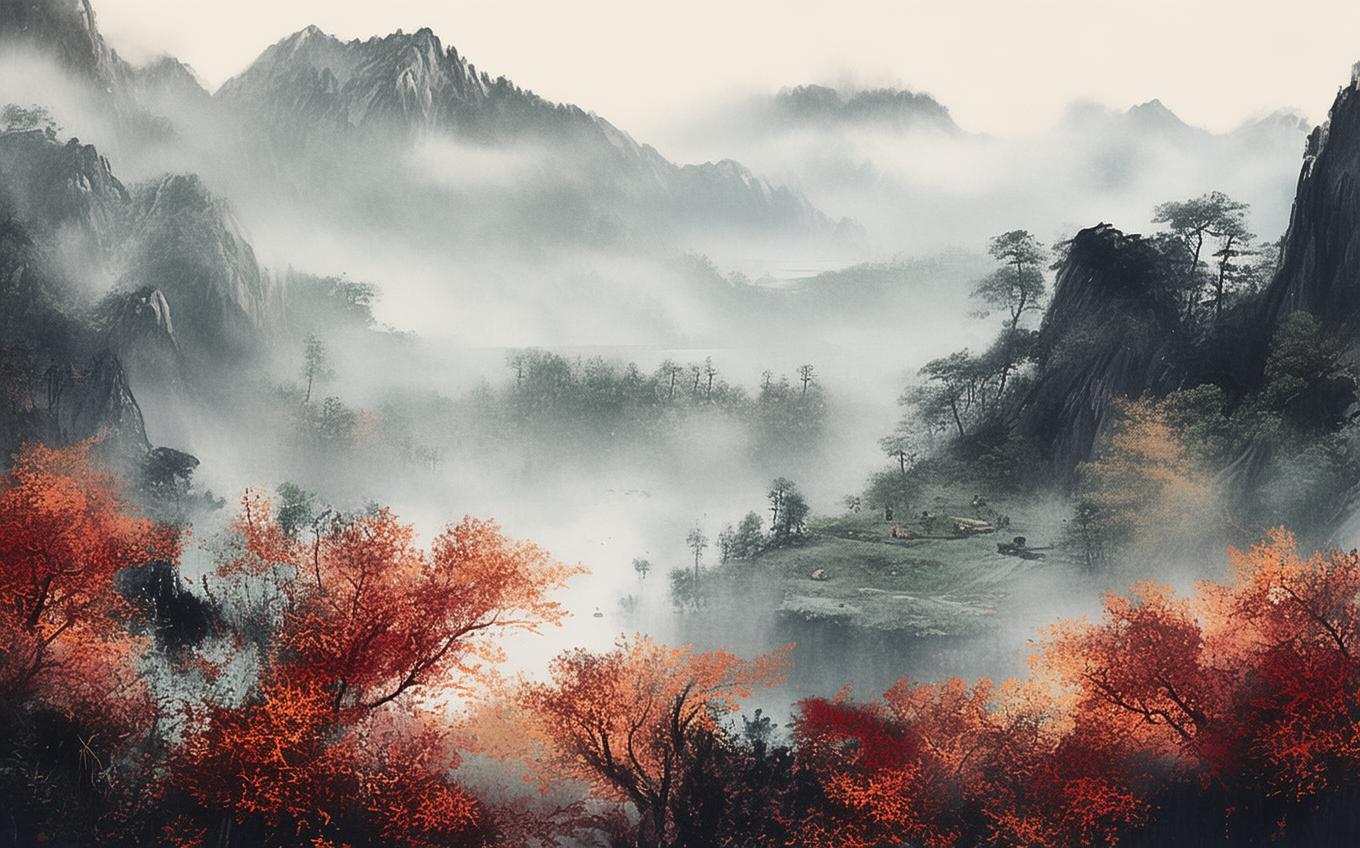
In the early Tang Dynasty, China experienced a cultural renaissance where emperors themselves often took up the brush to compose poetry. Among them, Emperor Taizong (Li Shimin, 598–649 CE) stands out not only as a visionary ruler but also as a refined man of letters. His poem “秋日效庾信体” (Qiū Rì Xiào Yǔ Xìn Tǐ – “Autumn Day, in Imitation of the Style of Yu Xin”) pays homage to the literary genius of Yu Xin (513–581), a poet of the Southern Dynasties whose elegant, image‑rich style became a model for Tang court poetry. This poem captures the fleeting beauty of an autumn landscape through a series of vivid, almost cinematic vignettes, blending southern lyricism with the emerging Tang aesthetic. For English readers fascinated by Chinese culture, this poem offers a window into how nature, time, and refined sensibility intertwine in classical verse.
The Poem: Full Text and Translation
岭衔宵月桂,
Lǐng xián xiāo yuè guì,
The ridge holds in its mouth the night moon like a cassia bud;
珠穿晓露丛。
Zhū chuān xiǎo lù cóng,
Pearls are threaded through thickets of dawn dew.
蝉啼觉树冷,
Chán tí jué shù lěng,
Cicadas cry and I sense the trees growing cold;
萤火不温风。
Yíng huǒ bù wēn fēng,
Fireflies’ light does not warm the wind.
花生圆菊蕊,
Huā shēng yuán jú ruǐ,
Blossoms are born on the round buds of chrysanthemums;
荷尽戏鱼通。
Hé jìn xì yú tōng,
Lotuses have withered, yet playful fish still pass through.
晨浦鸣飞雁,
Chén pǔ míng fēi yàn,
On morning shores, flying wild geese call;
夕渚集栖鸿。
Xī zhǔ jí qī hóng,
On evening islets, settling swans gather.
飒飒高天吹,
Sà sà gāo tiān chuī,
Rustling, rustling, the high heavens blow;
氛澄下炽空。
Fēn chéng xià chì kōng,
The haze clears beneath the blazing, empty sky.
Line-by-Line Analysis
Line 1 opens with a surreal, moonlit image. The mountain ridge “holds” the night moon as if it were a cassia blossom – a flower associated with the moon in Chinese mythology. This metaphor immediately establishes a delicate, almost painterly mood, where nature is not merely observed but transformed by the poet’s imagination. The word “衔” (xián, to hold in the mouth) personifies the ridge with a gentle, living gesture.
Line 2 shifts to a close‑up of the morning. Dewdrops are not just drops; they become “pearls” threaded through the vegetation. This metaphor elevates a common autumn sight into something precious and ephemeral. The juxtaposition of “night moon” and “morning dew” in the opening couplet spans an entire nocturnal cycle in two lines, compressing time like a scroll painting.
Line 3 introduces sound and temperature. The shrill cry of cicadas makes the coldness of the trees perceptible – one “feels” the chill through the insects’ lament. In classical Chinese poetry, the cicada often symbolizes the passing of summer and the melancholy of autumn. Here, the sensory blending (hearing evoking touch) reflects the holistic way Chinese poets experienced the natural world.
Line 4 deepens the autumnal chill with a paradox: fireflies glow warmly, yet their light cannot heat the wind. This line suggests that even the season’s remaining sparks are powerless against the encroaching cold. It is a subtle meditation on the limits of beauty and warmth in the face of cosmic change.
Line 5 turns toward a defiant note of life. Chrysanthemums, the quintessential autumn flower, produce blossoms from round buds – “圆菊蕊” (round chrysanthemum buds) emphasizes their geometric perfection and resilience. In Chinese culture, chrysanthemums symbolize longevity and the ability to flourish amid decay.
Line 6 balances decline with continuity. The lotus, a summer flower emblematic of purity, has withered entirely, yet the fish still “play” and navigate through the remaining stems. The verb “通” (tōng, to pass through or connect) suggests that life’s currents persist even when the surface appears spent. It is a striking image of the unseen vitality beneath autumnal loss.
Line 7 and Line 8 form a parallel structure capturing the rhythms of the day. Morning shores (“晨浦”) resonate with the calls of wild geese taking flight; evening riverbanks (“夕渚”) become resting places for large, settled swans. The couplet traces the migration and nesting habits of waterfowl – a time‑honored motif for the movement of time and the traveler’s longing. The shift from “飞” (fēi, flying) to “栖” (qī, roosting) encapsulates the arc of a day, from energetic departure to peaceful settlement.
Line 9 returns to the wind, now with the onomatopoeic “飒飒” (sà sà, rustling). The wind is coming from the “high heavens,” a vast, cosmic source, reminding the reader that the scene is subject to forces far beyond the human realm.
Line 10 concludes with a dramatic clearing. “氛澄” (fēn chéng, the haze clears) reveals a hot, empty sky – “炽空” (chì kōng). The adjective “炽” (blazing, scorching) is unexpected in a cool autumn poem; it suggests a residual heat, perhaps the fierce sun of late‑summer lingering. The emptiness of the sky after the haze lifts evokes a sense of sublime solitude, a hallmark of Tang nature poetry where the landscape becomes a mirror for the mind.
Themes and Symbolism
- Transience and Continuity: The poem weaves scenes of decay (withered lotus, cold wind) with images of ongoing life (chrysanthemums blooming, fish swimming). This duality reflects the Daoist and Buddhist notions that decline is never absolute – change is constant, and life persists in cyclical patterns.
- Nature as Emotional Correlative: Each natural element carries an emotional charge. The cicada’s cry is not only a seasonal marker but also a vehicle for coldness and melancholy. Fireflies that “do not warm the wind” become symbols of futile grace against the forces of time.
- Painterly Observation: The poem works like a handscroll of autumn vistas. The poet’s eye moves from the moonlit ridge to dewdrops, from tree‑top cicadas to ground‑level fireflies, then to flowers, water, birds, and finally the sky. This structured gaze reflects the Chinese aesthetic principle of jingjie (境界 – a world within the poem) where scene and feeling merge seamlessly.
- Imitation as Homage: By adopting Yu Xin’s style, Emperor Taizong was engaging in xiao – a form of respectful imitation that was central to literary training. The lightness of touch, the refined imagery, and the careful parallelism all pay tribute to the southern court poetry that Yu Xin mastered, while also adapting it to a more expansive Tang imperial sensibility.
Cultural Context
The title “效庾信体” places the poem squarely in the Tang tradition of literary dialogue with the past. Yu Xin, originally a court poet of the Liang dynasty, was captured and spent his later years in the Northern Zhou. His poetry blended southern elegance with northern melancholy, bridging two cultural spheres. For Tang rulers, especially Taizong, imitating Yu Xin’s style was a way to unite the literary heritage of the divided empire and to assert cultural authority. Autumn itself was a favored season for such reflective poetry, as it embodied the fruits of cultivation and the onset of winter – a metaphor for imperial responsibility and the melancholy of power.
Moreover, Taizong’s poem exemplifies how Chinese nature poetry almost never describes a landscape for its own sake. Every image is an invitation to feel the underlying qi (vital energy) of the world. The clearing haze and the blazing empty sky at the end can be read as a spiritual moment: the emperor, like any sensitive observer, stands before the vastness of nature, humbled and awed.
Conclusion
“秋日效庾信体” is a miniature masterpiece that distills the essence of an autumn day into ten couplets of shimmering precision. Through its layered imagery – moon‑like cassia, pearl‑like dew, cold‑singing cicadas, and a sky ablaze with emptiness – the poem invites readers to slow down and perceive the world with the same delicate attention the poet brought to his imperial garden. For modern readers, it bridges centuries and cultures, reminding us that the rustle of wind and the cry of a bird can still stir emotions we thought were only our own. In the classic manner of Chinese poetry, it leaves us not with a moral, but with a picture that resonates long after the words have faded into silence – like the “blazing, empty sky” that lingers after the haze is gone.
Comments (0)
No comments yet. Be the first to comment!