Introduction
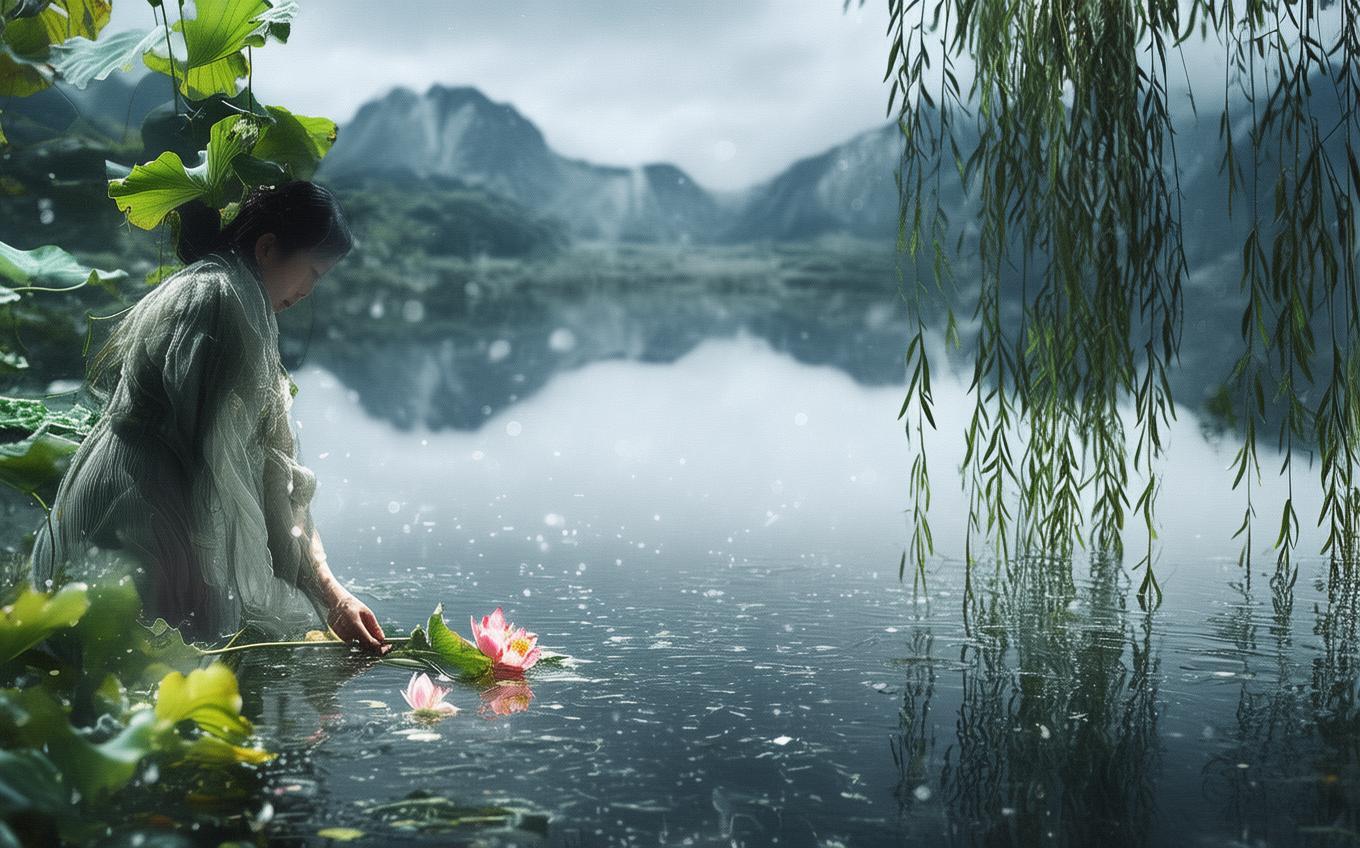
In the vast treasury of classical Chinese poetry, the Nineteen Old Poems (古诗十九首, Gǔshī Shíjiǔ Shǒu) stand as pillars of early lyrical art, composed anonymously during the Han dynasty (206 BCE – 220 CE). Among them, “涉江采芙蓉” (Shè Jiāng Cǎi Fúróng, “Crossing the River to Pick Lotus Flowers”) is a jewel of quiet melancholy. It captures a fleeting moment of longing, blending nature’s beauty with the ache of separation—a theme that would echo through centuries of Chinese verse. This poem speaks with astonishing immediacy even today, inviting us into the delicate world of a traveler whose heart remains tethered to a distant love.
The Poem: Full Text and Translation
涉江采芙蓉,
Shè jiāng cǎi fúróng,
Crossing the river to pick lotus flowers,
兰泽多芳草。
Lán zé duō fāng cǎo.
The orchid marsh abounds with fragrant grasses.
采之欲遗谁?
Cǎi zhī yù wèi shéi?
Plucking them, for whom shall I bestow this gift?
所思在远道。
Suǒ sī zài yuǎn dào.
The one I long for is on a distant road.
还顾望旧乡,
Huán gù wàng jiù xiāng,
Turning around, I gaze toward my old home;
长路漫浩浩。
Cháng lù màn hào hào.
The long road stretches vast and boundless.
同心而离居,
Tóng xīn ér lí jū,
Sharing one heart, yet we dwell apart,
忧伤以终老。
Yōu shāng yǐ zhōng lǎo.
Grief-stricken, I will grow old like this.
Line-by-Line Analysis
The poem opens with an act of simple, sensuous beauty: “shè jiāng cǎi fúróng” — crossing a river to gather lotus blossoms. The lotus (fúróng) is not an idle choice; in Chinese culture it symbolizes purity, love, and harmony, rising immaculate from muddy waters. The motion of crossing the river already suggests effort, a threshold being traversed, perhaps a psychological passage into memory.
The second line deepens the sensory landscape: “lán zé duō fāng cǎo.” Orchids and aromatic grasses fill the marsh, evoking a world saturated with fragrance and life. Orchids (lán) are emblems of refinement and moral integrity, often associated with noble friendship and unspoken love. The abundance of fragrant plants heightens the feeling of plenitude in nature—yet this plenitude will soon contrast with emotional emptiness.
The third line pivots dramatically with a rhetorical question: “cǎi zhī yù wèi shéi?” The speaker has gathered these beautiful, aromatic offerings, but suddenly realizes there is no one at hand to receive them. This moment crystallizes the poem’s core tension: the presence of beauty without a beloved to share it. The act of picking flowers, rooted in the ancient custom of presenting fragrant herbs as tokens of affection, becomes futile.
The answer follows immediately: “suǒ sī zài yuǎn dào” — the one I yearn for is far away on a long road. The phrase “yuǎn dào” (distant road) is a charged motif in early Chinese poetry, connoting official journeys, military service, or mercantile travel—forces that tear loved ones apart. Distance is not measured in miles but in the impossibility of reunion.
The fifth line shifts perspective: “huán gù wàng jiù xiāng.” The speaker turns back to gaze at the old home village. The word “huán gù” (turn around and look) implies a lingering, reluctant backward glance. Home is now a memory, perhaps a place irrevocably lost. The sixth line measures that distance: “cháng lù màn hào hào.” The road is long, and the reduplicated phrase “màn hào hào” paints a vastness that overwhelms the spirit, a landscape blurred by sorrow.
The final couplet distills the entire emotion into a stark, unforgettable statement: “tóng xīn ér lí jū, yōu shāng yǐ zhōng lǎo.” They share one heart—a profound union of feeling—yet physically they are doomed to live apart. The poem does not envision a happy ending; instead, the speaker bleakly foresees a lifetime of growing old in sorrow. The word “yōu shāng” (grief and injury) carries a weight deeper than simple sadness, a wound that time only deepens.
Themes and Symbolism
The central theme is the agony of separation from a loved one, crystallized in the paradox of “tóng xīn ér lí jū” — one heart, two bodies. The poem explores how physical distance cannot sever emotional intimacy, yet that same intimacy makes distance unbearable. Nature, bursting with beauty and fragrance, only sharpens the sense of loss; its cycle of renewal contrasts cruelly with the stasis of human longing.
Key symbols:
- Lotus (芙蓉, fúróng): Purity, love, and the brief blossoming of life, often linked with yearning women or noble men.
- Orchid and fragrant grasses (兰, 芳草): Moral elegance, unspoken desire, and the transience of beauty.
- The distant road (远道, yuǎn dào): The impersonal forces of duty and fate that divide lovers.
- The old home (旧乡, jiù xiāng): A lost paradise of togetherness, now a mental image.
Another subtle theme is the ritual of gift-giving. Plucking herbs to present to a lover or friend was a social custom; here the ritual is broken, and the speaker is left holding meaning without a recipient—a gesture suspended in time.
Cultural Context
The Han dynasty saw the development of a unified Chinese empire, along with a bureaucratic system that required men to travel far for official posts, military campaigns, or trade. The Nineteen Old Poems frequently give voice to the sorrow of those left behind—wives, mothers, friends—and the wanderlust-tinged exhaustion of the travelers themselves. These poems reflect ordinary human feelings, often outside the Confucian emphasis on ritual propriety, revealing a culture’s deep awareness of life’s transience.
Lotus gathering also had a festive, romantic aura in ancient China. In the “Chu Ci” (Songs of Chu), the act of picking fragrant plants often symbolizes seeking a worthy mate or a kindred spirit. By the time of the Han, this imagery had merged with folk songs, producing an idiom where nature becomes the intimate mirror of the heart. The poem’s anonymity universalizes the experience—this is not one person’s private grief, but a shared human condition.
Philosophically, the poem resonates with a Daoist sensibility of going with the flow (wu wei), yet it also sounds a Confucian note of loyalty and constancy. The speaker does not rebel; instead, they quietly endure, and it is this very endurance that ennobles the sorrow.
Conclusion
“涉江采芙蓉” endures because it speaks in the simplest language about a universal sorrow: loving someone you cannot reach. In just eight lines, it moves from a vivid, fragrant world to a quiet, devastating resignation. The poem leaves us with an image of a figure standing between river and home, flowers in hand, eyes fixed on a horizon that will never shorten. It echoes the truth that some distances are not measured by roads, but by the years that pass while we wait. For modern readers, whose separations may be emotional or digital rather than physical, this ancient voice still carries the weight of a heart divided yet whole, and the fragile beauty of hoping against time.
Comments (0)
No comments yet. Be the first to comment!