Introduction
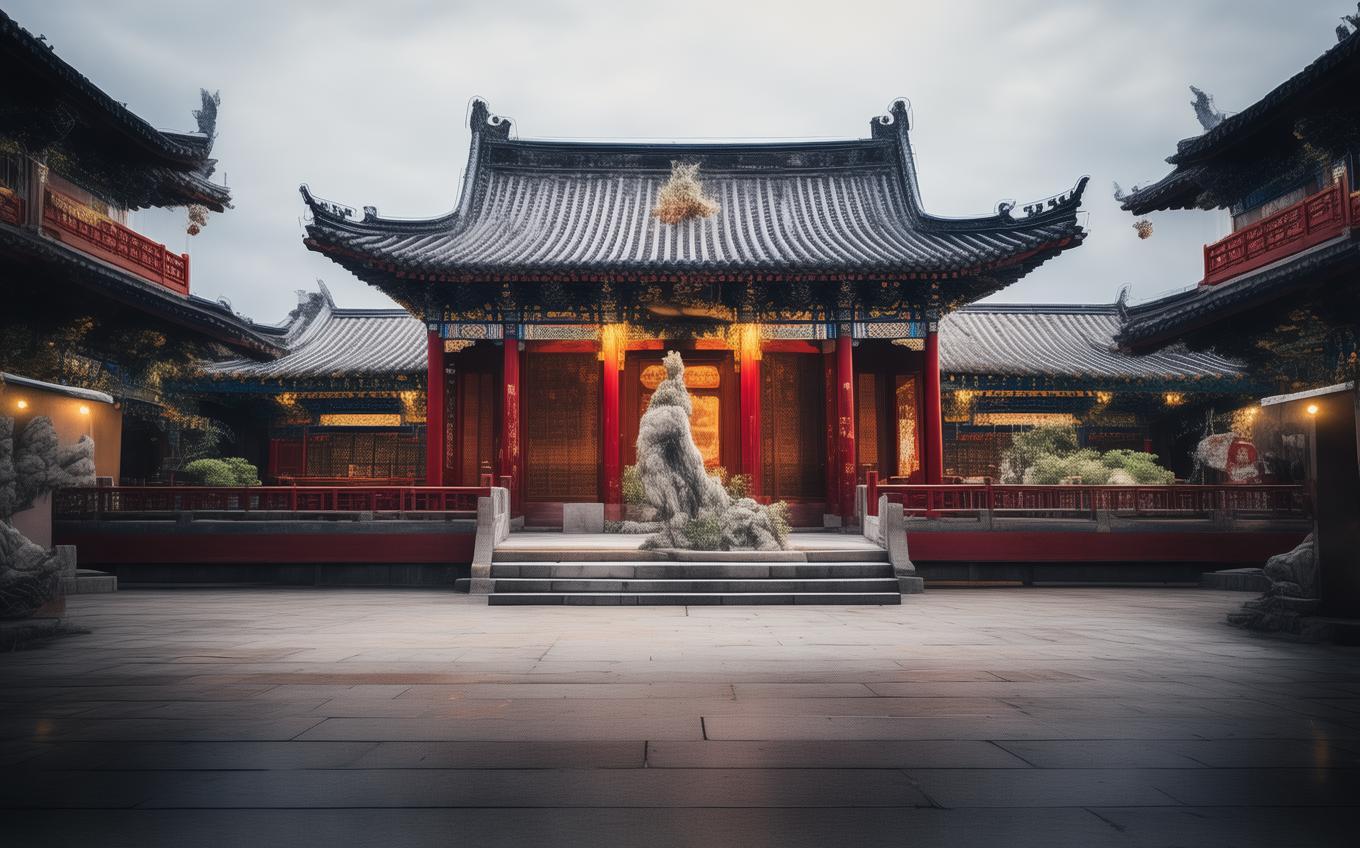
Li Bai (701–762), often celebrated as the "Immortal Poet," is one of the most luminous stars in the Tang dynasty firmament. Renowned for his Daoist-infused flights of imagination, wine-soaked spontaneity, and a deep affinity with nature, Li Bai also frequently engaged with Buddhist motifs, weaving them into his lyrical world. The poem Yǒng Xīngguó Sì Fó Diàn Qián Fān (咏兴国寺佛殿前幡) – “On the Banner Before the Buddha Hall of Xingguo Temple” – is a superb example of this synthesis. Composed during a visit to a Buddhist monastery, the poem observes a temple banner dancing in the wind and sunlight, transforming a static ritual object into a vehicle for profound reflection on impermanence, illumination, and the longing for transcendence. Its exquisite imagery and philosophical depth have secured it a treasured place in Chinese landscape and meditative poetry.
The Poem: Full Text and Translation
幡挂青霄上,
Fān guà qīngxiāo shàng,
The banner hangs against the azure firmament,
风摇紫殿前。
Fēng yáo zǐ diàn qián.
Wind sways it before the purple Buddha hall.
露垂银汉彩,
Lù chuí yínhàn cǎi,
Dewdrops trail the splendour of the Silver River,
云拂玉阶烟。
Yún fú yùjiē yān.
Clouds brush mist upon the jade-white steps.
日照光成采,
Rì zhào guāng chéng cǎi,
Sunshine strikes – its glow turns into rainbow hues,
霞铺色若然。
Xiá pū sè ruò rán.
Rosy clouds spread out in colours just as imagined.
何当一飞去,
Hédāng yī fēi qù,
When shall I soar away in one sudden flight
化作白云天。
Huà zuò báiyún tiān.
And transform into white clouds across the sky?
Line-by-Line Analysis
The poem opens by anchoring the eye upward: “幡挂青霄上” – the banner, a vertical streamer of silk or cloth used in Buddhist rituals, is suspended against the boundless cyan of the heavens. The word “挂” (hangs) suggests stillness, a poised presence between earth and sky. Immediately, the second line animates the scene: “风摇紫殿前” – the wind shakes it before the “purple hall,” a reverent epithet for the Buddha’s sanctuary. The colour purple carries imperial and sacred connotations, linking the earthly temple to celestial majesty. Together, these lines establish a delicate tension between stability and motion, material object and infinite space.
The third and fourth couplets heighten the cosmic scale. “露垂银汉彩” evokes the Milky Way – the “Silver River” in Chinese mythology – as if dewdrops are droplets spilling from its radiant stream, while “云拂玉阶烟” pictures clouds gently sweeping across the temple’s jade-like steps, blurring the boundary between sacred architecture and misty vapour. Li Bai masterfully blends the minute (dew) with the immense (the galaxy), making the temple a microcosm of the universe. The banner, touched by celestial dew and ethereal cloud, becomes a conduit between realms.
In lines five and six, the focus sharpens on light and colour. “日照光成采” – sunlight ignites the banner into a prism of colours, the character “采” explicitly meaning “variegated hues,” while “霞铺色若然” suggests that the rosy dawn or sunset clouds fan out, dyeing the scene in colours that seem almost willed into being by the poet’s imagination. This moment captures the Buddhist concept of rūpa (form) manifesting through interdependence – the banner’s beauty arises only through the interplay of wind, sun, and cloud, fleeting and luminous.
The final couplet takes a breathtaking turn from observation to aspiration. “何当一飞去” – “When can I fly away?” – is a classic Li Bai outburst, a longing for liberation from earthly constraints. The banner, fluttering as if about to take wing, becomes a mirror for the poet’s soul. To “化作白云天” – transform into white clouds and merge with the sky – is not a rejection of the temple’s sanctity, but a desire to embody the freedom and purity that the banner, in its airy dance, momentarily reveals. The poem ends on a note of transcendent longing, floating somewhere between Buddhist detachment and Daoist ecstasy.
Themes and Symbolism
One dominant theme is transience and impermanence. The banner’s constant motion in the wind embodies the Buddhist truth that all conditioned things are in flux. Yet Li Bai does not mourn this – instead, he finds in it a shimmering beauty, a kaleidoscope of light that points toward a higher reality.
A closely related theme is illumination and illusion. The play of sunlight, dew, and rosy clouds transforms a simple piece of fabric into a celestial spectacle. This resembles the Buddhist metaphor of the “banner moving in the wind” – a well-known Zen story where two monks debate whether the flag or the wind moves, only to be told that it is the mind that moves. Li Bai, attuned to such subtlety, invites us to see the banner as a projection of our own perceptions, a dance between inner and outer light.
Transcendence is the poem’s ultimate heartbeat. The final wish to fly away and become a cloud reflects Li Bai’s lifelong infatuation with Daoist immortality and unbounded freedom. Yet embedded in a Buddhist setting, it also echoes the Bodhisattva’s vow to move unhindered through all realms, a skyward ascent born of wisdom, not escape.
Key symbols:
- The banner (幡): a ritual object fluttering between the human and the divine, symbolising the mind’s restlessness and the potential for awakening when one sees through its movement.
- Purple hall (紫殿): the sacred space, the heart of the monastery, suggesting the indwelling Buddha-nature.
- Silver River (银汉) and jade steps (玉阶): cosmic and courtly imagery that ennobles the temple, linking it to Heaven’s architecture.
- White clouds (白云): in Chinese poetic tradition, clouds represent eremitism, purity, and the untrammelled life of a sage. Here they become the final destination of the soul’s flight.
Cultural Context
The Tang dynasty (618–907) was a golden age of cultural exchange, when Buddhism, Daoism, and Confucianism interwove to shape the intellectual landscape. Monasteries like Xingguo Temple were not only places of worship but also centres of art, poetry, and philosophical dialogue. A scholar-official like Li Bai, though not a strict adherent of any single creed, moved freely among these traditions. His poem reflects this spiritual hybridity: the setting is unmistakably Buddhist, yet the language of starry rivers and white-cloud metamorphosis draws heavily from Daoist alchemy and the ancient Chuci (“Songs of the South”) tradition of skyward journeys.
For a Tang reader, the banner (幡) carried profound ritual significance – it was used in ceremonies to transfer merit, guide spirits, and decorate sacred spaces. By meditating on its motion, Li Bai transforms a liturgical implement into a philosophical koan, asking his audience to see beyond the physical object and touch the luminous emptiness it signifies. This fusion of art and contemplation embodies the Chinese ideal of yijing (意境) – a poetic world where scene and sentiment are seamlessly one.
Conclusion
“咏兴国寺佛殿前幡” is a jewel of regulated verse, compressing infinity into forty brief characters. Its beauty lies in the way Li Bai lets the eye climb from a hanging banner to the clouds, from dewdrop to Milky Way, until the boundary between self and cosmos dissolves. The poem does not preach Buddhism; it whispers it through colour, light, and a deep, yearning silence. For modern readers, the image of a banner dancing in the wind remains a gentle reminder that even the most ordinary things, when seen with a poet’s clarity, shimmer with the possibility of transcendence. In a world constantly in motion, Li Bai’s words invite us to pause, look up, and perhaps, for a moment, feel the impulse to fly.
Comments (0)
No comments yet. Be the first to comment!