Introduction
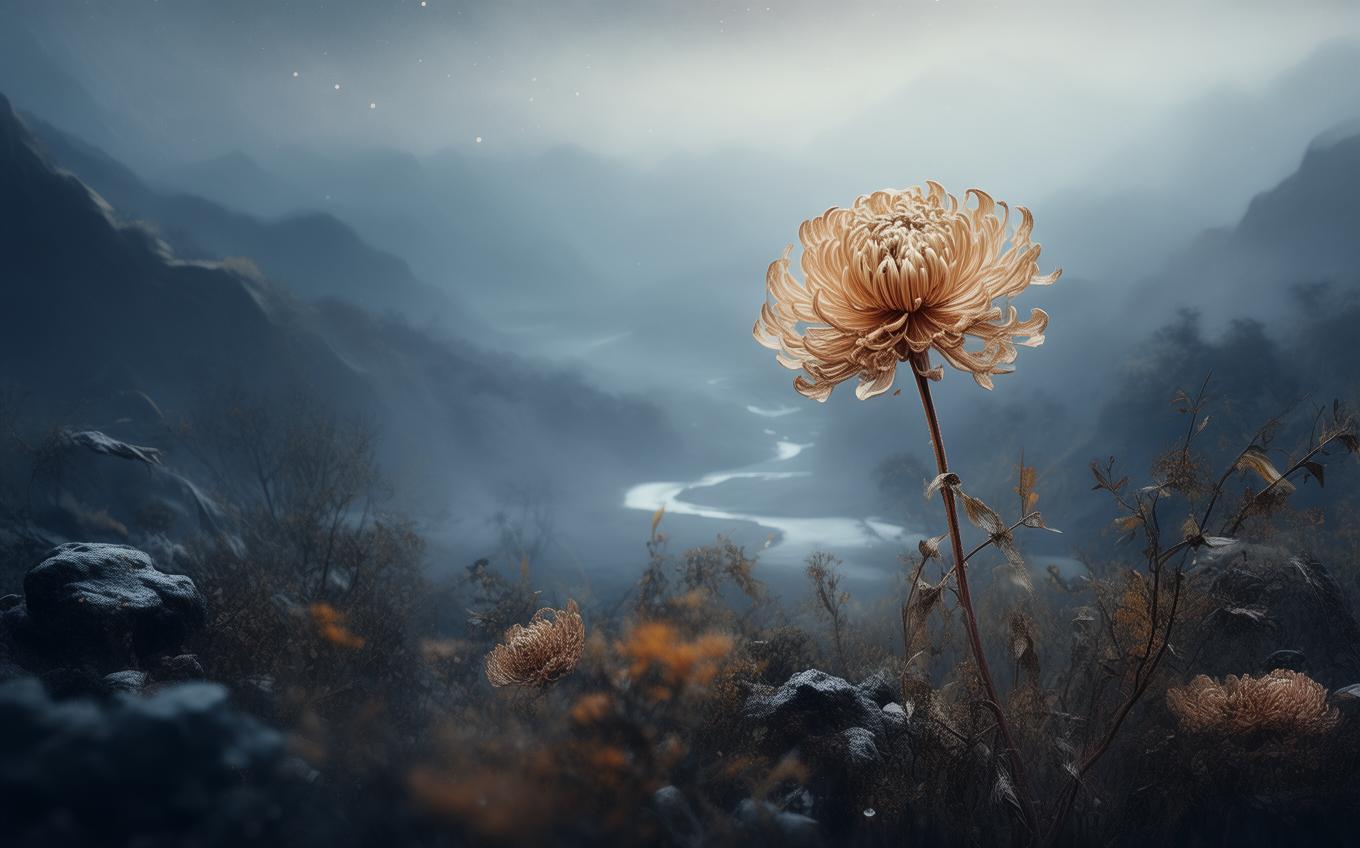
"赋得残菊" (Assigned Topic: Withered Chrysanthemums) is a poem by Emperor Taizong of Tang (唐太宗, personal name Li Shimin, 598–649 CE), one of the most visionary rulers in Chinese history. Beyond his political and military achievements, Taizong was a patron of the arts and an accomplished poet. This poem belongs to a genre called fù dé (赋得), where a set theme is given—often in palace gatherings or civil examinations—and the poet must spontaneously compose a regulated verse. Chrysanthemums, blooming in autumn’s chill and clinging to life even as frost descends, were a beloved subject in Chinese poetry, symbolizing resilience, integrity, and quiet dignity. Taizong’s poem captures the fading beauty of the flowers while hinting at a profound cycle of renewal, blending imperial grandeur with personal reflection.
The Poem: Full Text and Translation
阶兰凝曙霜,岸菊照晨光。
Jiē lán níng shǔ shuāng, àn jú zhào chén guāng.
On the steps, orchids congeal the daybreak frost; on the bank, chrysanthemums shine in the morning light.
露浓晞晚笑,风劲浅残香。
Lù nóng xī wǎn xiào, fēng jìn qiǎn cán xiāng.
Thick dew dries to reveal their evening smile; a strong wind carries a faint, lingering fragrance.
细叶凋轻翠,圆花飞碎黄。
Xì yè diāo qīng cuì, yuán huā fēi suì huáng.
Slender leaves wither their light emerald green; round blooms flutter into splinters of gold.
还持今岁色,复结后年芳。
Hái chí jīn suì sè, fù jié hòu nián fāng.
Yet still, holding this year’s hues, they will once again form next year’s blossoms.
Line-by-Line Analysis
Couplet 1: The Stage is Set
The opening juxtaposes two plants: orchids by the steps and chrysanthemums on the bank. The orchids are stiffened with frost—static, cold, almost emblematic of the hard journey from night. In contrast, the chrysanthemums are bathed in the first light of morning, actively “shining.” Taizong uses zhào (照, illuminate) to animate the scene; the flowers do not merely receive light but seem to radiate it. This pairing hints at the poem’s central tension between decline and persistent beauty.
Couplet 2: Sensory Intimacy
The second couplet moves closer. “露浓晞晚笑” is a delicate image: thick dew that had weighed down the petals evaporates under the day’s warmth, leaving the blooms looking as if they are smiling at dusk. Xī (晞, to dry in the sun) suggests a patient transformation—hardship gives way to grace. The “晚笑” (evening smile) personifies the flowers, gifting them a gentle, wistful consciousness. Then, “风劲浅残香” introduces a sudden contrast: a strong wind sweeps through, yet the chrysanthemums release only a subtle, residual fragrance. The word cán (残, remaining/waning) confirms their fading state, but the scent endures—soft but unyielding.
Couplet 3: The Beauty of Decay
Here the poem zeroes in on the physical deterioration. “细叶凋轻翠” describes the thin leaves losing their vibrant green; diāo (凋, wither) is a stark verb, but it is softened by qīng cuì (light kingfisher-green), a color both delicate and precious. “圆花飞碎黄” turns to the petals: the once perfectly round flowers are now breaking apart, their yellow fragments scattered by the wind like shattered gold. This is not a grim decay but a kind of glorious dissolution—the chrysanthemums’ last act is to gild the air with their remains.
Couplet 4: A Promise of Return
The final couplet delivers a philosophical pivot. “还持今岁色” affirms that the flower clings to the color of this year—it does not simply vanish but preserves its essence. “复结后年芳” then blossoms with hope: fù jié (复结, again form) promises that next year’s fragrance and blooms will return from the same root. The cycle of life is unbroken. Taizong, the emperor who united an empire, sees in a dying flower the blueprint of regeneration, a message as political as it is personal: even after decline, a new season of greatness can be nurtured.
Themes and Symbolism
-
Resilience and Renewal: The poem’s arc moves from frost to flowering again. Chrysanthemums, which bloom late and survive early frosts, are traditional symbols of endurance. Taizong deepens this by framing their withering not as an end, but as a necessary stage in a cycle that guarantees future blossoming.
-
The Coexistence of Beauty and Decay: The imagery refuses to separate grace from ruin. The “smile,” the “faint fragrance,” and the “shattered gold” all emerge precisely because the flower is fading. This echoes a Daoist sensibility: beauty lies in harmony with natural processes, not in resisting them.
-
The Scholar-Gentleman Ideal: In Chinese culture, the chrysanthemum is one of the Four Gentlemen (along with plum, orchid, and bamboo). It represents the virtuous recluse or the steadfast official who remains loyal even in adversity. Taizong, writing as emperor, subtly aligns himself with these qualities—rulers too must stand firm and wear their years with dignity.
-
Imperial Gaze and Impermanence: The poem, composed on an assigned topic at court, is also a meditation on power. An emperor who commands armies now contemplates petals carried by wind. It reveals a ruler acutely aware that his own reign, like the chrysanthemum, must one day scatter—yet hopes that his legacy will “again form next year’s blossoms.”
Cultural Context
The Tang Dynasty (618–907) is often seen as the golden age of Chinese poetry, and the fù dé form was a hallmark of intellectual life. Civil service examinations often required candidates to compose such poems, testing their ability to weave nature, Confucian morality, and stylistic grace into a tight structure. Taizong’s involvement in literary culture helped establish this custom. For him, writing poetry was both a personal joy and a display of the refined ruler—a Confucian ideal of a leader who governs through virtue and cultivation, not force.
Chrysanthemum appreciation also had deep roots. The poet Tao Yuanming (365–427) famously wrote of plucking chrysanthemums by the eastern fence, making the flower synonymous with a life of simplicity and uprightness. By Taizong’s time, chrysanthemum viewing in autumn, drinking chrysanthemum wine, and writing poems about them had become established seasonal rituals. A poem on 残菊 (wilted chrysanthemums) was thus a culturally loaded subject, inviting reflections on aging, the passage of time, and the natural order.
Conclusion
“赋得残菊” is a compact masterpiece that transforms a simple image—dying autumn flowers—into a layered meditation on transience and hope. Emperor Taizong’s brush moves from frost to morning light, from a smile to a scattering of gold, and finally to the quiet certainty of regrowth. For modern readers, the poem serves as a gentle reminder: decline is not defeat, and beauty often finds its most poignant expression just before it fades. In a world that often fears endings, Taizong’s chrysanthemums whisper that every ending holds the seed of a new beginning.
Comments (0)
No comments yet. Be the first to comment!