Analysis of "赋秋日悬清光赐房玄龄" - Classical Chinese Poetry
Introduction
The poem 赋秋日悬清光赐房玄龄 (Fù Qiū Rì Xuán Qīng Guāng Cì Fáng Xuánlíng) – “On the Autumn Day with Hanging Clear Light, Presented to Fang Xuanling” – is a luminous gem from the early Tang dynasty, composed by none other than Emperor Taizong (Li Shimin, 598–649). Renowned as one of China’s greatest sovereigns, Taizong was not only a military strategist and astute ruler but also a sensitive poet and calligrapher. This poem, written as a personal gift to his trusted chancellor Fang Xuanling (578–648), is a masterful blend of celestial imagery and political allegory. It celebrates the autumn sunlight as a metaphor for the emperor’s benevolent governance and extols the loyalty of a devoted minister. For English-speaking lovers of Chinese poetry, this piece opens a window onto the sophisticated court culture of the Tang, where nature, mythology, and statecraft intertwined seamlessly.
The Poem: Full Text and Translation
The poem is a ten-line pentasyllabic regulated verse (wǔyán páilǜ). Below, each line is presented in Chinese characters, Pinyin with tone marks, and a faithful English translation.
秋露凝高掌
qiū lù níng gāo zhǎng
Autumn dew congeals on the high bronze palm朝光上翠微
zhāo guāng shàng cuì wēi
Morning light ascends the green-tinged mountain参差丽双阙
cēn cī lì shuāng què
Irregularly it beautifies the twin watchtowers照耀满重闱
zhào yào mǎn chóng wéi
Shining, it fills the layered palace gates仙驭随轮转
xiān yù suí lún zhuǎn
The immortal chariot follows the wheel’s rotation灵乌带影飞
líng wū dài yǐng fēi
The divine crow flies with its shadow trailing临波无定彩
lín bō wú dìng cǎi
Facing the ripples, no fixed colors remain入隙有圆晖
rù xì yǒu yuán huī
Yet entering a crevice, a perfect round halo glows还当葵藿志
hái dāng kuí huò zhì
Still, like the sunflower and the pulse plant’s resolve倾叶自相依
qīng yè zì xiāng yī
They lean their leaves toward the sun, in mutual reliance.
Line-by-Line Analysis
The poem opens with a pair of quiet, crystalline images that ground the scene in both imperial history and natural beauty.
秋露凝高掌 – “Autumn dew congeals on the high bronze palm.” The “high palm” refers to a famous Han-dynasty construction: a bronze statue of an immortal holding a dew-collecting plate atop a tall pillar, built by Emperor Wu in his quest for longevity. By invoking this relic, Taizong does more than describe morning dew; he connects his own reign with the grandeur of the Han, while subtly implying that true permanence lies not in alchemy but in enlightened rule. The word 凝 (congeal) gives the dew a gem-like stillness, capturing the crisp, poised atmosphere of early autumn.
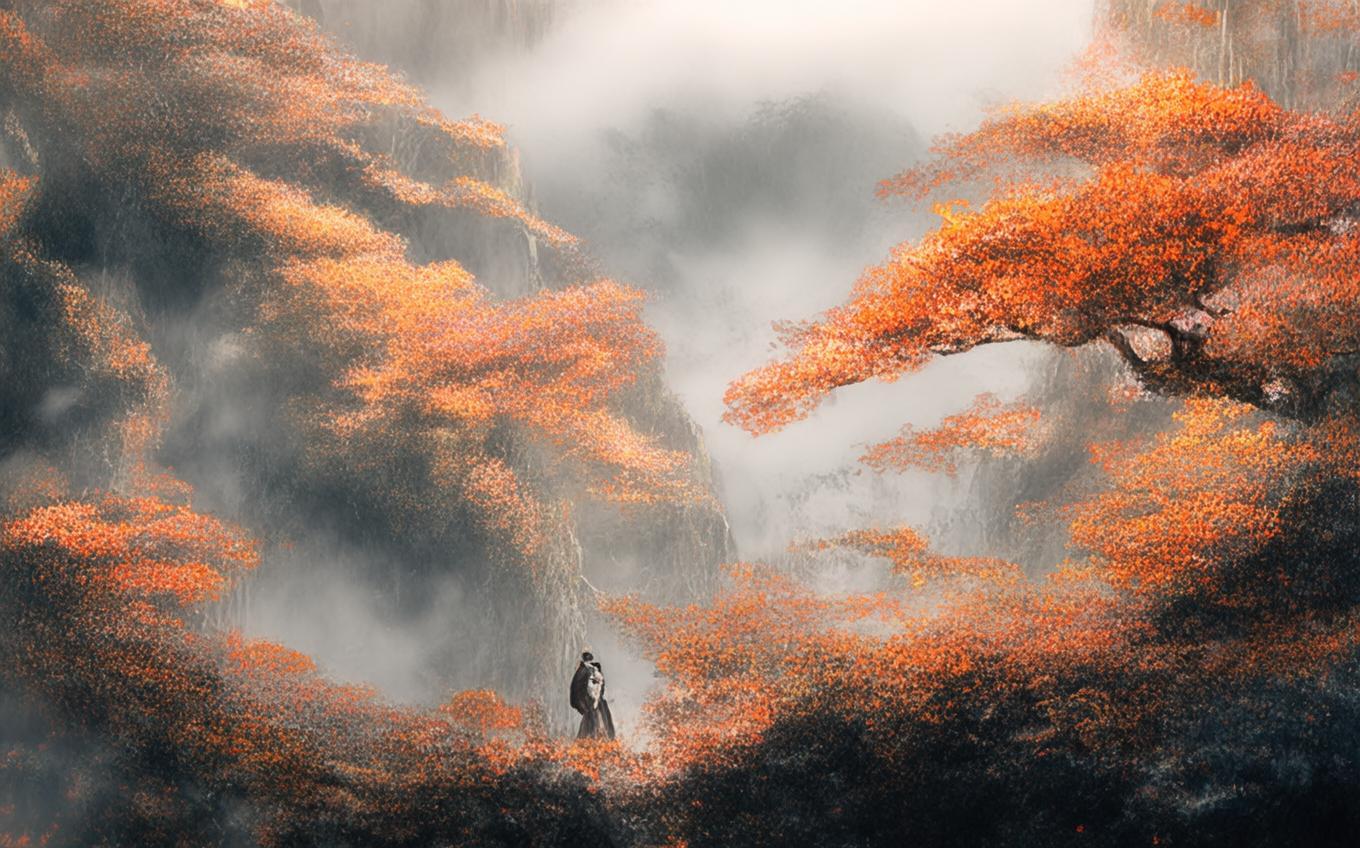
朝光上翠微 – “Morning light ascends the green-tinged mountain.” As the sun rises, its rays climb the lush hillsides. 翠微 (cuìwēi) is a delicate term for the bluish-green haze of distant mountains. The light here is active and gentle, creeping upward and suffusing the landscape with clarity – a perfect visual metaphor for the emperor’s grace spreading across the realm.
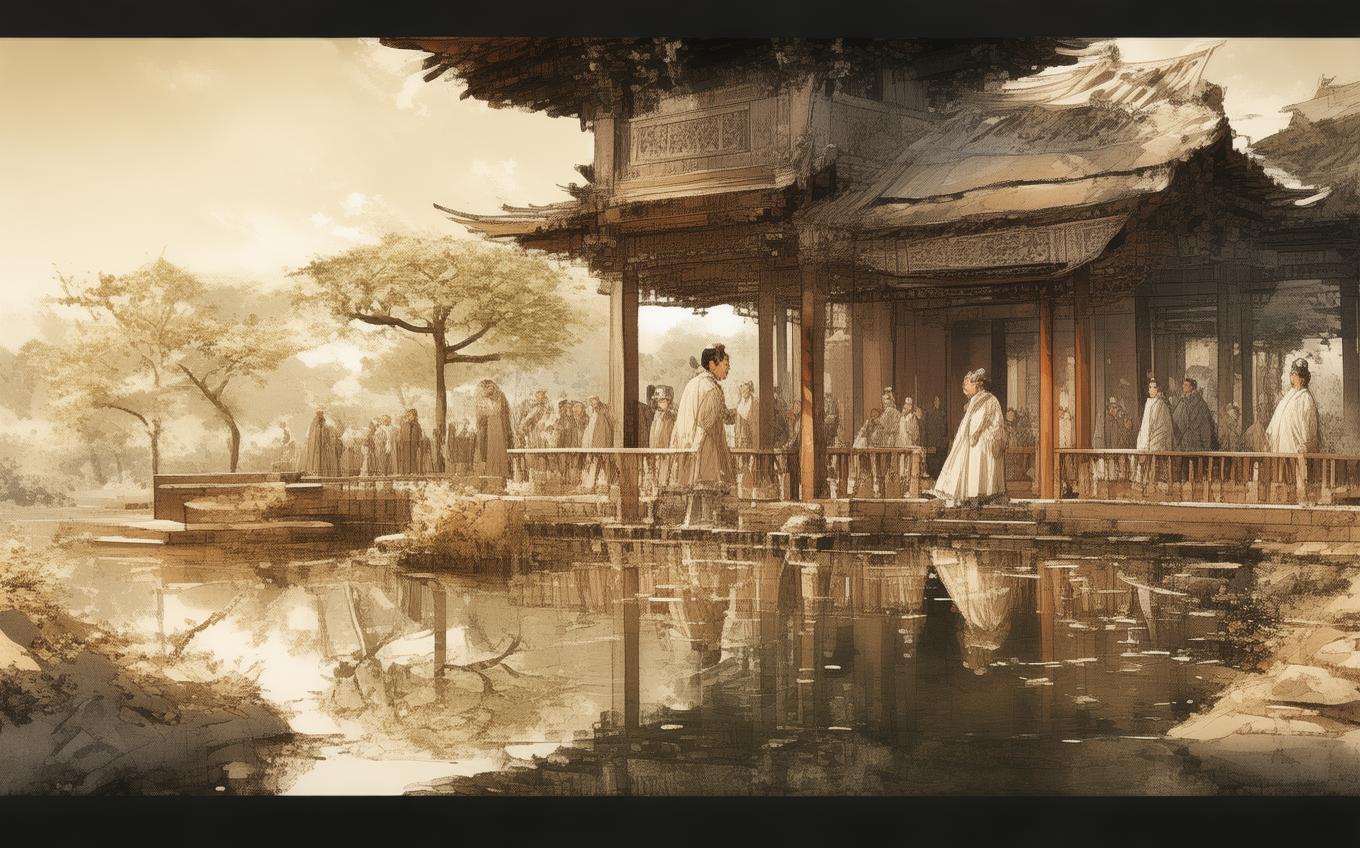
参差丽双阙 and 照耀满重闱 shift the gaze to the imperial palace. The twin watchtowers (双阙) flanking the palace entrance are adorned unevenly (参差) by the play of light and shadow, suggesting organic beauty rather than rigid symmetry. Then the light pours through the layered gates (重闱), filling the innermost courtyards. This movement from outer to inner spaces mirrors how the emperor’s favor penetrates the entire structure of government, reaching even the most secluded corners.
仙驭随轮转 and 灵乌带影飞 dive into solar mythology. The “immortal chariot” (仙驭) alludes to the sun’s charioteer, Xihe, who drives the sun across the sky. The “divine crow” (灵乌) is the three-legged golden crow that inhabits the sun in Chinese legend. As the wheel of the chariot turns, time advances; as the crow flies, its shadow falls upon the earth. The juxtaposition of celestial motion and terrestrial shadow hints at the seamless connection between heaven and the human world – a ruler, after all, rules by the Mandate of Heaven.
临波无定彩 and 入隙有圆晖 present a philosophical contrast. Sunlight playing on water scatters into ever-shifting, impossible-to-pin-down colors – a symbol of the mutable, fleeting nature of worldly phenomena. Yet when that same light slips through a tiny aperture (隙), perhaps a crack in a wall or between leaves, it forms a perfect, unwavering circle. This is a deeply Daoist moment: underlying the apparent chaos of change is a still, constant principle. Politically, it implies that even in a world of flux, the emperor’s virtue remains round and whole.
还当葵藿志 and 倾叶自相依 deliver the poem’s emotional and political conclusion. Sunflowers (葵) and certain legumes (藿) are known for their heliotropism – they turn their leaves to follow the sun. Here, that natural loyalty becomes a model for the ideal minister. Fang Xuanling is the single sunflower, the single cluster of pulse plants, leaning always toward the source of light and warmth. The phrase 自相依 (mutual reliance) is exquisitely balanced: it suggests both the plant’s dependence on the sun and the reciprocal bond between ruler and subject. The emperor needs the minister’s steadfast devotion just as the minister needs the emperor’s illuminating grace.
Themes and Symbolism
The poem’s central theme is the harmonious relationship between a wise ruler and a loyal minister, expressed through the symbol of autumn sunlight. Light, in all its transformations – dew, morning glow, scattered colors, perfect halo – represents the emperor’s virtue (dé) radiating downward. The sun is not harsh or overwhelming; it is clear (清光), tempered by autumn, and capable of beautifying without dominating.
Dew and bronze palm signal the weight of history and the quest for lasting achievement, while the sunflower (葵) serves as the poem’s most enduring symbol of fealty. In Chinese literary tradition, the sunflower’s turning toward the sun (葵藿倾太阳) became shorthand for unwavering loyalty to the sovereign, a motif that would echo through centuries of poetry.
Another important theme is the constant within the transient. The shimmering, unstable reflections on water contrast with the steady halo through the crevice, mirroring the Confucian ideal that a virtuous heart remains unchanged despite external turbulence. Fang Xuanling, who served through the tumultuous founding of the Tang, earned a reputation for careful deliberation and unflappable loyalty; the poem celebrates exactly those qualities.
Cultural Context
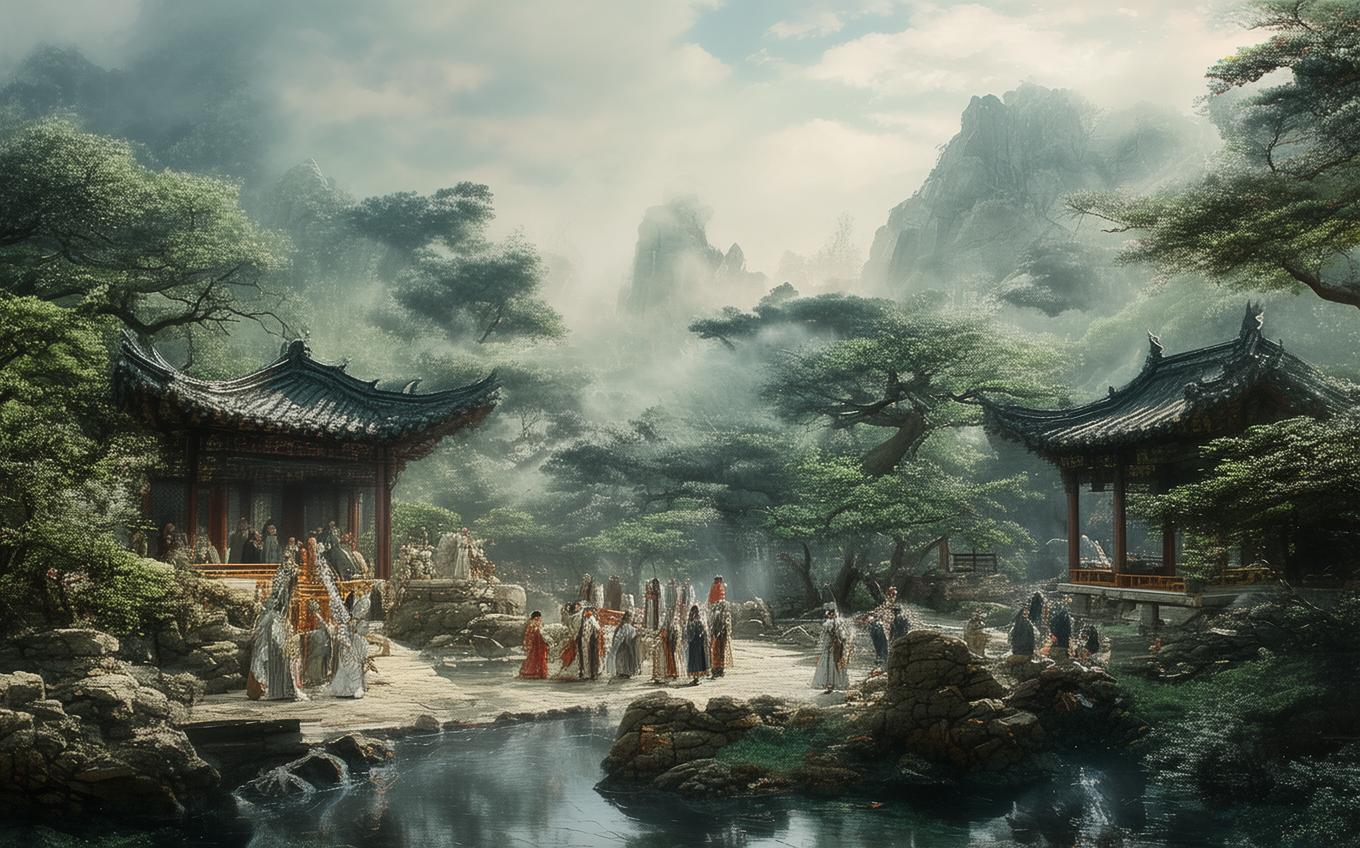
This poem was composed during the Zhenguan reign (627–649), often considered a golden age of Chinese imperial rule. Emperor Taizong surrounded himself with exceptional ministers, and Fang Xuanling was among the most trusted. More than a mere official, he was a key architect of Tang governance, known for his meticulousness and his ability to harmonize disparate voices at court.
Gift poems (cì shī) from emperor to official were a venerable tradition, serving both as personal tokens of affection and as public affirmations of political alliance. By embedding mythological and natural imagery, Taizong elevated a simple gesture into a timeless statement of shared values. The allusions to Han-dynasty immortality projects gently critique the excesses of past rulers while positioning Taizong’s own governance as one grounded in mutual human loyalty rather than magical elixirs.
The poem also reflects the Tang dynasty’s unique synthesis of Confucian, Daoist, and Buddhist thought. The Confucian emphasis on hierarchical harmony is present in the ruler-minister bond; the Daoist appreciation of nature’s fluidity and constancy appears in the water/light imagery; and the overall luminous, transcendent quality hints at a world infused with spiritual meaning.
Conclusion
赋秋日悬清光赐房玄龄 is far more than a royal compliment. It is a miniature cosmos in verse, where a single autumn day becomes a meditation on light, time, loyalty, and the delicate dance between change and permanence. For contemporary readers, the poem’s appeal lies not only in its elegant imagery but also in its vision of leadership – one defined by clarity, warmth, and a profound sense of mutual reliance. In an age of shifting loyalties and fleeting accolades, Taizong’s words still shine through the crevice of history: a perfect halo of confidence in the bond between those who light the way and those who faithfully turn toward the light.
Comments (0)
No comments yet. Be the first to comment!