Introduction
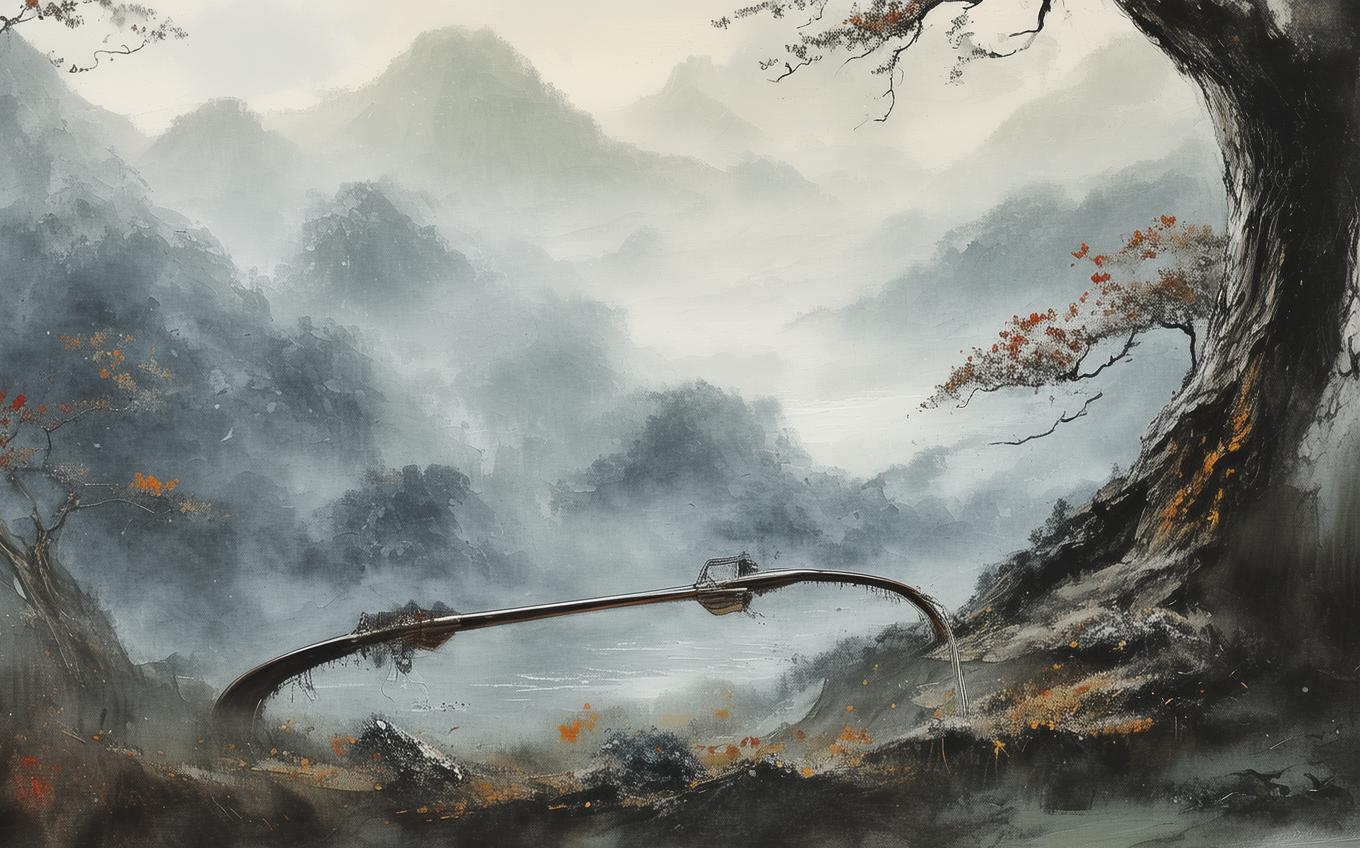
The poem "咏弓" (Yǒng Gōng, "Chant of the Bow") is a striking quatrain composed by Emperor Taizong of the Tang dynasty (reigned 626–649 CE). Known personally as Li Shimin, he was not only one of China’s greatest rulers—unifying the empire and laying the foundation for a golden age—but also a skilled poet and calligrapher. This poem, likely written during his early military campaigns or to express the ideal of the warrior-scholar, captures the dynamic energy of archery in four brief lines. It remains a celebrated example of how a ruling emperor could condense martial prowess, natural imagery, and literary allusion into a compact, vivid verse, reflecting the Tang dynasty’s fusion of wen (civil refinement) and wu (martial strength).
The Poem: Full Text and Translation
上弦明月半
shàng xián míng yuè bàn
Drawn bow is a half moon, bright and clear;
激箭流星远
jī jiàn liú xīng yuǎn
The shot arrow: a shooting star, far, far away.
落雁带书惊
luò yàn dài shū jīng
It startles the wild goose carrying a letter, making it drop;
啼猿映枝转
tí yuán yìng zhī zhuǎn
The gibbon cries, its shape twisting round the branch.
Line-by-Line Analysis
Line 1: 上弦明月半
shàng xián míng yuè bàn
The first line uses a celestial simile: a drawn bow is compared to the first-quarter moon (上弦月, the waxing half-moon). In Chinese, 上弦 specifically denotes the phase when the moon’s bright half faces upward like a strung bow. This image not only describes the weapon’s elegant curve but also imbues it with a cosmic, serene beauty. The stillness of “bright moon half” contrasts sharply with the explosive action to follow, setting up a moment of poised tension before the arrow’s release.
Line 2: 激箭流星远
jī jiàn liú xīng yuǎn
Here the poem erupts into motion. 激箭 means a forcefully shot arrow, and it is likened to a shooting star (流星) streaking across the sky. The word 远 (far) emphasizes the arrow’s incredible speed and range, vanishing into the distance. This line captures the ideal of archery mastery: instantaneous, unerring, almost supernatural. The metaphor also ties human skill to heavenly phenomena, suggesting that the act of shooting partakes in the order and velocity of the cosmos.
Line 3: 落雁带书惊
luò yàn dài shū jīng
The shot now finds its mark—but indirectly, through a vivid literary allusion. The “wild goose carrying a letter” refers to the story of Su Wu, a Han dynasty diplomat exiled among the Xiongnu who purportedly tied a message to a goose’s leg. In the poem, the speeding arrow startles the goose so fiercely that it drops its precious letter. The line pivots on the word 惊 (startle), conveying not a violent kill but a kind of sublime fright that disrupts even legendary tales. Archery here becomes a force that interrupts history and myth, demonstrating the archer’s power over both nature and narrative.
Line 4: 啼猿映枝转
tí yuán yìng zhī zhuǎn
The final line shifts to another woodland creature: a gibbon, known in Chinese poetry for its melancholy cries. As the arrow passes, the gibbon cries out and twists its body, perhaps glimpsed through the branches (映枝 suggests its form is reflected or silhouetted against the foliage). The verb 转 (turn, twist) could describe the ape’s agile movement or the arrow’s parabolic arc, or even the hunter’s turning gaze. The scene closes with a blend of sound (啼, wail) and motion, leaving the reader with a sense of lingering echo and supple vitality. The poem thus ends not with a fallen prey but with nature stirred, alive and responsive.
Themes and Symbolism
Martial Elegance: The poem elevates archery from a mere combat skill to an art form aligned with cosmic beauty. The bow is the moon; the arrow, a star—the hunter’s action becomes a microcosm of the heavens’ rhythms.
Power and Restraint: Although the arrow frightens and disrupts, the poem avoids gore or explicit violence. The result is an aestheticized power—an ideal of the Confucian gentleman who wields force with precision and grace, never excessive cruelty.
Integration of Wen and Wu: Emperor Taizong embodied the synthesis of literary culture (wen) and martial valor (wu). The goose-and-letter allusion demands classical education, while the archery theme asserts physical prowess. Together they present the emperor as a complete Renaissance-like figure.
Nature as Witness: The startled goose and crying gibbon are not merely targets; they are sentient beings that react to the arrow’s trajectory, creating a dialogue between human action and the natural world. This reflects the Chinese poetic tradition of qing-jing ronghe (fusion of feeling and scene), where inner and outer states mirror each other.
Cultural Context
Archery (射, shè) was considered one of the Six Arts (六藝) that a nobleman should master, alongside rites, music, charioteering, calligraphy, and mathematics. In Confucian thought, the archer’s stance and release reflected his moral self-cultivation: a straight arrow required an upright character. For Tang emperors like Taizong, hunting and military exercises were not only state affairs but also deeply symbolic rituals that confirmed their mandate to rule.
The poem’s allusions tap into shared cultural memory. The “goose with a letter” evoked Su Wu’s loyalty and perseverance, subtly praising the scholar-warrior’s integrity. The gibbon’s cry often appeared in Tang poetry as an emblem of the southern wilderness and of poignant solitude. By weaving these motifs together, Taizong created a miniature tapestry that was both personal (perhaps recollecting a hunting moment) and universally resonant.
Furthermore, the Tang dynasty prized jian’an style poetry—vigorous, direct, yet richly imagistic. "咏弓" exemplifies this aesthetic: it is concise, action-packed, and brilliantly visual, all while conforming to the strict tonal patterns of a regulated quatrain (絕句).
Conclusion
Emperor Taizong’s "咏弓" compresses a world of motion and meaning into twenty characters. Through its lunar and stellar metaphors, its literary echoes, and its responsive natural stage, the poem celebrates the moment of the shot as a convergence of human skill and cosmic grandeur. For modern readers, this brief chant transcends its martial origin to speak about the elegance of focused action, the brevity of a perfect instant, and the deep connection between culture and nature. It remains a gem of Tang poetry, inviting us to hear the twang of the string, the startled cry of the gibbon, and the silent arc of a star across the sky.

Comments (0)
No comments yet. Be the first to comment!