Introduction
The Tang Dynasty (618–907 AD) is often celebrated as a golden age of Chinese poetry, a time when even emperors turned their hands to verse. Emperor Taizong of Tang (Li Shimin, 598–649) is best remembered as a brilliant military strategist and the consolidator of a vast empire, but his literary interests reveal a quieter side. Among his surviving works is the poem 赋得早雁出云鸣 (Fù dé zǎo yàn chū yún míng – “Composed on the Theme ‘Early Wild Geese Cry Out from the Clouds’”). The phrase 赋得 (“on the set theme”) indicates this was likely written for a court poetry competition or a social gathering, where participants would elaborate on a given topic. In this elegant five-character regulated verse, Li Shimin paints an autumn scene of migrating geese, blending natural observation with subtle imperial symbolism. This analysis will guide English-speaking readers through the poem’s imagery, structure, and cultural resonance.
The Poem: Full Text and Translation
初秋玉露清
Chū qiū yù lù qīng
In early autumn, jade-like dew is clear and bright,
早雁出云鸣
Zǎo yàn chū yún míng
early wild geese cry out as they emerge from the clouds.
隔岸和霜落
Gé àn hé shuāng luò
Across the river, they blend with the falling frost,
迎风带月行
Yíng fēng dài yuè xíng
facing the wind they journey, bearing the moonlight with them.
度云连海暗
Dù yún lián hǎi àn
Skimming the clouds, they link the darkening sea,
飘叶共波轻
Piāo yè gòng bō qīng
drifting leaves share the lightness of the waves.
似怯冰弦冷
Sì qiè bīng xián lěng
As if timid before the cold of icy zither strings,
时翻雾翅萦
Shí fān wù chì yíng
now and then they flip their misty wings in a lingering trace.
Line-by-Line Analysis
The poem opens with a crisp, sensory image. 初秋玉露清 (early autumn, jade dew clear) sets the season and mood. Dew is a classic synecdoche for autumn in Chinese poetry, but calling it “jade-like” elevates the natural world to something precious and translucent. The clarity of the dew mirrors the clarity of the season’s onset—a moment still free of decay.
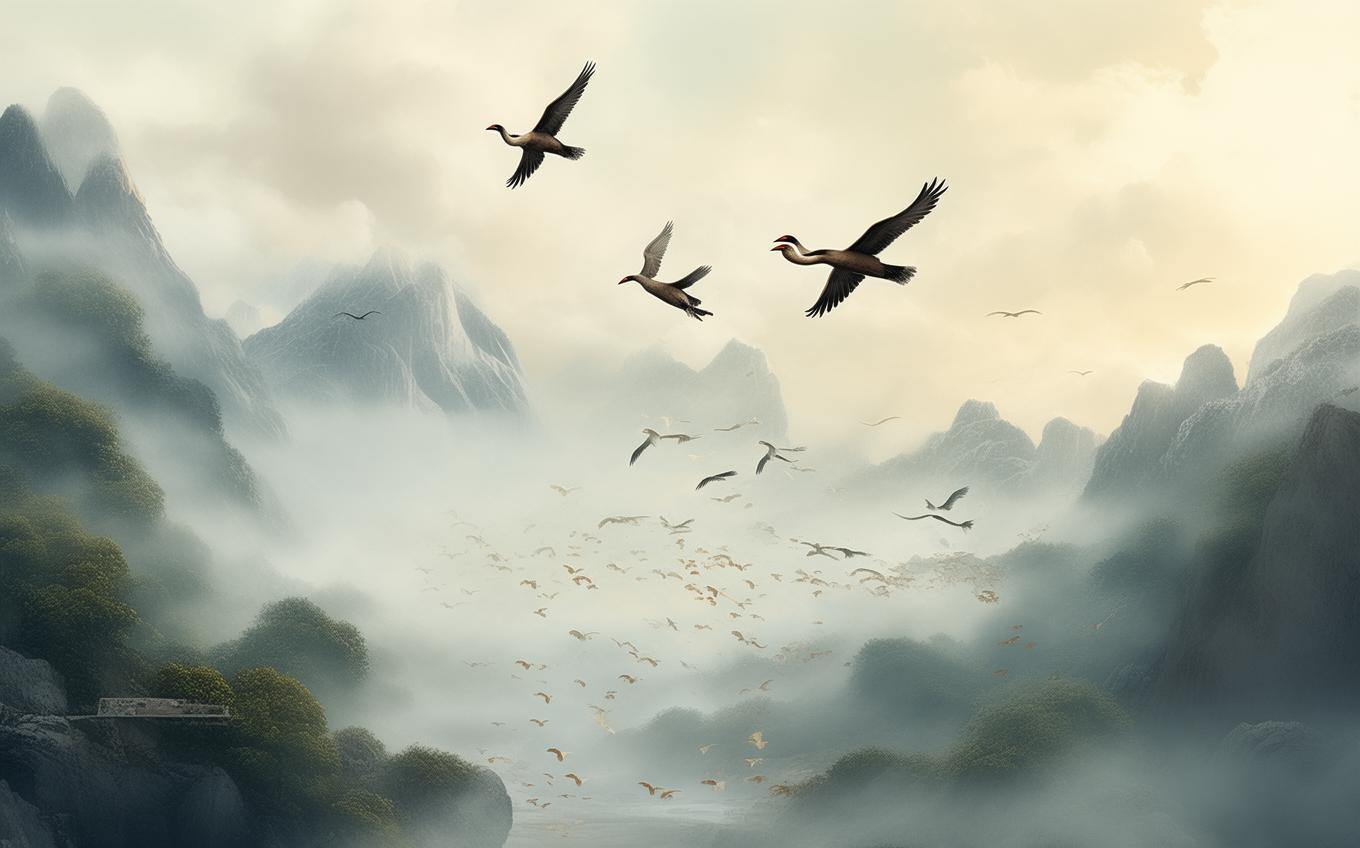
The second line introduces the title theme: 早雁出云鸣 (early wild geese cry out from the clouds). The wild goose (yan) is one of the most potent symbols in classical Chinese verse, often standing for a lonely traveler, a distant message, or the passage of time. By placing the geese emerging from clouds, the poet foregrounds their sudden, almost otherworldly appearance. Their cry pierces the quiet, a sound that instantly evokes the melancholy of departure.
The couplet 隔岸和霜落,迎风带月行 expands the scene. The geese fly across the river, their voices mingling with the frost that descends silently. Frost and goose cry are both harbingers of cold; their fusion creates a synaesthetic effect—cold can be heard, and sound can be felt. In the fourth line, the geese are personified as travelers “facing the wind” and “bearing the moon.” The moon, a common companion of homesickness, becomes a cargo they carry as they press southward, adding a layer of endurance and grace.
The third couplet shifts to a panoramic scale. 度云连海暗 (skimming clouds, they link the darkening sea) shows the geese crossing vast expanses. The verb lian (link) suggests they become a bridge between sky and sea, their flight uniting the elements. Meanwhile, 飘叶共波轻 (drifting leaves share the waves’ lightness) juxtaposes the geese with falling leaves—both carried by the autumn wind, both ephemeral. The leaves riding the ripples mirror the geese skimming the air, reinforcing a sense of harmonious motion in the natural world.
The final couplet 似怯冰弦冷,时翻雾翅萦 introduces a sudden shift from observation to introspection. “Icy zither strings” likely refer to the cold weather itself, imagined as a musical instrument that plays a piercing, shivering tune. The geese seem to flinch at this invisible melody, their response almost human. Their “misty wings” flipping and lingering trace a pattern of hesitation and resilience. The word ying (entwine, linger) suggests their trace remains in the sky long after they have passed, a visual echo of their cry that lingers in the ear.
Themes and Symbolism
Nature as a Mirror of the Human Condition
Though the poem appears purely descriptive, the geese are unmistakably a symbol. In Chinese literature, wild geese are creatures of loyalty (they fly in ordered formations) and homesickness (their seasonal migration parallels human longing for return). Here, they embody the tension between purpose and vulnerability—determined to fly south yet chilled by frost and wind. An emperor writing such a scene might be glimpsing his own subjects’ toils, or even his own loneliness at the apex of power.
Transience and Continuity
Autumn imagery—dew, frost, falling leaves, migrating birds—traditionally points to the fleeting nature of life. Yet Li Shimin balances this with images of enduring motion: the geese “link” the sea, the leaves “share” the waves’ rhythm, and the wings leave a lingering trace. The poem suggests that while individuals pass, the patterns of nature persist, much like the dynasty the poet ruled.
Sound and Silence
The poem is built on a tension between sound (the goose cry, the imagined zither strings) and silence (the quiet descent of frost, the hush of mist). This interplay mirrors the classical Chinese aesthetic of yijing (artistic conception), where meaning arises in the space between what is said and what is left unsaid.
Cultural Context
The title prefix 赋得 tells us this was a “set-theme” poem, a common practice during the Tang at imperial banquets, examinations, and literary gatherings. Poets would demonstrate their craft by elaborating on a predetermined phrase, often drawn from an earlier poetic line or natural phenomenon. Such compositions prized technical skill, balance, and the ability to infuse a prescribed topic with personal feeling. That an emperor engaged in this practice reveals the Tang court’s fusion of statecraft and literary culture.
Li Shimin’s choice of the early goose theme also carries political subtlety. The goose in flight was a symbol of official messengers and far-reaching imperial communication. By focusing on the geese’s arduous journey, the emperor might be acknowledging the challenges of governance over a vast terrain—a silent tribute to the officials who, like the birds, braved distances to fulfill their duties. Moreover, the poem’s serene, impersonal tone reflects the Confucian ideal of a ruler who observes the natural order with detachment and wisdom, allowing the patterns of tiān (heaven) to guide human affairs.
Conclusion
“赋得早雁出云鸣” is a gem of Tang court poetry, combining delicate natural imagery with the poised voice of an emperor-poet. Li Shimin transforms a set theme into a meditation on movement, cold, and resilience, inviting readers to hear the cry of wild geese across centuries. For the modern audience, the poem offers a window into a world where even a ruler found time to gaze at migrating birds and inscribe their flight in measured, musical verse. It reminds us that poetry, at its core, is an act of attention—the same attention that, for a brief moment, brings the early geese back out of the clouds, crying, still flying, still free.
Comments (0)
No comments yet. Be the first to comment!