Introduction
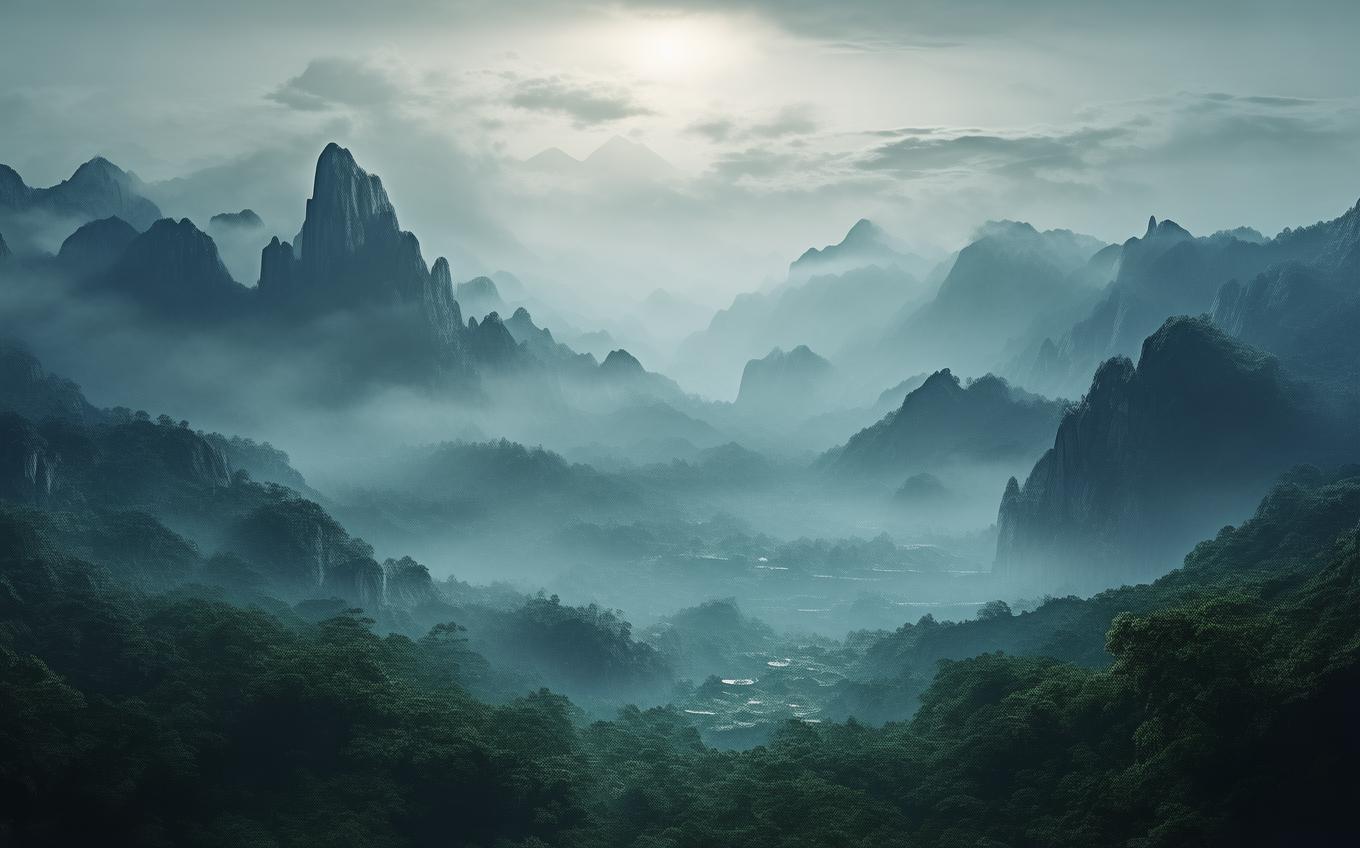
Composed by Emperor Taizong of the Tang dynasty (Li Shimin, 598–649), “辽东山夜临秋” (Liáodōng Shān Yè Lín Qiū — “Approaching Autumn at Night in the Hills of Liaodong”) is a deceptively quiet landscape poem written far from the imperial palace. The poem emerged during his military campaigns against the Goguryeo kingdom in the 640s CE, when the emperor personally led troops into the frontier region of Liaodong. Rather than celebrating martial glory, these four lines capture a solitary moment of natural observation, filled with subtle disquiet. The piece exemplifies the “scene-emotion” (情景) aesthetic central to classical Chinese poetry, where external images become a mirror of the poet’s inner world. For English-speaking readers, it offers a compact yet profound glimpse into how a Tang ruler could set aside his armor, gaze at the hills, and distill a transient autumn night into timeless verse.
The Poem: Full Text and Translation
烟生遥岸隐,
Yān shēng yáo àn yǐn,
Mist rises, the distant shore vanishes;
月落半崖阴。
Yuè luò bàn yá yīn,
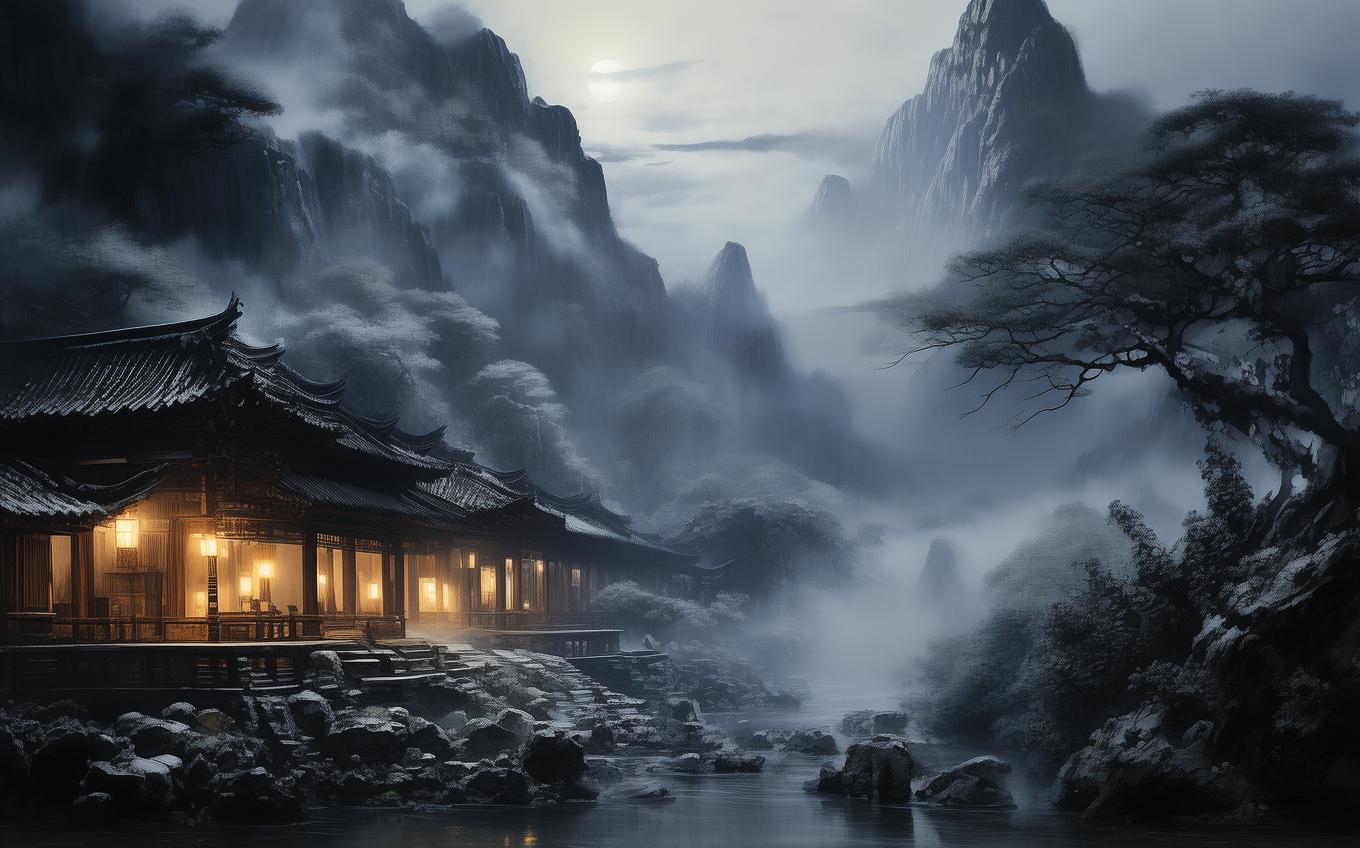
The moon descends, half the cliff lies in shadow;
连山惊鸟乱,
Lián shān jīng niǎo luàn,
Through the linked mountains, startled birds scatter;
隔岫断猿吟。
Gé xiù duàn yuán yín,
Beyond the peaks, the cry of gibbons breaks off.
Line-by-Line Analysis
Line 1: 烟生遥岸隐
The poem opens with an image of emergence and disappearance. “烟” (yān) is not thick smoke but the kind of light mist or haze that rises at dusk from rivers and damp earth. The character “生” (shēng — “is born, arises”) gives this mist an almost animate quality, as if the night breathes it into being. “遥岸” (yáo àn) — “distant shore” or “far bank” — suggests the poet is looking out over a body of water, perhaps a river winding through the Liaodong hills. The final word “隐” (yǐn — “hidden, concealed”) completes the movement: the rising haze gradually obscures the opposite shore. There is a softness here, a blurring of boundaries between land and water, reality and dream — a visual prelude to the solitude to come.
Line 2: 月落半崖阴
The moon, traditionally a companion of travelers and lonely hearts, is not ascending but “落” (luò — “falling, setting”). The poet’s gaze shifts upward to a cliff face, where the sinking moonlight divides the rock into light and shadow. “半” (bàn — “half”) is precise: one half of the cliff still catches the pale glow, the other sinks into darkness. The interplay of yin and yang is unmistakable — “阴” (yīn) here denotes not only shadow but also the cool, feminine, receptive principle of the cosmos. A lone observer watching the moon set over a craggy cliff would feel the weight of time slipping away, a quiet melancholy that needs no direct statement.
Lines 3–4: 连山惊鸟乱,隔岫断猿吟
The couplet heightens the sense of disturbance. “连山” (lián shān) — “linked mountains” — emphasizes the vast, undulating terrain. Within this expanse, “惊鸟乱” (jīng niǎo luàn): startled birds fly up in confusion. Something has alarmed them — perhaps a sudden noise, perhaps the poet’s own presence, perhaps nothing more than the deepening chill. The word “乱” (luàn — “chaotic, scattered”) adds a note of disorder to the otherwise still scene.
Then the final line: “隔岫” (gé xiù) — “across the caves/peaks” — introduces distance and separation. “岫” (xiù) can mean a mountain cave or rocky peak, a secluded spot often associated with hermits or wild creatures. From that far-off place, the mournful cry of gibbons (“猿吟” — yuán yín) is heard — but only for a moment. The sound “断” (duàn) — “breaks off, is cut short.” The gibbon’s wail, a classic Chinese poetic symbol of loneliness and longing, does not even complete itself; it fragments and dies into silence. The broken sound leaves the mountain night more empty than before, as if nature itself holds its breath.
Themes and Symbolism
The primary theme is loneliness within a vast natural world. The poet, despite being an emperor with an army at his back, presents himself solely as a perceiving eye, dwarfed by mist, mountains, and the fading moon. The fleeing birds and the interrupted gibbon cry suggest a rupture in the natural order — a subtle mirror of an uneasy heart.
Transience is another key thread. Mist rises and swallows the shore; the moon falls; birds scatter; the gibbon’s voice breaks. Nothing in the poem is stable, complete, or permanent. This mirrors the Buddhist-Taoist sensibility that infuses Tang poetry, where beauty is cherished precisely because it cannot last.
The primary symbols reinforce these themes:
- Mist (烟): obscurity, the blurred boundary between presence and absence.
- Setting moon (月落): the passage of time, the waning of light and life.
- Half-shadowed cliff (半崖阴): duality, the coexistence of clarity and darkness in one’s mind.
- Startled birds (惊鸟): sudden disruption, hidden danger, the fragility of peace.
- Broken gibbon cry (断猿吟): isolation, the failure of communication, the echo of sorrow cut short.
Cultural Context
Emperor Taizong is remembered as one of China’s greatest rulers, a warrior-scholar who consolidated the Tang Empire and ushered in an era of cosmopolitan prosperity. His Liaodong expeditions, while ultimately unsuccessful in conquering Goguryeo, were moments when he personally experienced the harsh frontier. Writing a poem in such circumstances was not unusual; composing verse was a core civilizational skill for Tang elites, a demonstration of self-cultivation and emotional refinement.
The poem belongs to the tradition of “landscape poetry” (山水诗), which reached its golden age in the Tang dynasty. Unlike purely descriptive nature poetry, the landscape poem seeks to fuse the outer world with the poet’s interior state. The choice of autumn — the season of decline, harvest, and preparation for winter — deepens this resonance. In Chinese poetics, autumn carries a heavy weight of nostalgia, reflection, and the bittersweet awareness of mortality.
Furthermore, the gibbon (yuán) had long been established as a voice of untamed wilderness and human longing. Its cry was believed to echo through gorges, stirring travelers’ homesickness. By having the sound “break off,” Li Shimin not only portrays a literal acoustic moment but also taps into that rich literary memory, doubling the sense of severance.
Conclusion
“辽东山夜临秋” is a miniature masterpiece of atmosphere and restraint. In just twenty characters, it transforms a borderland night into a landscape of the soul, where mist, moonlight, birds, and a distant gibbon become the vocabulary for an emperor’s unspoken solitude. There are no declarations of loneliness, no direct confessions — only things perceived, vanishing, and falling silent. For modern readers, the poem reminds us that even the most powerful figures are, in quiet moments, simply human beings watching the world and listening for what might be lost. In an age of constant noise, this ancient verse invites us to pause, gaze at our own “distant shore,” and feel the fragile beauty of a single autumn night on a faraway hill.
Comments (0)
No comments yet. Be the first to comment!