
Introduction
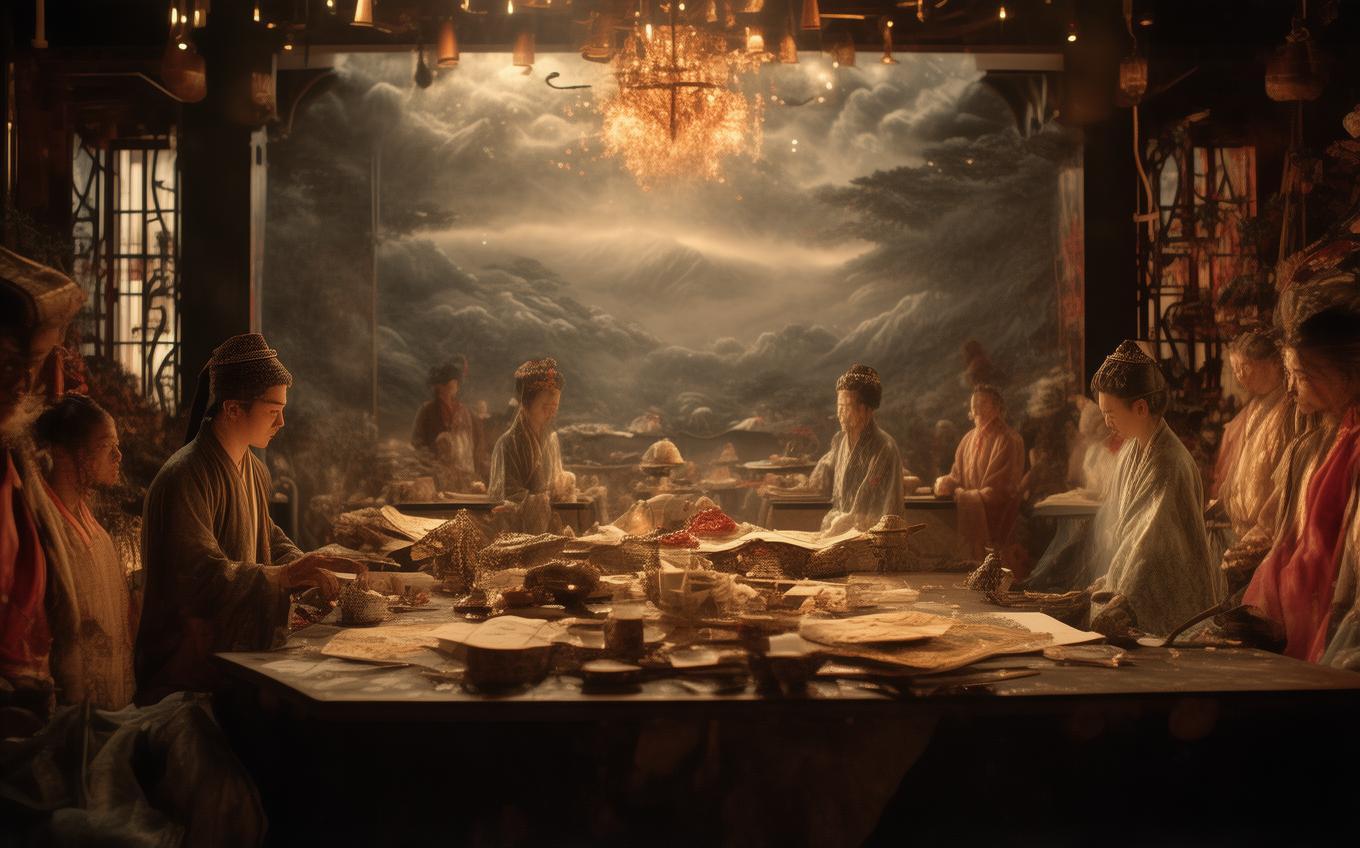
"两仪殿赋柏梁体" (Liangyi Dian Fu Boling Ti, “Composed in the Bo Liang Style at the Hall of Two Principles”) is a striking example of a uniquely Chinese courtly tradition: a chain poem written jointly by the emperor, his consort, princesses, ministers, and even a foreign envoy. Composed in the early eighth century, probably during the Zhou dynasty of Empress Wu Zetian (r. 690–705), the piece was performed in the Liangyi Hall, a grand palace within the Tang imperial city of Chang’an. The Bo Liang style (柏梁体) harks back to a legendary gathering under Emperor Wu of the Han, where each courtier contributed a seven-character line sharing the same rhyme. This Tang revival transforms the old convention into a magnificent display of hierarchy, loyalty, and shared literary pleasure. For English readers, the poem offers a vivid window into the intertwined worlds of politics, poetry, and performance at the height of medieval China.
The Poem: Full Text and Translation
Each line is presented with its speaker, originally identified in the text after a dash. The poem uses a single end‑rhyme “-ang” throughout.
大明御宇临万方 (Li Xian)
Dà míng yù yǔ lín wàn fāng
The great radiance governs the cosmos, overseeing the myriad regions.
顾惭内政翊陶唐 (Empress Wei)
Gù cán nèi zhèng yì Táo Táng
I look upon myself and blush to assist the inner court after the model of Yao.
鸾鸣凤舞向平阳 (Princess Changning)
Luán míng fèng wǔ xiàng Píngyáng
The luan bird sings, the phoenix dances, facing the Pingyang Palace.
秦楼鲁馆沐恩光 (Princess Anle)
Qín lóu Lǔ guǎn mù ēn guāng
The towers of Qin and lodges of Lu are bathed in the light of imperial grace.
无心为子辄求郎 (Princess Taiping)
Wú xīn wèi zǐ zhé qiú láng
Without any selfish heart, a son hence strives to be a worthy gentleman.
雄才七步谢陈王 (Li Chongmao, Prince of Wen)
Xióng cái qī bù xiè Chén wáng
My bold talent, like the seven-step poem, humbly declines before the Prince of Chen.
当熊让辇愧前芳 (Shangguan Wan’er)
Dāng xióng ràng niǎn kuì qián fāng
Facing the bear and yielding the carriage, I feel unworthy of fragrant precedents.
再司铨筦恩可忘 (Cui Shi)
Zài sī quán guǎn ēn kě wàng
Twice I have supervised the selection of officials – can such grace be forgotten?
文江学海思济航 (Zheng Yin)
Wén jiāng xué hǎi sī jì háng
The river of letters, the sea of learning – I ponder how to cross them.
万邦考绩臣所详 (Wu Pingyi)
Wàn bāng kǎo jī chén suǒ xiáng
Assessing the merits of all states – that is what your minister studies in detail.
著作不休出中肠 (Yan Chaoyin)
Zhù zuò bù xiū chū zhōng cháng
Composing without cease, my writings pour straight from my heart.
权豪屏迹肃严霜 (Dou Congyi)
Quán háo bǐng jī sù yán shuāng
The powerful and arrogant retreat from sight, awed by the harsh frost.
铸鼎开岳造明堂 (Zong Jinqing)
Zhù dǐng kāi yuè zào míng táng
Casting the tripods, opening the sacred peaks, building the Bright Hall.
玉醴由来献寿觞 (Ming Xilie, Tibetan envoy)
Yù lǐ yóu lái xiàn shòu shāng
Since ancient times, jade‑sweet wine has been offered in the goblet of longevity.
Line-by-Line Analysis
The opening line, spoken by Li Xian – the future Emperor Zhongzong who would later be restored to the throne – announces the cosmic rule of the dynasty. “大明” (great brightness) evokes the sun, a traditional symbol of imperial authority, and the phrase “临万方” (overseeing all regions) asserts a universal mandate. This establishes the poem’s central conceit: the empire is a harmonious, illuminated realm.
The Empress’s line deftly combines humility with aspiration. She “blushes” (惭) at her own governance, promising to emulate the sage‑king Yao (陶唐), the archetype of virtuous rule. In a single breath she acknowledges her subordinate role while attaching herself to the loftiest Confucian ideal.
The two princesses speak next, their lines saturated with fairy‑tale imagery. Princess Changning uses the luan (a mythical bird) and the phoenix – both auspicious omens – and locates the scene at the Pingyang Palace, the residence of an ancient Han princess famous for her talent. Princess Anle’s “towers of Qin” and “lodges of Lu” allude to the legendary lodgings of the Duke of Zhou and the Qin dynasty’s cultural splendor, now bathed in the emperor’s grace. These lines reveal how imperial women performed their learning and refinement, all the while reinforcing their status as recipients of dynastic blessing.
Princess Taiping, a powerful figure who controlled her own army, strikes a more personal note: she insists she has no selfish ambition, but only wishes her sons to become noble men – a diplomatic self‑effacement. The young Prince of Wen then alludes to the story of Cao Zhi, the “Prince of Chen,” who in the third century composed a poem in seven paces to save his life. By graciously “declining” comparison, the prince performs both literary skill and courtly tact.
Shangguan Wan’er, the legendary female official and poet, invokes two ancient paragons of female virtue: the consort who shielded an emperor from a bear and the one who refused to ride in the royal carriage so as not to overstep propriety. Her line is a masterclass in ritual modesty: she claims she cannot live up to these “fragrant precedents,” but the very reference demonstrates her erudition and moral standing.
The minister Cui Shi recalls his repeated service in selecting officials – the heart of Tang bureaucracy – and asks rhetorically if such imperial grace can be forgotten. Zheng Yin pictures literature and learning as a vast ocean to be navigated, a humble admission of intellectual quest. Wu Pingyi, head of the examination system, offers his expertise in “assessing the merits of all states,” a line that both flatters the court’s meritocratic ideal and stakes his own claim to indispensable service. Yan Chaoyin portrays his ceaseless writing as a visceral, heartfelt outpouring, while Dou Congyi boasts that the mere “harsh frost” of authority has made the powerful hide – a chilling metaphor for the reach of law. Zong Jinqing’s line celebrates the grandest ritual acts: casting bronze tripods (symbols of legitimacy), opening sacred mountains, and constructing the Bright Hall where heaven is worshipped, all timeless tokens of a sage ruler.
The final line, spoken by the Tibetan ambassador Ming Xilie, gracefully closes the circle. The “jade‑sweet wine of longevity” is an ancient offering; here it becomes a tribute from the farthest reaches, affirming the empire’s magnetic centrality.
Themes and Symbolism
The dominant theme is sacralized sovereignty. Light – “大明” (great radiance), “恩光” (grace’s light) – pervades the poem, picturing the ruler as a sun whose virtue illuminates even the distant lands. Every speaker, whether royalty or foreign envoy, exists in a graded orbit around that central star.
Linked to this is the performance of Confucian hierarchy. The poem is not merely a collection of individual voices; it is a dynamic social diagram. The order of speakers – heir apparent, empress, princesses, female official, ministers, foreign tributary – mirrors the precise ranking of the Tang court. Each line, while ostensibly a creative effort, reinforces the speaker’s assigned place and loyalty.
A second theme is the civilizing power of culture. Allusions flow from legendary sage‑kings (Yao, the Duke of Zhou) to literary prodigies (Cao Zhi) to ritual artifacts (tripods, Bright Hall). This dense web of references asserts that the present dynasty
Comments (0)
No comments yet. Be the first to comment!