Introduction
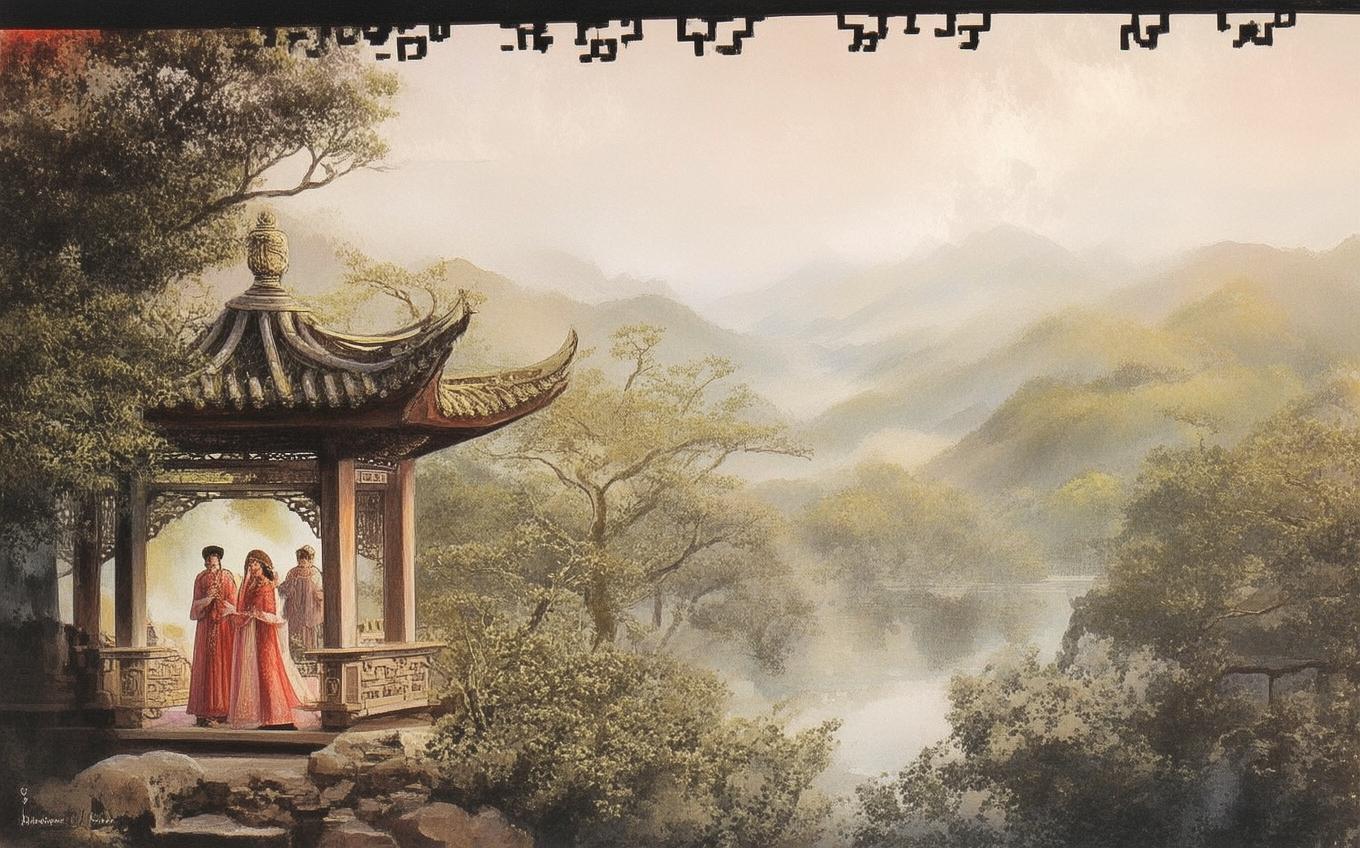
In the resplendent court of Tang China, few occasions could match the splendor of an imperial double ceremony: the Crown Prince taking a consort and the Princess Taiping being married off on the same day. The poem Tàizǐ nà fēi Tàipíng gōngzhǔ chūjiàng (“The Crown Prince Takes a Consort and Princess Taiping is Given in Marriage”) was composed by none other than Emperor Gaozong (Li Zhi) himself to commemorate this magnificent event. Written in the seventh century, this short regulated verse (律诗) captures the solemnity, auspiciousness, and sheer pageantry of a dynastic celebration. Unlike the melancholic introspection often found in Chinese poetry, this piece is a bright, ceremonial tableau—a glittering snapshot of the Tang empire at its height, when poetry was the language of statecraft and the emperor a poet among poets.
The Poem: Full Text and Translation
龙楼光曙景
Lóng lóu guāng shǔ jǐng
The Dragon Tower gleams in the dawn landscape,鲁馆启朝扉
Lǔ guǎn qǐ cháo fēi
The Lu Residence opens its morning gates.艳日浓妆影
Yàn rì nóng zhuāng yǐng
The brilliant sun casts shadows of elaborate adornment,低星降婺辉
Dī xīng jiàng wù huī
The low stars descend with the Woman Constellation’s radiance.玉庭浮瑞色
Yù tíng fú ruì sè
The jade courtyard floats with auspicious colors,银榜藻祥徽
Yín bǎng zǎo xiáng huī
The silver plaques are embellished with propitious emblems.云转花萦盖
Yún zhuǎn huā yíng gài
Clouds swirl and flowers twine around the canopy,霞飘叶缀旂
Xiá piāo yè zhuì qí
Rosy mist drifts, leaves bedeck the banners.
Line-by-Line Analysis
The opening couplet sets the scene with architectural majesty and ritual timing. “Dragon Tower” (龙楼) is a synecdoche for the crown prince’s palace—the dragon being the imperial emblem of the heir apparent. The dawn light that “gleams” on it signals a new beginning, a propitious moment chosen by court astrologers. The second line refers to the “Lu Residence” (鲁馆), an allusion to the Zuo Tradition (左传), where a princess of the state of Lu had her own dwelling prepared by her husband’s state as a mark of honor. By invoking this ancient model, the poem elevates Princess Taiping’s marital home to a classic ideal, while “morning gates” opening implies the commencement of the wedding rites.
The second couplet merges celestial imagery with human beauty. The “brilliant sun” casting shadows of “elaborate adornment” paints a picture of richly dressed brides and court ladies whose makeup and jewels catch the morning light. More than a mere description of luxury, the sun symbolizes the emperor’s benevolent radiance shining upon the union. The “low stars” and the “Woman Constellation” (婺, Wù) bring astrological resonance. The Woman Constellation was associated with the female principle and, by extension, with empresses and princesses. The line suggests that even the heavens are participating: stars sink low to lend their brilliance, as if the very cosmos blesses Princess Taiping’s descent (出降) into marriage. The double union—son taking a consort, daughter leaving the palace—is thus mirrored by the intimate collaboration of sun and stars.
The third couplet moves from the celestial to the terrestrial ceremonial space. The “jade courtyard” (玉庭) evokes the lustrous stone that adorned imperial pavilions, while “floating with auspicious colors” implies that the balustrades and walkways are draped in silks of red and gold, the visible quality of good fortune (瑞, ruì). The “silver plaques” (银榜) were inscribed panels hung upon palace gates and halls bearing felicitous phrases and symbolic animals. To “embellish with propitious emblems” (藻祥徽) means they are carved or painted with dragons, phoenixes, and the character for double happiness (囍). Everything material has been transformed into a canvas of blessing.
The closing couplet introduces a dynamic, almost processional movement. Clouds that “swirl” and mist that “drifts” suggest the slow, majestic pace of the wedding procession, while “flowers entwine the canopy” and “leaves bedeck the banners” are both literal decorations and nature’s own tribute. In Chinese lore, auspicious clouds and sweet dew appear when the ruler’s virtue aligns with Heaven’s will. Here, nature does not merely witness but actively adorns the imperial cavalcade, completing the picture of a universe in harmony.
Themes and Symbolism
The poem’s overarching theme is cosmic and dynastic harmony. Every image—dawn, stars, sun, flowers—is coordinated to reflect the perfect timing and moral rightness of the double wedding. The union of the crown prince and the princess’s departure are not private family affairs but grand acts of state that renew the bond between the ruling house, the tianxia (天下, “all under Heaven”), and the celestial order.
Auspiciousness (祥瑞) is the beating heart of the poem. The poet does not merely describe what he sees; he translates every object into a portent of good fortune. The jade courtyard, silver plaques, and fluttering banners are material manifestations of the dynasty’s virtue. In Tang court culture, recognizing and recording auspicious signs was a political act that legitimated the emperor’s mandate. This poem, therefore, was not merely a personal expression but a performative declaration that Heaven smiled upon the Li family’s rule.
The polarity of yin and yang underlies the structural balance. The Crown Prince (yang, active, ascending dragon) receives a consort (yin), while Princess Taiping (yin, descending star) moves outward to marry. The sun and the stars, the dragon tower and the Lu residence, the canopy and the banners all form complementary pairs, recreating the harmonious marriage of cosmic forces.
Cultural Context
The Tang Dynasty (618–907) represents a golden age of Chinese poetry, but also of imperial ritual. Weddings within the imperial clan were meticulously choreographed affairs governed by the Kaiyuan Rites (开元礼), themselves rooted in ancient Confucian classics. The title itself uses the term “出降” (chūjiàng, literally “descend out”), the proper word for an imperial princess marrying a man of lower rank—since by protocol, even a princess would “descend” in status to her husband’s family. Meanwhile, the crown prince “纳妃” (nà fēi, “takes a consort”), reflecting his higher station. Such precise terminology signals that the poem is a formal state document in verse.
The simultaneous marriage of a son and daughter of the emperor was a rare event, and this particular occasion brought together the most powerful figures of the early Tang: Emperor Gaozong, his wife Empress Wu (later Wu Zetian, who may have had a hand in political matchmaking), the heir Li Hong, and the beloved Princess Taiping. The poem thus marks a moment of surface serenity in a court that would soon be wracked by power struggles. Reading it today, we glimpse the ideal that the dynasty projected onto itself—a universe of perfectly ordered relationships, bright with the promise of continuity.
Conclusion
太子纳妃太平公主出降 is not a poem of personal emotion but a jewel of occasional verse—a verbal equivalent of the gold-threaded silks and twinkling lanterns that adorned the Tang palace on that day. Its beauty lies in its seamless blending of nature, astrology, architecture, and ritual into a single shimmering image of dynastic bliss. For English-speaking readers, it opens a window onto a world where poetry was both art and ideology, where an emperor could capture in eight lines the cosmic justification of his rule. Even after thirteen centuries, the poem’s luminous courtly elegance endures, reminding us that sometimes the highest poetry is also the most public—a gift given by a father who was also a Son of Heaven.
Comments (0)
No comments yet. Be the first to comment!